
Solar manufacturing is booming. Advocates say it could go bust without incentives
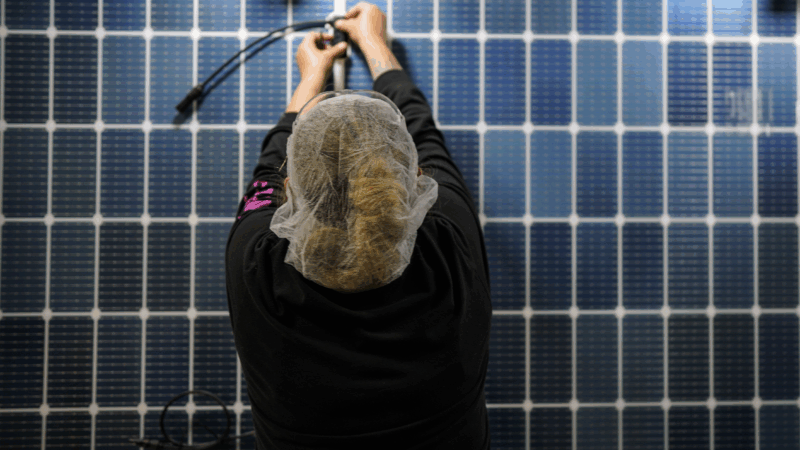
A couple of years ago, Mick McDaniel started a company in Indianapolis to make solar panels in the United States. Then-President Joe Biden had just signed the Inflation Reduction Act, a law packed with tax incentives for clean energy. America’s solar market was about to take off.
Since then, tens of billions of dollars have poured into solar factories that are operating or under development, according to the Solar Energy Industries Association, or SEIA, which advocates on behalf of the field. Once those factories are all finished, the facilities could create close to 60,000 manufacturing jobs, the trade group has said.
But those investments are now at risk.
Congressional Republicans are on the verge of rolling back clean-energy tax credits as part of a huge tax-and-spending bill that’s a cornerstone of President Trump’s second-term agenda. On the chopping block are incentives that encourage solar developers to buy American-made products, like solar panels and components.
Abruptly unwinding the incentives would threaten a decade-long push to onshore solar manufacturing and challenge China’s dominance of the sector, according to industry executives and analysts.
“What I see two years out is low-cost will once again drive demand in this market,” says McDaniel, general manager of Bila Solar. He adds, “That’s going to be a hard road for some of us who have [higher costs] than panels made over in China or Southeast Asia.”

President Trump supported solar manufacturing in his first term
Since 2022, when Biden signed the Inflation Reduction Act into law, companies have invested $9.1 billion in U.S. solar factories that are operating and another $36.7 billion in facilities that are under construction or in development, according to SEIA.
This year, U.S. factories will be able to make enough solar panels to meet most of the country’s demand, the trade group said.
Asked about the potential impacts of ending clean-energy tax credits that help domestic solar factories, a White House spokesperson, Taylor Rogers, said in a statement to NPR that the “radical climate initiatives” of the Biden administration are costing Americans billions of dollars. “Rather than using taxpayer dollars to subsidize uneconomic energy sources to meet vague climate change goals, President Trump is unleashing energy sources that are economical and will drive down bills for everyday families,” Rogers said.
But Trump himself tried to boost U.S. solar manufacturing during his first term. In 2018, Trump approved tariffs on imported solar cells and panels after the U.S. International Trade Commission found that a flood of imports hurt American companies. In a recent post on Truth Social, Trump complained that China dominates renewable energy supply chains.
Renewables are cost competitive with fossil-fueled energy — even without subsidies, according to the financial firm Lazard. But manufacturers and industry analysts say U.S. solar developers still need incentives to use American-made products.
If the tax credits disappear too soon, companies building solar plants will “buy the cheaper foreign panels to get that cost down as much as you possibly can,” says Doug Lewin, an energy consultant in Texas. “And that leaves the American manufacturer of solar modules [and components] just stranded.”
Trump’s 2018 tariffs helped protect domestic manufacturers, says Scott Moskowitz, vice president of market strategy and industry affairs at Qcells, which announced it was building a Georgia solar factory in 2018 shortly after Trump set the import tariffs. However, Moskowitz says the tax incentives passed under the Biden administration were key to creating demand for solar panels and components that are produced in the U.S.
“It’s not a question of whether or not the country is going to install solar if these provisions are removed or phased out too quickly,” Moskowitz says. “It’s just a matter of where [project developers] are going to get the product from.”
The stakes go beyond who supplies America’s solar market. With more time, Moskowitz says U.S. manufacturers could scale up the size of their operations to compete globally.
“You want to set up that counterweight to China,” Lewin says. “You want to be able to tell Pakistan and Latin America and everywhere else, ‘No, you can go through the United States for this vital resource for the 21st century. You don’t have to go to China.'”

Presidents have tried for years to make America a solar manufacturer
Every president since Barack Obama has used tariffs to try to nurture domestic solar manufacturing by raising costs on imported panels and components — first from China and later from Southeast Asia, as well.
However, tariffs on their own weren’t enough to build a manufacturing sector big enough to meet U.S. solar demand. That’s why the incentives in the Inflation Reduction Act were hailed as a breakthrough by advocates of the domestic solar industry.
“We were already seeing an increase in manufacturing before that, but the IRA was like throwing gas on that fire,” says Lewin, the Texas energy consultant.
But just as American manufacturing is taking off, the outlook for the country’s solar market has now been thrown into doubt by Congress.
Legislative text released by the Senate Finance Committee earlier this month calls for phasing out tax credits for solar plants starting next year. Under current law, those credits, which encourage companies to use American-made products, are scheduled to start phasing out in 2032 or when greenhouse gas emissions from the electricity sector are 25% of 2022 levels, whichever comes later.
“I expect to see a couple of painful years in the U.S. solar industry, period,” says Craig Lawrence, a partner at the investment firm Energy Transition Ventures. “But I ultimately think it bounces back.”

Supporters push for slow tax-credit phaseout
The broader impact of rolling back incentives will depend on the details of whatever lawmakers ultimately agree to.
Without tax credits, America would build fewer clean-energy projects and use more natural gas to generate electricity, according to a study this winter commissioned by the Clean Energy Buyers Association, whose members range from Amazon to ExxonMobil to Walmart.
“There will be some companies that go under if they do this. But we will still see solar built. We’ll just see less of it, and it’ll be more expensive,” Lewin says.
Those costs are expected to be passed on to homeowners, renters and businesses through higher electricity bills, according to the Clean Energy Buyers Association’s study.
Limiting renewable energy development also raises concerns about electric reliability, says Heather Reams, president of Citizens for Responsible Energy Solutions, a right-of-center advocacy group.
“You’re looking at the lights going out and the air conditioning going off in the hot summer,” Reams says. “And then not meeting the [electricity] demands of tomorrow, leaving the U.S. behind competitively.”
Industry executives and analysts say clean energy projects are crucial to meet rising power demand from things like data centers and factories, because the plants can be constructed quickly and produce electricity that is relatively cheap.
Reams’ group has called for lawmakers to delay phasing out the tax credits at least until after 2027. “I don’t think anyone’s arguing they need to be here until the end of time,” she says. “But market certainty is something that all business owners understand.”
Manufacturers are already struggling with the looming policy changes.
“If my market is smaller, what kind of decisions do I have to make about investment, hiring and growth on my side to right size my business for that future that will be smaller?” says McDaniel, the Indianapolis solar manufacturer. “We don’t know how much that demand side will get impacted and how much smaller that market will be.”
With Congress under pressure to deliver Trump a tax-and-spending bill by July 4, solar manufacturers and their supporters are running out of time to sway Republican lawmakers.
“They’re getting ready to walk off the field,” Lewin says, “and cede the 21st century to the Chinese.”

Between Megan Moroney and Ella Langley, country women rule the charts
It's a big week for women in country music — and, it turns out, for women whose songs are favored by women in figure skating.

A Jan. 6 rioter pardoned by Trump was sentenced to life in prison for child sex abuse
Since receiving presidential pardons, dozens of former Capitol rioters have gotten into more legal trouble. In Florida, Andrew Paul Johnson was sentenced to life in prison for child sex abuse.
President Trump, Pam Bondi sued over sale of TikTok assets
The case, filed in a federal court in Washington, D.C., accuses the Trump administration of ignoring legislation designed to stop the spread of Chinese propaganda — and instead helping to broker a partial sale to businessmen close to Trump.

A rift between Spain and Trump widens over Spanish opposition to the Iran war
The Spanish government reiterated it would not let U.S. forces use two joint military bases in Spain as the U.S.-Israeli war in Iran escalates, widening a rift with the Trump administration.
Blackpink, modern K-pop’s trailblazing group, tries to find its way home
A new mini-album finds the world's biggest girl group in a tight spot: competing with its own legacy.
If you loved ‘Sinners,’ here’s what to watch next
So you loved best picture nominee Sinners. What should you watch next? We asked our audience to share their recommendations. They suggested Near Dark, The Wailing and other vampire horror films.
