
So um, why do we say ‘um’ so much?
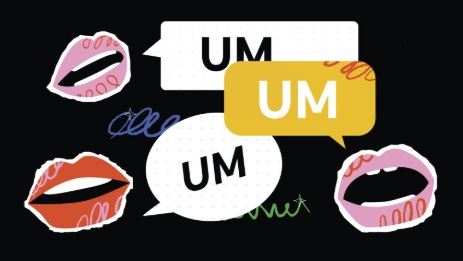
We say and hear it all the time — with friends, at work, while watching the news. And though it may be frowned upon in some contexts, this two-letter, omnipresent filler word is a small but mighty building block of conversation.
So for the latest Word of the Week, let’s, um, have a talk about, um … “um.”
Why do we use it so much?
“Um” has a myriad of utilities.
It fills the space when we’re trying to think of what word or idea to say next, it can soften our tone to make us sound more casual or polite, or it can signal to people that we’re not finished speaking, which is known as “turn holding,” said Jess Zafarris, an etymologist and co-host of the Words Unravelled podcast.
“That buys you time and helps prevent other people from talking over you,” she said.
The shortness of “um” and its employment of the “uh” vowel also make it really easy to say, as our tongues are relaxed, according to Delphine Dahan, who leads a psycholinguistics lab at the University of Pennsylvania.
“Speakers can produce [it] effortlessly on the drop of a hat,” she said.
Because of this, filler words with similar sounds and uses show up across languages and cultures. In France, it’s an “ugh” sound. Brits and Australians say “erm.” Among Spanish speakers, “ehh” is comparable, and in Japan, they may say “ano,” Zafarris said.
“They reflect the neutral noises that we make when speaking in our given dialect,” she said.
Using “um” in person vs. in written text
“Um” typically hasn’t appeared in written contexts because we have time to pause and think about what comes next. According to the Oxford English Dictionary, it appears seven times per 1 million written English words.
But in recent years, young people in particular have begun writing “um” in informal contexts to express humor, confusion or irony or to signal a correction. TikTok captions say things like “um.. is this normal,” “um so this happened and I’m still shaking” and “[because] um what are you doing.”
“It does show up more in social media than in business emails or annual reports or things like that — situations where people are writing as though they were speaking,” said Mignon Fogarty, who has written several books on language under the moniker “Grammar Girl.”
However, our in-person conversations function very differently. It is a joint effort that requires a person to be present in real time. The example Dahan often gives her students is that a handshake is not a handshake until the other person grabs your hand and moves it up and down.
“If I’m the speaker, you ask me a question, and now I answer it,” Dahan said. “I have to give you an answer. I cannot, without violating some unspoken rules, drop the ball on you. So we are doing something together.”
Saying “um” signals to the person that you are still there, still thinking, and it prevents pauses longer than a second, after which a person may question your commitment to the conversation.
“If I don’t give you an account, you don’t know whether I’m still doing my part,” Dahan said.
It’s a social contract that messaging apps have adopted too. The dot-dot-dot bubble that pops up when a person is typing is essentially a virtual “um,” Dahan said.
Where did it come from?
The earliest records of “um” are in plays written by English satirist John Marston as early as 1604, the Oxford English Dictionary says.
“Plays often are the instances you find these, because they are written to reflect everyday speech,” Zafarris said.
But “um” has some older cousins. “Ah” and “ha” were used as filler words in 1400s Middle English. “Hem” (as in “hem” and “haw”) was used in Middle English and early modern English, which spans from the late 1400s to the 1700s. “Ah” and “oh” were used as fillers as well, Zafarris said.
Why is it so, um, controversial?
“Um” can get a lot of hate. In movies and television shows, characters are unlikely to use filler words. People who may generally be considered articulate, such as teachers and politicians, may use them less, which requires practice. There’s a sense that speakers who use “um” frequently are less decisive and clear minded, Zafarris said.
“We have established in corporate culture, and in public speaking and rhetoric, that to make a clear argument or make a clear point you should sound as decisive as possible,” she said. (Industry secret: Many journalists, including myself, edit out filler words from interviews to avoid sentences that sound clunky and to give sources an authoritative voice.)
We also tend not to notice when we use “um” ourselves. Dahan hypothesizes that like many of our other bodily functions, we just stop paying attention to it after a while. But we can be much more aware of other people’s “ums.”
“If you are interacting with someone and you are drawing a judgment of the value of that person, of their professionalism or anything like that, I think you’re more likely to notice,” she said.
If you want to use “um” less, it will take a conscious effort. You can slow down or use less common fillers, like “how can I say that?” or “see what I mean?” Dahan said.
From guns to ballots: FARC’s campaign for votes in Colombia
Ten years after Colombia's peace deal, former FARC commander on the election campaign trail is discovering that winning ballots can be tougher than waging war.

Bill to force formal utility rate hearings for the first time in more than 40 years delayed
Alabama's Public Service Commission hasn't held a formal rate hearing for utilities since 1981. A bill that would force the commission to hold such hearings is under consideration in the state legislature, although the measure was delayed in a House committee this week. We get more details on our weekly legislative update with Todd Stacy, host of Capitol Journal on Alabama Public Television.
A college student’s perspective on using AI in class
Instead of banning AI, why don't schools teach students to use it critically? College freshman Maximilian Milovidov shares what he has learned in an "AI writing" course at Columbia University.
The U.S. unexpectedly loses 92,000 jobs, adding to worries about the economy
The job market showed further signs of weakness last month as employers cut 92,000 jobs. The unemployment rate inched up to 4.4%, from 4.3% in January.

Taking the heat. Sauna’s popular and there may be health benefits too
It's an age old practice that's having a moment right now. But is there anything to the health claims? Scientists say sauna is more than hot air.
Iran retaliates after Israel strikes Beirut and Tehran as war enters Day 7
Iran fired missiles toward Israel Friday, Israeli officials said, after Israel launched fresh strikes on Tehran and hit Beirut's southern suburbs overnight.
