
Senators from both parties grilled RFK Jr. on vaccines and more
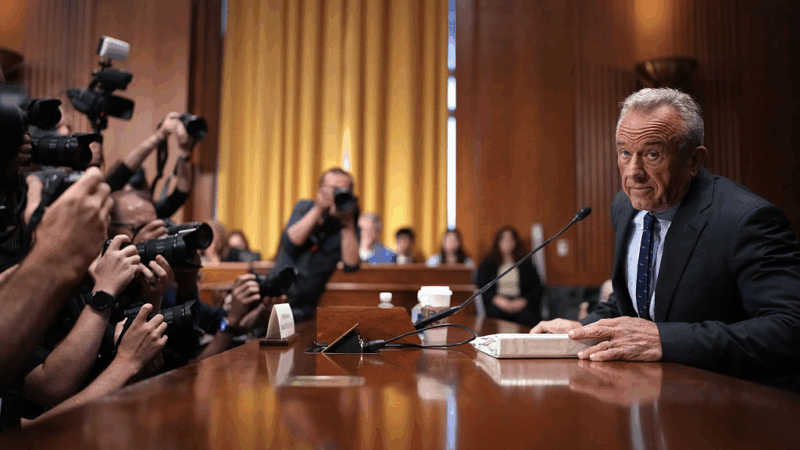
In a contentious Senate hearing marked by raised voices and heated exchanges, Health and Human Services Secretary Robert F. Kennedy Jr. faced calls to resign from Democrats and unexpected criticism from Republicans.
Several Republican senators brought up the legacy of President Donald Trump’s Operation Warp Speed, which sent a safe COVID vaccine to the public in record time, helping save millions of lives. They pushed Kennedy to explain his current approach to the shots and mRNA technology.
Under his leadership, the health agency cancelled hundreds of millions of dollars in research funding on mRNA technology for future vaccines, and the Food and Drug Administration limited access to the COVID shots, saying only people at high risk of complications from COVID or those over 65.
“President Trump deserves a Nobel Prize for Operation Warp Speed,” said Sen. Bill Cassidy, a Louisiana Republican and physician, whose vote was critical in Kennedy’s confirmation. He demanded Kennedy explain his changing stance on COVID vaccines, and said: “effectively, we’re denying people vaccine” — an assertion echoed by many physicians’ groups including the American Association of Pediatrics and the American Medical Association.
Cassidy had exacted assurances from Kennedy during his confirmation process in February that he would not restrict Americans’ access to vaccines, a promise the senator now accuses Kennedy of violating. Kennedy fired the entire 17-member Advisory Panel on Immunization Practices at the Centers for Disease Control and Prevention, replacing them with members Cassidy argued are largely unscientific vaccine skeptics with vested financial interests in suing vaccine makers.
Another Republican physician on the Senate Finance Committee, Dr. John Barrasso of Wyoming, joined Democrats in criticizing Kennedy for undermining vaccines.
“In your confirmation hearings, you promised to uphold the highest standards for vaccines. Since then, I’ve grown deeply concerned,” Barrasso told Kennedy at the hearing. “I’ve been hearing from many of my medical colleagues, and there are real concerns that safe, proven vaccines like measles, like hepatitis B and others, could be in jeopardy and that would put Americans at risk and reverse decades of progress.”
He expressed concern that Kennedy could politicize vaccines further and undermine public health.
CDC leadership change debated
Kennedy hotly defended his decisions and statements on vaccines and on changes at the CDC, arguing the agencies have historically relied on bad data.
“These changes were absolutely necessary adjustments to restore the agency to its role as the world’s gold standard public health agency,” he said. He claimed he had the backing of “scientists and doctors are supporting me all across the country.”
Senators also repeatedly asked Kennedy about his decision to push out newly confirmed CDC chief Susan Monarez. Though she was his own pick to lead the agency, he said Monarez was lying when she claimed she was fired from that job after only a month for insisting on rigorous scientific review.
In response to questions from Sen. Elizabeth Warren, D-Mass., Kennedy said: “I told her she had to resign because I asked her, ‘Are you a trustworthy person?’ And she said, ‘No.'”
Trump administration allies like Republican Ron Johnson of Wisconsin rushed to his defense, calling the senators’ pointed questions “abuse,” and lauding Kennedy for his attempts to overhaul health agencies.
Vaccine access arguments
Kennedy’s seven-and-a-half month tenure as Health Secretary is roiling the fields of science and health. His early sweeping changes included mass layoffs across the federal health and science agencies, from the FDA to the CDC to the National Institutes of Health.
Democratic senators took issue with these and other changes, as they and Kennedy accused each other of lying and manipulating data to serve political ends.
The committee’s ranking Democratic member Sen. Ron Wyden criticized Kennedy’s approach to vaccines: “I think Secretary Kennedy is dead set on making it harder for children to get vaccines and that kids are going to die because of it,” he said.
Sen. Warren challenged Kennedy to “honor your promise that you made when you were looking to get confirmed” not to take away vaccines from people who want them. She said his recent moves to change the classification of the COVID vaccine do just that.
In response, Kennedy said “everybody can get access to them” for free, including those on Medicare and Medicaid, though the many contradictory statements have left many patients, doctors and insurers confused.
Kennedy said it was unclear the COVID vaccine had saved millions of lives — a data point generally accepted by scientists and doctors. But he also seemed to backtrack on assertions that he is “anti-vaccine,” arguing that there remain some unknown risks, even with long-approved vaccines.
“Saying I’m anti-vaccine is like saying I’m anti-medicine,” Kennedy said, arguing he just wants more research to look into possible risks. “It doesn’t mean that I’m, you know, anti-vax. It just means I’m pro-science.”
His argument didn’t appear to sway the Democratic senators in attendance, with several calling for Kennedy to resign throughout the hearing.

US military used laser to take down Border Protection drone, lawmakers say
The U.S. military used a laser to shoot down a Customs and Border Protection drone, members of Congress said Thursday, and the Federal Aviation Administration responded by closing more airspace near El Paso, Texas.

Deadline looms as Anthropic rejects Pentagon demands it remove AI safeguards
The Defense Department has been feuding with Anthropic over military uses of its artificial intelligence tools. At stake are hundreds of millions of dollars in contracts and access to some of the most advanced AI on the planet.

Pakistan’s defense minister says that there is now ‘open war’ with Afghanistan after latest strikes
Pakistan's defense minister said that his country ran out of "patience" and considers that there is now an "open war" with Afghanistan, after both countries launched strikes following an Afghan cross-border attack.

Hillary Clinton calls House Oversight questioning ‘repetitive’ in 6 hour deposition
In more than seven hours behind closed doors, former Secretary of State Hillary Clinton answered questions from the House Oversight Committee as it investigates Jeffrey Epstein.
Chicagoans pay respects to Jesse Jackson as cross-country memorial services begin
Memorial services for the Rev. Jesse Jackson Sr. to honor his long civil rights legacy begin in Chicago. Events will also take place in Washington, D.C., and South Carolina, where he was born and began his activism.

In reversal, Warner Bros. jilts Netflix for Paramount
Warner Bros. says Paramount's sweetened bid to buy the whole company is "superior" to an $83 billion deal it struck with Netflix for just its streaming services, studios, and intellectual property.
