
Senate passes $901 billion defense bill that pushes Hegseth for boat strike video
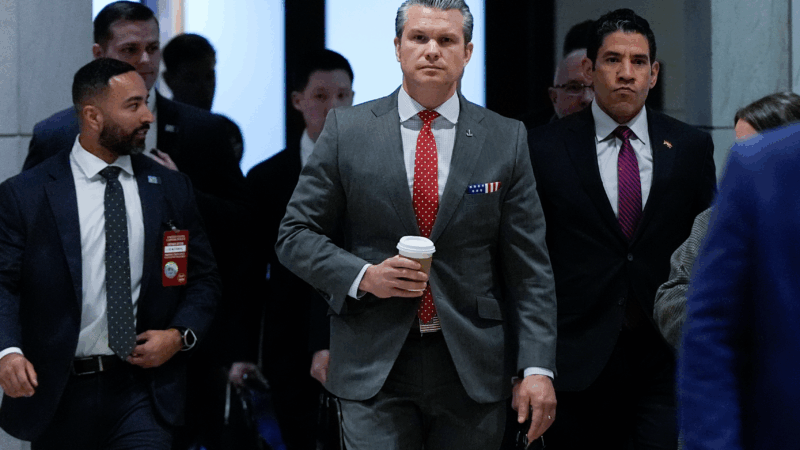
WASHINGTON — The Senate gave final passage to an annual military policy bill Wednesday that will authorize $901 billion in defense programs while pressuring Defense Secretary Pete Hegseth to provide lawmakers with video of strikes on alleged drug boats in international water near Venezuela.
The annual National Defense Authorization Act, which raises troop pay by 3.8%, gained bipartisan backing as it moved through Congress, and the White House has indicated that it is in line with President Trump’s national security priorities. However, the legislation, which ran over 3,000 pages, revealed some points of friction between Congress and the Pentagon as the Trump administration reorients its focus away from security in Europe and towards Central and South America.
The bill pushes back on recent moves by the Pentagon. It demands more information on boat strikes in the Caribbean, requires that the U.S. keep its troop levels in Europe at current levels and sends some military aid to Ukraine.
But overall, the bill represents a compromise between the parties. It implements many of Trump’s executive orders and proposals on eliminating diversity and inclusion efforts in the military and grants emergency military powers at the U.S. border with Mexico. It also enhances congressional oversight of the Department of Defense, repeals several years-old war authorizations and seeks to overhaul how the Pentagon purchases weapons as the U.S. tries to outpace China in developing the next generation of military technology.
“We’re about to pass, and the president will enthusiastically sign, the most sweeping upgrades to DOD’s business practices in 60 years,” said Sen. Roger Wicker, the Republican chair of the Senate Armed Services Committee.
Still, the sprawling bill faced objections from both Democratic and Republican leadership on the Senate Commerce Committee. That’s because the legislation allows military aircraft to obtain a waiver to operate without broadcasting their precise location, as an Army helicopter had done before a midair collision with an airliner in Washington, D.C., in January that killed 67 people.
“The special carve-out was exactly what caused the January 29th crash that claimed 67 lives,” Sen. Ted Cruz, the Republican chair of the Senate Commerce Committee, said at a news conference this week.
Cruz said he was seeking a vote on bipartisan legislation in the next month that would require military aircraft to use a precise location sharing tool and improve coordination between commercial and military aircraft in busy areas.
Boat strike videos
Republicans and Democrats agreed to language in the defense bill that threatens to withhold a quarter of Hegseth’s travel budget until he provides unedited video of the strikes with the House and Senate Committees on Armed Services, as well as the orders authorizing them.
Hegseth was on Capitol Hill Tuesday ahead of the bill’s passage to brief lawmakers on the U.S. military campaign in international water near Venezuela. The briefing elicited contrasting responses from many lawmakers, with Republicans largely backing the campaign and Democrats expressing concern about it and saying they had not received enough information.
The committees are investigating a Sept. 2 strike — the first of the campaign — that killed two people who had survived an initial attack on their boat. The Navy admiral who ordered the “double-tap” strike, Adm. Frank “Mitch” Bradley, also appeared before the committees shortly before the vote Wednesday in a classified briefing that also included video of the strike in question.
Congressional oversight
Lawmakers have been caught by surprise by the Trump administration several times in the last year, including by a move to pause intelligence sharing with Ukraine and a decision to reduce U.S. troop presence in NATO countries in eastern Europe. The defense legislation requires that Congress be kept in the loop on decisions like that going forward, as well as when top military brass are removed.
The Pentagon is also required, under the legislation, to keep at least 76,000 troops and major equipment stationed in Europe unless NATO allies are consulted and there is a determination that such a withdrawal is in U.S. interests. Around 80,000 to 100,000 U.S. troops are usually present on European soil. A similar requirement also keeps the number of U.S. troops stationed in South Korea at 28,500.
Lawmakers are also pushing back on some Pentagon decisions by authorizing $400 million for each of the next two years to manufacture weapons to be sent to Ukraine.
Cuts to diversity and climate initiatives
Trump and Hegseth have made it a priority to purge the military of material and programs that address diversity, anti-racism or gender issues, and the defense bill would codify many of those changes. It will repeal diversity, equity and inclusion offices and trainings, including the position of chief diversity officer. Those cuts would save the Pentagon about $40 million, according to the Republican-controlled House Armed Services Committee.
The U.S. military has long found that climate change is a threat to how it provides national security because weather-related disasters can destroy military bases and equipment. But the bill makes $1.6 billion in cuts by eliminating climate-change related programs at the Pentagon.
Repeal of war authorizations and Syria sanctions
Congress is writing a closing chapter to the war in Iraq by repealing the authorization for the 2003 invasion. Now that Iraq is a strategic partner of the U.S., lawmakers in support of the provision say the repeal is crucial to prevent future abuses. The bill also repeals the 1991 authorization that sanctioned the U.S.-led Gulf War.
The rare, bipartisan moves to repeal the legal justifications for the conflicts signaled a potential appetite among lawmakers to reclaim some of Congress’s war powers.
Congress will also permanently lift U.S. sanctions on Syria as part of the legislation, following up on the Trump administration’s decision to temporarily lift many penalties. The nation is rebuilding after its former leader Bashar Assad was deposed, and supporters of the new government say that permanently lifting the sanctions will spur the country’s economic reconstruction and encourage the establishment of democracy.

Pentagon shifts toward maintaining ties to Scouting
Months after NPR reported on the Pentagon's efforts to sever ties with Scouting America, efforts to maintain the partnership have new momentum
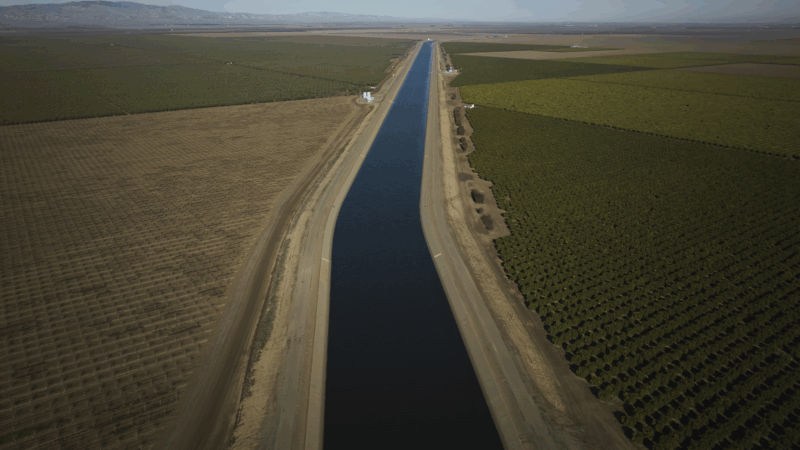
Why farmers in California are backing a giant solar farm
Many farmers have had to fallow land as a state law comes into effect limiting their access to water. There's now a push to develop some of that land… into solar farms.

Every business wants your review. What’s with the feedback frenzy?
Customers want to read reviews and businesses need reviews to attract customers. But the constant demand for reviews could be creating a feedback backlash, experts say.
Civil rights leaders say the racial progress Jesse Jackson fought for is under threat
Activists say racial progress won by the Rev. Jesse Jackson is under threat, as a new generation of leaders works to preserve hard-fought civil rights gains.
‘Get back to integrity’: Oklahoma’s Kevin Stitt on Republicans after Trump
NPR's Steve Inskeep asks Oklahoma Gov. Kevin Stitt about his spat with President Trump, immigration and the future of the Republican Party.

Tariffs cost American shoppers. They’re unlikely to get that money back
After the Supreme Court declared the emergency tariffs illegal, the refund process will be messy and will go to businesses first.
