
Scientists learn more about how human embryos implant using artificial wombs
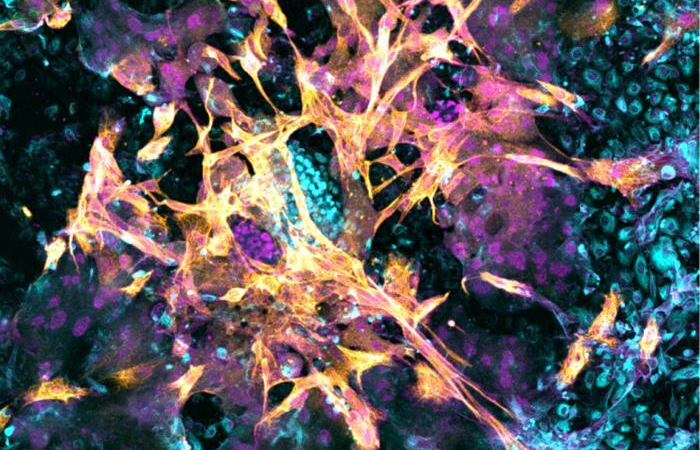
Scientists have gotten an unprecedented look at how the human embryo implants in a uterus. They did this by creating very primitive, womb-like environments in the lab.
The goal is to help people have healthy babies by finding new clues to the causes of miscarriages and infertility. But the research raises tough ethical concerns. It was published Tuesday in three papers in the journals Cell and Cell Stem Cell.
“This is really important work that’s moving embryo research forward – an important advance in the search for scientific answers for what makes a pregnancy healthy,” says Insoo Hyun, a bioethicist at The Hastings Center, a bioethics think tank, who was not involved in the research. “However, it also presents a technology that could be used for other purposes that are concerning.”
That includes the possibility of some day using this kind of technology to enable embryos to develop much further – perhaps even completely – in the lab. This process, called ectogenesis, has the potential to make a natural human womb unnecessary.
“That is very troubling,” says Ana Iltis, a bioethicist at Wake Forest University.
But the scientists working on this research argue that possibility remains theoretical, and the work could yield important clues to early human development.
“This is very exciting,” says Jun Wu, a molecular biologist at the University of Texas Southwestern Medical Center involved in the research.
One of the most important moments in a human embryo’s journey to becoming a baby is when the microscopic ball of cells burrows into the womb. But that pivotal step of embryonic implantation has long been mysterious because it unfolds hidden inside the body.
“Human implantation is essentially a black box — a mystery,” Wu says. “Implantation happens very early on during pregnancy. Essentially we don’t know when, we don’t know where. It’s happening in a womb we cannot have access to.”
Insights into the causes of miscarriage
In the new research, Wu and colleagues in China obtained cells and tissue collected from the lining of wombs during routine medical procedures and figured out how to recreate a key part of the lining of the womb inside tiny plastic devices in their labs.
“You can call it: A womb on a chip,” Wu says.
The scientists then placed human embryos donated for research after infertility treatments, as well as primitive embryo-like entities created from stem cells — called embryoids — inside their tiny wombs on chips and peered through a microscope to watch what happened next.
“For the first time, we observed the entire sequence of human implantation,” Wu says. “We are very excited about this.”
The researchers have already used their wombs on chips to discover clues about how embryos and wombs interact, which can “help us understand the implantation process at the molecular level,” Wu says.
The researchers also compared artificial wombs using cells from healthy wombs with artificial wombs using cells from wombs of women who had miscarriages.
“We observed implantation failure right in front of our eyes, which is very surprising and also exciting,” Wu says.
Wu’s team even screened more than 1,100 drugs to see if any might prevent miscarriages, and identified some that look promising.
A separate team in the U.K. did similar research in their lab in Cambridge.
“We’ve been able to observe some really fantastic aspects of human embryo development, many of which have never been seen before,” says Peter Rugg-Gunn, a developmental biologist at the Babraham Institute. “To be able to see these events for the first time, it was fantastic.”
Other scientists hailed the research.
“It’s very exciting,” says Robin Lovell-Badge, a developmental biologist at the Francis Crick Institute in London who was not involved in the research. “I think they will allow more information to be developed about this absolutely critical stage of human development which has to date been otherwise pretty much impossible to study.”
An ethical slippery slope?
Among the difficult ethical issues raised by the research are questions about destroying human embryos for research.
“For those of us who believe that humans are humans and deserving of ethical respect, whether embryonic, adolescent, or elderly, these experiments are unethical,” says Dr. Daniel Sulmasy, a Georgetown University bioethicist.
The experiments also raise questions about using these devices to study human embryos past 14 days of development, which is considered off limits in many places. (The researchers did not use their devices to try that.)
There are also concerns about implanting even primitive embryo models created from stem cells into anything that resembles a human womb.
“Some might be concerned with how far this might go,” says Hyun, the Hastings Center bioethicist. “It is a little bit on a slippery slope scientifically.”
Indeed some bioethicists are very concerned about how far this may go.
“It’s research that could facilitate future attempts to support not only research on early embryos but on growing embryos for significant periods of time in labs, perhaps eventually to the point of fetuses,” says Iltis, the Wake Forest University bioethicist.
If that ever became possible, it raises the prospect of producing human fetuses for “spare parts,” Iltis says. “They could be grown to be sources of organs and tissues for transplantation. That is very troubling.”
The researchers doing the work say their research is nowhere near that, and they have no intention to pursue it.
“Development entirely outside the uterus is a science fiction,” Wu says. “I don’t think we’re anywhere close to that.”
But Iltis argues other scientists are already testing much larger artificial wombs to save very premature babies. So what sounds like science fiction today, could become a reality much sooner than many people think.
“We have this long history of saying, ‘Don’t worry. The science isn’t there. That’s not the goal. That’s not what we’re trying to do.’ And then being presented with a breakthrough that signals that the train has left the station.”
“I don’t think it’s far-fetched to think that eventually it might be possible to create lab-generated tissues and organs through something like this technology.”

Bill making the Public Service Commission an appointed board is dead for the session
Usually when discussing legislative action, the focus is on what's moving forward. But plenty of bills in a legislature stall or even die. Leaders in the Alabama legislature say a bill involving the Public Service Commission is dead for the session. We get details on that from Todd Stacy, host of Capitol Journal on Alabama Public Television.

Baz Luhrmann will make you fall in love with Elvis Presley
The new movie is made up of footage originally shot in the early 1970s, which Luhrmann found in storage in a Kansas salt mine.
My doctor keeps focusing on my weight. What other health metrics matter more?
Our Real Talk with a Doc columnist explains how to push back if your doctor's obsessed with weight loss. And what other health metrics matter more instead.
Forget the State of the Union. What’s the state of your quiz score?
What's the state of your union, quiz-wise? Find out!

A team of midlife cheerleaders in Ukraine refuses to let war defeat them
Ukrainian women in their 50s and 60s say they've embraced cheerleading as a way to cope with the extreme stress and anxiety of four years of Russia's full-scale invasion.

SNL mocked her as a ‘scary mom.’ In the Senate, Katie Britt is an emerging dealmaker
Sen. Katie Britt, Republican of Alabama, is a budding bipartisan dealmaker. Her latest assignment: helping negotiate changes to immigration enforcement tactics.
