
Port Sudan was a safe haven in Sudan’s civil war. Now it’s being attacked
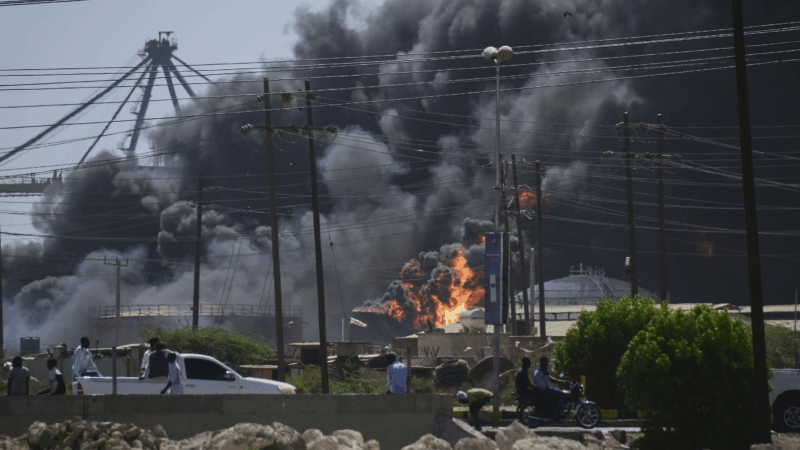
Sudan’s temporary capital city, Port Sudan, previously a safe haven during the country’s two-year civil war, has come under attack for the first time by a series of drone strikes for consecutive days.
The strikes, launched by the paramilitary Rapid Support Forces for the third day, attacked a terminal at the city’s airport overnight on Tuesday. All flights have been grounded, local officials told NPR.
The popular Marina Hotel, opposite the newly built presidential palace, and the city went without power, eyewitnesses said. Possibly casualty numbers were not immediately clear.
The strikes on Tuesday followed attacks on a military warehouse near the airport, civilian infrastructure and an oil depot on the southern outskirts of the city on Sunday and Monday, which sent vast plumes gushing into the sky.
Lt. Gen. Mahjoub Bishara, the army’s Red Sea commander, said that 11 “suicide drones” targeted the Osman Digna air base and other facilities near Port Sudan International Airport on Sunday.
The war in Sudan has killed as many as 150,000 people, according to some estimates, and has led to the world’s largest humanitarian crisis and worst famine in decades, according to the United Nations. More than 15 million people have been displaced, one of every three of the country’s prewar population.
The drone strikes are the first on the de-facto capital, along the Red Sea where the military-led transitional government is based. According to the U.N., about a quarter of a million refugees have fled to the state where Port Sudan resides since the civil war erupted in April 2023.
A haven caught in the war
The city became the temporary capital after the paramilitary RSF took over Khartoum in the early months of the war. In March, after intense fighting, the army recaptured it for the first time.
A sleepy port city before the war, Port Sudan became one of the few places during the conflict where many have tried to rebuild their lives.
NPR reported from Port Sudan last month when cranes dotted the skyline with new businesses and infrastructure being built across the city. Government ministries, diplomatic missions and nongovernmental organizations have been based there, moving from the capital Khartoum that the war has left in ruins.
A popular hotel close to the residence of Sudan’s leader, Gen. Abdel-Fattah Burhan, was also attacked, according to local reports. Images posted on Sudanese media showed the main hall covered in debris.
Drone attacks by the RSF have rapidly increased as the paramilitary group has lost ground in the war with the Sudanese Armed Forces (SAF), who have recaptured several cities in central and eastern Sudan over the last year.
A major dam and one of the main power stations, providing electricity to most of northern Sudan has also been repeatedly struck by the RSF. Last month, NPR witnessed engineers rushing to repair the power station in Atbara, a town 300 miles south of Port Sudan that has been a sanctuary for thousands of displaced people. But the power station was struck again a week later as well as a displacement camp where a mother and her four children were killed.
An airport in Kassala, a town in eastern Sudan, near its borders with Ethiopia and Eritrea, was also struck on Saturday.
Background to the war
The more than two-year war between SAF and the RSF, who were once partners, ignited over a dispute from a transition to civilian rule. Both sides led a coup against the civilian-led government in 2023, installed after longtime autocratic President Omar al-Bashir was deposed in 2019 following a revolution. Gen. Burhan, the SAF leader became chairman of the new transitional government and de facto president, while Gen. Mohamed Hamdan Dagalo, the RSF leader known as Hemedti, became vice chair.
The RSF, which evolved from the infamous Janjaweed militia largely responsible for the genocide in Darfur 20 years ago, refused to be integrated into the Sudanese army, the leading partner in the transition. Tensions ignited into full blown war, with both sides blaming the other for igniting.
While both sides have committed abuses, the RSF and allied Arab militias have been accused of committing another genocide in Darfur against African ethnic groups, according to the United States, the U.N. and other groups.
Last month, after a prolonged siege condemned by the U.N., the RSF took over the Zamzam, the largest refugee camp in Sudan, hosting more than 500,000 people and where at least 180,000 refugees were suffering famine. Its fighters then executed several refugees and medical workers at the camp, including 10 staff from the aid group relief international, which ran the only medical facility at the camp. More than 400,000 refugees residing there have since fled, most to the remote town of Tawila in northern Darfur.
The United Arab Emirates’ alleged role
The RSF are widely believed to be heavily armed by the United Arab Emirates, following mounting evidence by human rights groups and news organizations, showing continuous deliveries of suspected weapons to RSF-controlled areas. The UAE strongly denies this.
Several RSF weapons retrieved by the Sudanese Army have been linked to the UAE. In a report published last year by the Yale Humanitarian Research Lab, researchers found Zamzam camp and El Fasher were being shelled by artillery guns identified as a AH4 155 mm Howitzer, produced by a weapons manufacturer in China, the researchers said.
According to U.S. Defense Department records reviewed by the lab, the UAE is the only known country to have purchased this weapon. “This is one of the most major clues to date of potential direct UAE support to the RSF,” said Nathaniel Raymond, executive director of the Yale group.
On Monday, the International Court of Justice rejected an attempt by Sudan to try the UAE for being legally complicit in the genocide in Darfur. The court did not rule on the case, but said that it did not have the jurisdiction.
Sen. Tim Kaine calls on the Senate to vote on the war powers resolution
NPR's Scott Simon talks to Sen. Tim Kaine, D-Va., about the U.S. strikes on Iran.
Political science expert weighs in on Iran’s nuclear program in light of U.S. strikes
NPR's Scott Simon speaks to Ariane Tabatabai, the Public Service Fellow at Lawfare, about U.S. attacks on Iran and how President Trump's calls for regime change might be received there.
Week in Politics: Does Trump have political support for his actions in Iran?
We look at what President Trump's decision to attack Iran means, what kind of support he has in Iran and what this moment means for his administration.
Unlocking the secrets of an ancient plague
The first historically recorded pandemic is believed to have struck the walled city of Jirash, in what is now modern-day Jordan, in the 7th century. A new study reveals details about those who died.
Panic, fury, and some hope, in Iran as U.S. launches strikes
In Tehran, panicked residents rushed home to shelter and terrified children poured out of classrooms as U.S. air strikes hit the capitol.

Parents, are you sure your kid’s car seat is installed right? Here’s how to know
In this visual guide, certified car seat experts walk through common installation mistakes and how to fix them. Learn what a secure car seat base and a tightly fastened tether look like and more.
