
Oil and gas prices are soaring. Some countries are ready with solar panels and EVs
As the U.S.-Israeli war with Iran continues, the Strait of Hormuz remains closed, cutting off a quarter of oil and natural gas supplies from the rest of the world. Qatar has shut down its liquified natural gas or LNG production, with no clear date to restart in sight.
But energy experts say some countries are better positioned to weather this energy crisis than they would have been just a few years ago. That’s because of the rapid growth of renewable energy, battery systems and electric vehicles, says Jan Rosenow, energy and climate professor at Oxford University.
“That’s not a coincidence,” Rosenow says. “It’s a deliberate strategy to move away from [imported oil] and electrify.”
In China, more than half of new car sales are now electric. In Nepal, it’s more than 70%. As oil prices rise, residents with EVs are less vulnerable than if they had to rely on fuel. “It’s an energy security solution and it’s a cost solution,” says Kingsmill Bond, analyst at the energy think tank Ember.
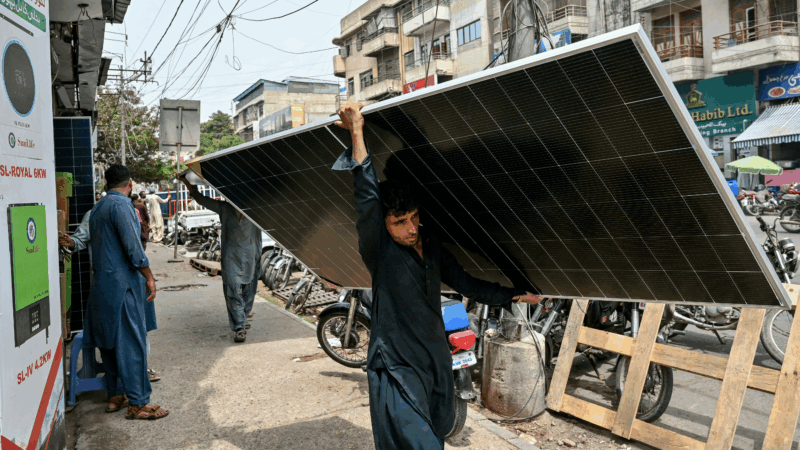
Natural gas and LNG prices are also rising. But countries like Pakistan are more resilient because of the unprecedented growth of solar, says Nabiya Imran, at the Pakistani think tank Renewables First.
“The widespread adoption of solar and batteries kind of serves as a hedge or a protection sort of against these price shocks that the fossil fuel markets are very vulnerable to globally,” she says.
Some countries in Latin America and Africa are still deciding between investing in traditional fossil fuel infrastructure or renewable energy and batteries. The growing energy crisis fueled by the war makes the stakes more clear, Bond says. “ Once you’ve got your solar panel, there’s no cost for the sun,” he says. “But once you’ve got your gas fire power station, you have to pay every day for the gas that you burn in it.”
“With a stroke,” he says, “this war has dramatically increased the power and the influence of those who want to go down the solar route.”

A solar revolution, and more energy security
On many rooftops in Pakistan, solar panels shine atop homes and buildings. In recent years, the country has seen an unprecedented growth of solar as prices for Chinese imports have fallen. Since 2023, Pakistan has imported roughly 41 GW of solar panels from China, according to Ember data. That’s enough to power millions of homes. All other power generation sources combined in Pakistan, including coal, natural gas, and nuclear, were about 46 GW in 2024, according to Ember data.
“Pakistan is the poster-child for the solar revolution,” Bond says. “Pakistan has done the sensible thing for themselves and they’ve imported solar panels and that has enabled them to reduce their gas burn.”
Pakistan still relies on imported fossil fuels, particularly for cars and trucks. That makes the country’s transportation system particularly vulnerable to the current price and supply shocks with the war, Imran says. With oil and diesel prices climbing, the Pakistani government recently closed schools and ordered employees to work from home so people drive less.
Pakistan imports most of its LNG from Qatar. But Pakistan isn’t as exposed to this loss of supply in part because of its new solar and wind capacity, Pakistan’s energy minister told Reuters last week. Last year, Pakistan reduced its LNG imports, in part because of the rapid growth of solar and batteries.
To manage the current loss of LNG supplies, Pakistan is deploying a variety of solutions, including expanding renewable generation, according to energy research firm, Wood MacKenzie.
Because so many Pakistanis now have solar and batteries, Imran says the country’s electricity sector has more of a cushion in this crisis. “Which kind of makes Pakistan’s energy transition story,” she says, “not just a story about climate, but also a story about risk management for energy security.”

Lessons from the Ukraine war
The idea that renewable energy and batteries can provide energy security is not new. After Russia launched its full-scale invasion of Ukraine in 2022, Europe faced a steep drop off in Russian natural gas. At the time, the European Commission framed renewable energy as a way out of natural gas dependency.
Some European countries have taken these energy security lessons to heart. Spain and Portugal have increased their installations of solar, wind, and batteries, and have decreased their natural gas imports.
Other European countries, however, replaced Russian gas imports with LNG imports from the U.S. and Qatar. “And that was a mistake as we are now finding out,” Bond says.
Bond says he’s hopeful that in recent days some European politicians are making a case for investing in more renewable energy as an energy security solution.
“There are very strong arguments which are now being made inside Europe to say, ‘Look, let’s not make the same mistake again,'” Bond says.
Countries choosing renewables
The high prices of fossil fuels following Russia’s full-scale of Ukraine was part of what drove more countries to adopt renewables and batteries in recent years, says Paasha Mahdavi, associate professor of political science at the University of California, Santa Barbara.
“ So many countries have turned to renewables because they are tired and sick of this volatility in pricing, the squeeze they can’t really do anything about,” Mahdavi says.
Oil prices rose to more than $100 a barrel on Sunday. Asian and European natural gas prices have seen double digit percentage increases since the war began. Rosenow sees the potential of a prolonged energy crisis only increasing demand for renewables, batteries and electric vehicles.
Oil and gas prices may be up, Rosenow says, but the sun and wind don’t care what’s happening in the Strait of Hormuz.
Trump threatens NATO allies over Strait of Hormuz help
With the Iran war entering a third week and the price of oil reaching nearly $105 a barrel on Monday, President Trump again urged NATO countries and China to help the U.S. secure the vital Strait of Hormuz.
75 years ago, a viral TV moment ignited America’s obsession with the Mafia
Crooked contracts, bribery, shady characters. In 1951, millions tuned in to watch the Kefauver organized crime hearings, showing the power of television.

Influencers push ‘parasite cleanses’ but doctors say to steer clear
Some people online believe many of us have dangerous parasites in our gut and need to flush them out with herbal supplements. Here's what doctors say about the trend.
As parents clamor for a treatment touted for autism, doctors hesitate to prescribe it
After the leucovorin got public attention as a potential autism treatment, families rushed to get it. Many doctors are torn about prescribing an unproven drug but don't want to lose patients' trust.

Is tech making us too obsessed with our bodies?
All this health tracking might not be actually very...healthy.There's a lot of evidence that health tracking can be good for us. Studies have shown that fitness trackers are effective at increasing physical activity, and can pretty accurately detect issues like arrhythmia. And now they're getting a promotional boost from some very influential people: Secretary of Health and Human Services Robert F. Kennedy Jr., and doctor and wellness influencer Casey Means – President Trump's nominee for surgeon general and founder of Levels Health, a company that analyzes data from continuous glucose monitors. But even as health wearables have benefits – how do they fit into the Make America Healthy Again vision for health? What does all this data really do for us – and who else could access it?Brittany is joined by Adam Clark Estes, senior technology correspondent at Vox, and Lindsay Gellman, a freelance journalist who reports on health and business, to get into it.Want more about modern health? Check out these episodes:Were Americans actually healthier in the past?The difference between losing weight & being "healthy" Exercise is more important than everSupport Public Media. Join NPR Plus.Follow Brittany on Instagram: @bmluseFor handpicked podcast recommendations every week, subscribe to NPR’s Pod Club newsletter at npr.org/podclub.
5th member of Iranian women’s soccer team gives up asylum in Australia
The player's departure shortly before midnight on Sunday leaves two of an initial seven squad members in Australia.
