
No Nobles Day: Britain’s Parliament boots its last hereditary Lords after 700 years
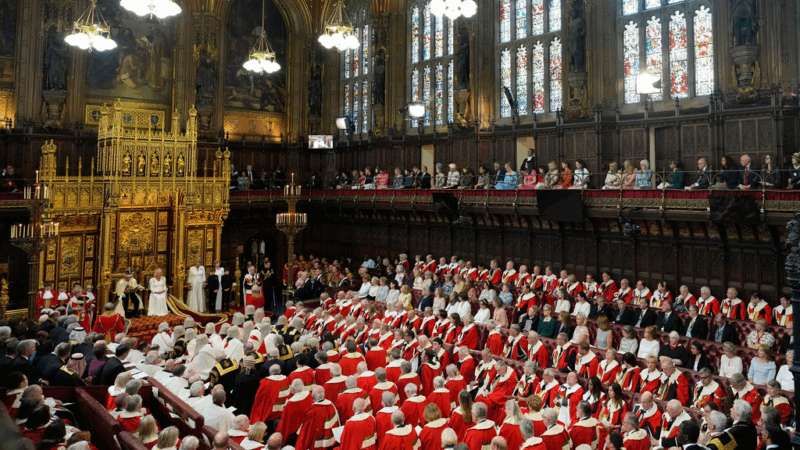
LONDON — Centuries of British political tradition will end within weeks after Parliament voted to remove hereditary aristocrats from the unelected House of Lords.
On Tuesday night members of the upper chamber dropped objections to legislation passed by the House of Commons ousting dozens of dukes, earls and viscounts who inherited seats in Parliament along with their aristocratic titles.
Government minister Nick Thomas-Symonds said the change put an end to “an archaic and undemocratic principle.”
“Our parliament should always be a place where talents are recognized and merit counts,” he said. “It should never be a gallery of old boys’ networks, nor a place where titles, many of which were handed out centuries ago, hold power over the will of the people.”
The House of Lords plays an important role in Britain’s parliamentary democracy, scrutinizing legislation passed by the elected House of Commons. But critics have long argued that it is unwieldy and undemocratic.
The case of Peter Mandelson, who resigned from the Lords in February after revelations about his friendship with the late sex offender Jeffrey Epstein, drew renewed attention to the upper chamber and the problem of lords behaving badly.
The chamber currently has more than 800 members, making it the second-largest legislative chamber in the world after China’s National People’s Congress.
For most of its 700-year history, its membership was composed of noblemen — almost never women — who inherited their seats, alongside a smattering of bishops. In the 1950s, these were joined by “life peers” — retired politicians, civic leaders and other notables appointed by the government, who now make up the vast majority of the chamber. Roughly 1 in 10 members are currently hereditary peers.
In 1999, the Labour government of then-Prime Minister Tony Blair evicted most of the 750 hereditary peers, though 92 were allowed to remain temporarily to avoid an aristocrats’ rebellion.
It was another 25 years before Prime Minister Keir Starmer’s current Labour government introduced legislation to oust the remaining “hereditaries.”
The lords put up a fight, forcing a compromise that will see an undisclosed number of hereditary members allowed to stay by being “recycled” into life peers.
The bill will become law once King Charles III grants royal assent — a formality — and the hereditary peers will leave at the end of the current session of Parliament this spring, completing a political process begun a quarter century ago. In Lords terms, that is speedy.
Labour remains committed to eventually replacing the House of Lords with an alternative second chamber that is “more representative of the U.K.” If past experience is anything to go by, change will come slowly.
“So, here we are at the end of well over seven centuries of service by hereditary peers in this Parliament,” Nicholas True, the opposition Conservative Party leader in the Lords, told the chamber.
“Many thousands of peers served their nation here and thousands of improvements to law were made,” he said. “It wasn’t all a stereotypical history of reaction in ermine. Many of those people, no doubt, were flawed but for the most part, they served their nation faithfully and well.”

Rebecca Gayheart Dane on caring for her late husband, Eric Dane, and synthetic voices
The wife of 'Grey's Anatomy' actor Eric Dane says caring for him gave her an "extra dose" of compassion for others.

Chile turns right: Kast inaugurated as nation’s most conservative leader since Pinochet
Chile has sworn in its most right-wing president in decades — and his rise, and ideology, are rooted in a small town beneath the Andes.
Iran’s soccer team cannot participate in the FIFA World Cup, Iranian minister says
Iran is set to play three games in the U.S. this June. But amid the U.S.-Israel military campaign that has killed Iran's supreme leader, Iran's sports minister said the team would pull out.

Pentagon probe points to U.S. missile hitting Iranian school
A military assessment suggests a U.S. Tomahawk cruise missile was responsible for at least 165 deaths at an Iranian girls' school, according to a U.S. official who was not authorized to speak publicly.

Harrison Ford isn’t retiring: ‘I really wouldn’t know what to do with myself’
Ford struggled to find his footing in Hollywood before being cast as Han Solo in Star Wars. Now 83, he plays a therapist in the Apple TV series Shrinking: "I really do love the work," he says.

On her new album, Kacey Musgraves returns home, to the ‘Middle of Nowhere’
Before making her upcoming sixth album, the country star returned to her small-town Texas home and discovered the power of in-between spaces. "I found a lot of clarity there," she says.
