
No matter what happens at the Oscars, Delroy Lindo embraces ‘the joy of this moment’
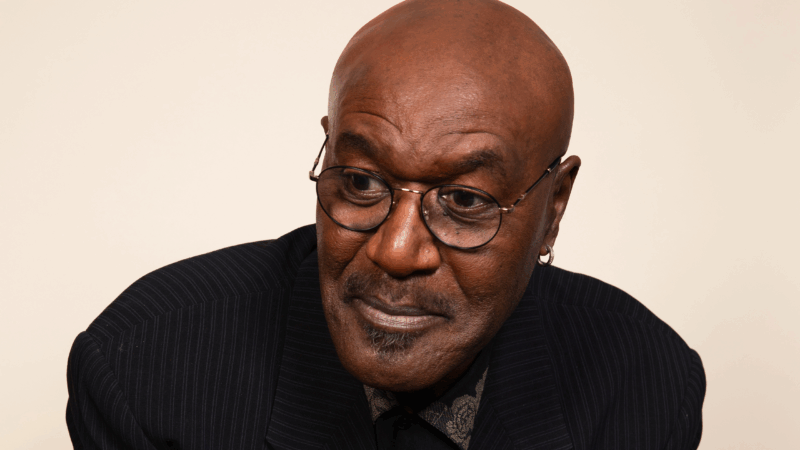
Over the course of his decades-long career on stage and in Hollywood, Sinners actor Delroy Lindo has experienced firsthand what he calls the “disappointments, the vicissitudes of the industry.”
On Feb. 22, at the BAFTA awards in London, Lindo and Sinners co-star Michael B. Jordan were the first presenters of the evening when a man with Tourette syndrome shouted a racial slur.
Initially, Lindo says, he questioned if he had heard correctly. Then, he says, he adjusted his glasses and read the teleprompter: “I processed in the way that I process, in a nanosecond. Mike did similarly, and we went on and did our jobs.”
Lindo describes the BAFTA incident as “something that started out negatively becoming a positive.” A week after the BAFTAs, he appeared with Sinners director Ryan Coogler at the NAACP awards.
“The fact that I could stand there in a room predominantly of our people … and feel safe, feel loved, feel supported,” he says. “I just wanted to officially, formally say thank you to our people and to all of the people who have supported us as a result of that event, that incident.”
Sinners is a haunting vampire thriller about twins (both played by Jordan) who open a juke joint in 1930s Mississippi. The film has been nominated for a record 16 Academy Awards, including best actor for Jordan and best supporting actor for Lindo, who plays a blues musician named Delta Slim.
This is Lindo’s first Oscar nomination; five years ago, many felt his performance in the Spike Lee film Da 5 Bloods deserved recognition from the Academy. When that didn’t happen, Lindo admits he was disappointed, but he had no choice but to move on.
“I have never taken my marbles and gone home,” he says. “And I want to claim that I will not do that now. I will continue working.”
Interview highlights
On his preparation to play Delta Slim
Various people have mentioned … [that] my presence reminds them of an uncle or their grandfather, somebody that they knew from their families, and that is a huge compliment, but more importantly than being a compliment, it’s an affirmation for the work. My preparation for this started with Ryan sending me two books, Blues People, by Amiri Baraka — who was [known as] LeRoi Jones when he wrote the book — and Deep Blues, by Robert Palmer.
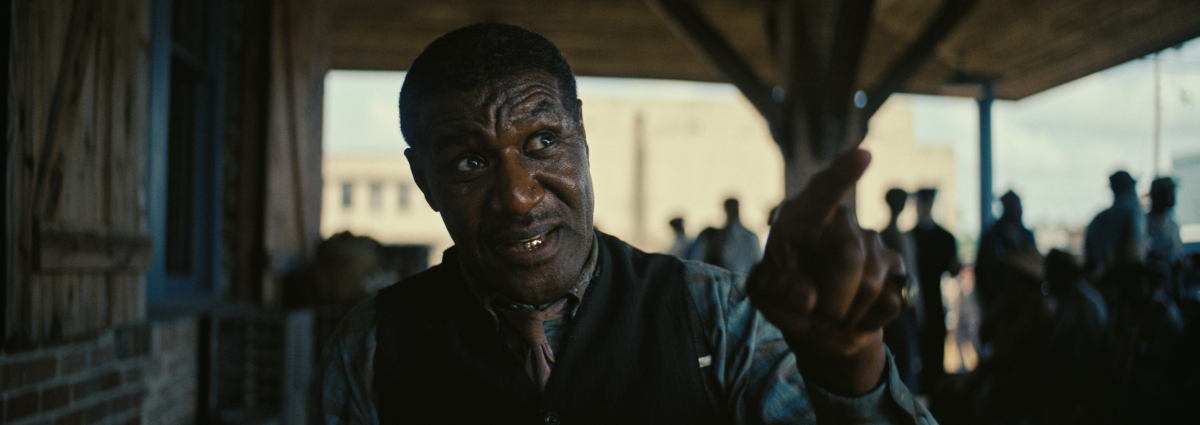
In reading those books and then referencing those books, continuing to reference those throughout production, I was given an entrée into the worlds, the lifestyles of these musicians. There’s a certain kind of itinerant quality that they moved around a lot. The constant for them is their music, so that there is this deep-seated connection to the music.
On being Oscar-nominated for the first time — and thinking about other Black actors, including Halle Berry and Lou Gossett Jr., who had trouble getting work after their wins
I will not view it as a curse, because I am claiming the victory in this process, no matter what happens.
Delroy Lindo
I will not view it as a curse, because I am claiming the victory in this process, no matter what happens. … In terms of this moment, I absolutely am claiming, as much as I can, the joy of this moment. I’m not saying I don’t have trepidation, I do. It’s the reason I was not listening to the broadcast this year when the nominations were announced. I did not want to set myself up. But I’m … attempting as much as I can to fortify myself and know in my heart that I will continue working as an actor. I absolutely will.
On being “othered” as a child because of his race
Because my mom was studying to be a nurse they would not allow her to have an infant child with her on campus, so as a result of that, I was sent to live with a white family in a white working class area of London. … I was loved, I was cared for, but as a result of living with this family in this all-white neighborhood, I went to an all-white elementary or primary school. And I was literally the only Black child in an all-white school.
So one afternoon, after school had ended, I was playing with one of my playmates … And at a certain point in our game, a car pulls up, and this kid that I was playing with goes over to the car and has a very short conversation with whomever was in the car, which I now know was his parent, his father. He comes back and he … says, “I can’t play with you.” And that was the end of the game.
On the experience of writing his forthcoming memoir
It’s been healing, actually. I’m not denying that it has opened me up. I’ve been compelled to scrutinize myself. I’m using that word very advisedly, “scrutinized.” It’s a scrutiny, it’s an examination of oneself. But in my case, because a very, very, very significant part of what I’m writing has to do with re-examining my relationship with my mom. And so my mom is a protagonist in my memoir. I’m told by my editor and by my publisher that one of the attractions to what I’m writing is that it is not a classic “celebrity memoir.” I am examining history. I’m examining culture. I’m looking at certain passages of history through the lens of the “Windrush” experience [of Caribbean immigrants who came to the UK after World War II].
On getting a masters degree to help him write his mother’s story
My mom deserved it. My mom is deserving. And not only is my mom deserving, by extension, all the people of the Windrush generation are deserving. Stories about Windrush are not part of the global cultural lexicon commensurate with its impact. The people of Windrush changed the definition of what it means to be British. There are all these Black and brown people, theretofore members of what used to be called the British Commonwealth. And they were invited by the British government to come to England, the United Kingdom, to help rebuild the United Kingdom in the aftermath of the destruction of World War II. My mom was part of that movement. They helped rebuild construction, construction industry, transportation industry, critically, the health industry, the NHS, the National Health Service. My mom is a nurse.
The reason that I went into NYU was because my original intention was to write a screenplay about my mom. I wanted to write a screenplay about my mom because I looked around and I thought: Where are the feature films that have as protagonist a Caribbean female, a Black female, where are they? … I wanted to address that, I wanted to correct that, what I see as being an imbalance.
Ann Marie Baldonado and Susan Nyakundi produced and edited this interview for broadcast. Bridget Bentz, Molly Seavy-Nesper and Beth Novey adapted it for the web.
Transcript:
TONYA MOSLEY, HOST:
This is FRESH AIR. I’m Tonya Mosley, and my guest today is Delroy Lindo, an actor whose presence has shaped film and theater for more than 50 years. From West Indian Archie in Spike Lee’s “Malcolm X” to the charming and cruel drug kingpin in “Clockers” to a father guarding an unspeakable secret in “The Cider House Rules,” for me, Delroy’s characters often feel lived in, complicated and hard to shake. In Ryan Coogler’s latest film “Sinners,” Lindo plays Delta Slim, a hard-drinking, deeply knowing blues harmonica player in 1930s Mississippi.
(SOUNDBITE OF FILM, “SINNERS”)
DELROY LINDO: (As Delta Slim) Blues wasn’t forced on us like that religion. No, son, we brought this with us from home. It’s magic, what we do. It’s sacred, and it’s big.
MOSLEY: Delroy Lindo is nominated for best supporting actor for his role as Delta Slim – his first Oscar nomination in a 50-year career. “Sinners” leads all films this year with 16 nominations. Lindo trained at the American Conservatory Theater in San Francisco and made his name in the theater, Broadway, Yale Rep and the Kennedy Center, performing August Wilson and Lorraine Hansberry before Spike Lee brought him to film audiences. Over the decades, he’s moved between stage, film and television from “Get Shorty” and “Ransom” to his turn as the razor-sharp attorney in “The Good Fight.” In 2020, he reunited with Spike Lee for “Da 5 Bloods,” playing a traumatized Vietnam vet, returning to the jungle to recover buried gold and the remains of a fallen soldier. Delroy Lindo, welcome to FRESH AIR.
LINDO: Thank you. Thank you for having me. Thank you.
MOSLEY: I want to set up “Sinners” for those who have not seen it and to remind those who have seen the film. So “Sinners” is this haunting Southern epic set in 1932 Mississippi, and twin brothers Stack and Smoke – both played by Michael B. Jordan – and they return home from Chicago to open a juke joint, only to find that their plans are overtaken by the supernatural evil as vampires and Hoodoo, and there’s buried trauma, and it all converges into this single horror-filled night. And I want to play the scene where we first meet your character, Delta Slim. In this scene, Stack approaches you at a train station where you’re busking and tries to convince you to play at the Juke Joint’s opening night, and you’re hesitant at first until Michael, as Stack, wins you over, and Stack speaks first.
(SOUNDBITE OF THE FILM, “SINNERS”)
MICHAEL B JORDAN: (As Stack) I’ll give you $20 to come play at our juke tonight.
LINDO: (As Delta Slim) Yeah, I wish I could. I’m going to be at Messenger’s tonight, same as I am every Saturday night.
JORDAN: (As Stack) They ain’t paying you $20 a night. I know that.
LINDO: (As Delta Slim) You ain’t paying no $20 a night. You paying $20 maybe tonight. Tomorrow night? The week after that? Nah. I’ve been at Messenger’s every Saturday night for the last 10 years. Messenger’s going to be there another 10 years after that, at least. I play, and I get as much corn liquor as I can drink. Sinner like me, I can’t ask for more than that.
MOSLEY: That’s my guest today, Delroy Lindo as Delta Slim in “Sinners.” You know, there’s kind of a wryness to your character. There’s a little bit of humor there. You know, he knows exactly what he’s worth, and he kind of is not going to settle for what he feels like could be a flash in the pan, you know? I read that in the first draft of the film, as it was written, your character kind of begins and ends there, and you kind of told the director, Ryan Coogler, like, he needs to be built out more. He’s rich, and I want to see him more in the film. Is that true?
LINDO: So no, it wasn’t that my character began and ended with that first scene. What it was was that the introduction was so dynamic that what happened in the second half of the screenplay, I was not as present. I was there, but I was not as present. And since Ryan had introduced the character – my character, Delta Slim – so dynamically, I spoke with Ryan and I said, how can we enhance my presence in the second act of the film? And Ryan understood that. And he assured me that we would work on enhancing my presence in the second act. And he did.
MOSLEY: Talk to me a little bit about your preparation for this man because there is a knowing. There’s a scene that I love so much. It’s where you and Stack, Michael B. Jordan, and Preacher Boy are driving through.
LINDO: In the car.
MOSLEY: You’re in the car. You know exactly the one I’m talking about.
LINDO: Yeah.
MOSLEY: You’re driving through the cotton fields.
LINDO: Yeah.
MOSLEY: And you start to talk about a lynching.
LINDO: Yeah.
MOSLEY: And there’s so much in that that feels so real. There’s a knowing in you. You’re starting to tell the story, and then you just break out in humming. And that reminded me so much of my grandfather and hearing him sometimes. He’d talk, and then he’d just start humming. And I want to know where that comes from, from you – that knowing, you know, that you brought to that character.
LINDO: First of all, thank you for what you just said about your grandfather because various people have mentioned to me that that scene and my presence reminds them of an uncle or their grandfather, somebody that they knew from their families. And that is a huge compliment. But more importantly than being a compliment, it’s an affirmation for the work. To answer your question, it started – my preparation for this started with Ryan sending me two books, “Blues People” by Amiri Baraka – who was LeRoi Jones when he wrote the book – and “Deep Blues” by Robert Palmer.
And I read those books. That was my intro into the world of “Sinners.” And in reading those books and then referencing those books throughout production, I was given an entree into the worlds, the lifestyles of these musicians. There was a certain kind of itinerant quality that they moved around a lot. The constant for them is their music, so that there is this deep-seated connection to the music. And because they are following where the music takes them, that then becomes an intrinsic part of their lifestyles.
MOSLEY: I’ve heard you say that for characters, you first look at maybe those similarities, and then you look at the differences. And then you work from there.
LINDO: Mm-hmm. That’s exactly right.
MOSLEY: That particular scene, though, where you’re talking about the lynching and then you just go into humming, it’s almost – it also signifies something else for me. Like, sometimes when there’s – it’s – there are no words for something.
LINDO: There are no words.
MOSLEY: And when there are no words, that’s where the blues comes in. There’s where the music.
LINDO: That’s exactly where the music comes from. And yet another affirmation for me, Tonya, in terms of how people have received this work, it’s incredibly affirming that audiences – many audiences – have made the connection between the pain of what I was experiencing and the birth of the music. And I certainly was not thinking about that in the moment.
MOSLEY: Was it scripted?
LINDO: No. The humming? The hollering?
MOSLEY: Yeah, yeah.
LINDO: No, it was not scripted. It happened organically on probably the sixth or seventh take. And what is so beautiful about that moment and its retention in the film, it was born of a company of people all working together. And what I mean by that is, we had a very specific distance to get the scene. We had a finite amount of real estate to get the scene in. We started at point A, and by the time we got to point B or point Z, I had to have finished the monologue. It was a three-page monologue.
MOSLEY: Within a certain amount of time.
LINDO: Within a certain amount of time. And then we had to turn the car around, turn all the equipment around and go in the opposite direction and do it again, and then turn around and come back and go in the opposite direction and do it again. On probably the sixth take – and I’m forever indebted to Mike, playing Stack – Mike didn’t stop the car. We got to the – what was supposed to be the end point, and he veered off into the underbrush and kept going. Ryan kept the cameras rolling. Autumn Durald Arkapaw – a brilliant cinematographer – she was right there. We continued filming. And as a result of that, it gave the scene more time to breathe and for us extra time – more time to be in that moment.
And it’s important for me to articulate this every single time I talk about that aspect of the scene. We were very much working in concert. We were very much working as an ensemble at that point. I may have been the conduit for what happened, but Michael B. Jordan was right there as Stack. Miles Caton as Preacher Boy was right there. We were all in the car together. Ryan kept the cameras rolling. Autumn was right there, and the DP. We were all working together, and that is what captured that moment.
MOSLEY: Let’s take a short break. My guest is Delroy Lindo, nominated for his first Academy Award for his role as a blues musician, Delta Slim, in Ryan Coogler’s “Sinners.” We’ll continue our conversation after a short break. This is FRESH AIR.
(SOUNDBITE OF CLAUS OGERMAN AND DANILO PEREZ’S “RAYS AND SHADOWS”)
MOSLEY: This is FRESH AIR, and today I’m talking with actor Delroy Lindo. He’s nominated for an Oscar for his performance in “Sinners,” which leads all films this year with 16 Academy Award nominations. When we left off, we were talking about the craft behind Delta Slim and “Sinners.” Now I want to turn to something that happened last week, when Lindo went to London to celebrate the film at the BAFTAs.
So, Delroy, you’ve been on a roll (laughter).
LINDO: Can I stop you one second? With all due respect (laughter) – with all due respect, I’m actually not going to talk about this.
MOSLEY: Not at all?
LINDO: (Laughter).
MOSLEY: You’re not going to talk about it.
LINDO: I…
MOSLEY: And why are you laughing?
LINDO: I’m laughing because at – in the intro, when you said, oh, yes, we’ll be talking about what happened with BAFTA…
MOSLEY: I saw you chuckle a little bit. You smiled over there.
LINDO: ‘Cause I said, no, we’re not.
(LAUGHTER)
MOSLEY: Tell me why.
LINDO: I have made two comments about what happened, and I feel that for me, that is all I need to say. And the comments that I have made, which I will repeat for you…
MOSLEY: Can I first tell people what we’re talking about?
LINDO: Absolutely.
MOSLEY: And then on the other side of it…
LINDO: No, absolutely. Please.
MOSLEY: OK. So while you and Michael B. Jordan were on stage presenting an award for the BAFTAs, which is basically the U.K.’s version of the Oscars – very high honors – a man in the audience named John Davidson shouted a racial slur. And Davidson has Tourette syndrome and has said the outburst was involuntary, and he’s apologized. And you have made some comments about it, and I want to hear what you have to say about it.
LINDO: The only thing that I’ve said is that at the NAACP Awards…
MOSLEY: Yes.
LINDO: …Ryan and I were presenting an award, and right before we went on stage, I said to Ryan that I wanted to just say something. He didn’t know what I was going – I said, let me just – before we start reading the teleprompter, I have something I want to just say. And what I said to the audience were words to the effect that Mike and I, “Sinners'” company of people, appreciate all the love and the support that we have received as a result of what happened at BAFTA. And the fact that I could stand there in a room predominantly of our people feels…
MOSLEY: Of Black people ’cause it’s at the NAACP Awards.
LINDO: The NAACP Awards.
MOSLEY: Yeah.
LINDO: I could stand there and feel safe, feel loved, feel supported and just simply affirm the love and the support that they have given us. And I just wanted to officially, formally say thank you to our people and to all of the people who have supported us as a result of that incident.
And then the second thing, I was at the after-party – the BAFTAs – and I don’t know what I was thinking, but a gentleman came up to me at the after-party and said – he introduced himself and said, oh, I’m with Vanity Fair. And that should have told me, this is a journalist right here.
MOSLEY: (Laughter).
LINDO: He said, I’m with Vanity Fair (laughter).
MOSLEY: Yeah.
LINDO: It didn’t occur to me this is a journalist. But what I said to him was, look, it would have been nice if somebody from BAFTA had spoken to Mike and I.
MOSLEY: Yeah. Afterwards.
LINDO: And that’s all I said. And that’s all I am going to say. Oh, I’m sorry. There was one other thing that I said. I’m sorry. I said it was an example of something that could have been – that started out negatively becoming a positive from the standpoint of the love and support that we had received. And I received a text – a biblical text – that I want to just share with you. And the verse of the day is – my wife sends verses, affirmations…
MOSLEY: Yeah.
LINDO: …To various people – be not overcome of evil but overcome evil with good. Romans 12:21. A negative turned into a positive, which essentially is what – I didn’t quote that Bible passage. I wish – I told her that when she sent me this. God, I wish I’d have said that.
MOSLEY: Delroy, I’m – I feel like that’s an answer to my question. You know, when I saw the clip of that, I think, like a lot of people – ’cause I’ve had quite a few conversations about this with people – we immediately looked to your face.
LINDO: (Laughter).
MOSLEY: And we were searching your face. And, of course, we’re searching your face – we’re searching Michael B. Jordan’s face, but we’re searching your face because you are a renowned actor who’s been around for a long time. And so, so many of us kind of look to you on, how would I respond to that? And how is this man, who is an elder, who we look up to – how is he responding to it?
LINDO: Sure.
MOSLEY: And I wanted to know what you told Michael B. Jordan afterwards, when you guys are one-on-one, and you’re talking about this thing that’s a very real thing. Yes, to have someone with Tourette syndrome blurt that out – that’s a whole nother thing. But in general, your relationship with that word…
LINDO: Mike and I spoke on – this is Tuesday. Mike and I spoke on Sunday for the first time, just amongst ourselves about what…
MOSLEY: After it happened, yeah.
LINDO: After it happened. This past Sunday, Mike and I spoke. And it was interesting ’cause we both had a similar – individually, we both had similar responses because you have to understand, we had jobs to do. We were the first presenters of the evening, and we had to read that teleprompter. And we both did exactly that. Now, my wife says that I adjusted my glasses.
(LAUGHTER)
LINDO: And she said she knew when I adjusted my glasses, something was happening internally. I was not aware that I had adjusted my glasses, but there was a nanosecond – a nano of a nano of a nanosecond – when I’m thinking, wait, did I just hear what I thought I heard (laughter)? But then – and it truly was a nanosecond – one had to read the teleprompter and get on with presenting the award. So, you know, there was not – there was no time at all. I processed in the way that I processed in a nanosecond. Mike did similarly, and we went on and did our jobs. So…
MOSLEY: Yeah. That makes sense.
LINDO: Yeah.
MOSLEY: You know, what’s also kind of ironic is the connection to the word because of the character that you play – played on…
LINDO: How about that?
MOSLEY: …”The Good Fight.”
LINDO: Oh, how about that? Sure.
MOSLEY: Yeah. It’s power. This word, the N-word, who gets to say it? What happens when it’s used for a long time? And I actually want to play a clip that went viral even before the BAFTAs, so this has been a thing…
LINDO: Oh, way before the BAFTAs.
MOSLEY: Yes.
LINDO: Yeah.
MOSLEY: It’s of you as your character, Adrian Boseman, on “The Good Fight,” and you’re encouraging a white television host to say the N-word on air. Let’s listen.
(SOUNDBITE OF TV SHOW, “THE GOOD FIGHT”)
ARNIE BURTON: (As Chuck) I see racism against whites every day, every single day, yet I’m a racist for pointing that out?
DARREN RITCHIE: (As character) Adrian, what’s your take?
LINDO: (As Adrian Boseman) Take on what?
RITCHIE: (As character) What Chuck just said. Is racism just a one-way street?
LINDO: (As Adrian Boseman) I think that’s his opinion.
BURTON: (As Chuck) Look at your firm, Adrian. You get the benefit of no-bid contracts because you’re an African American firm. Now, as a white lawyer, what am I supposed to think of that?
LINDO: (As Adrian Boseman) I don’t know.
RITCHIE: (As character) I think Chuck is pointing out a double standard here, Adrian. I mean, take hip-hop. We’ve talked about this on the show before. You have African American rappers saying N-word this and N-word that, but a Caucasian can’t.
LINDO: (As Adrian Boseman) So say it.
RITCHIE: (As character) Say what?
LINDO: (As Adrian Boseman) Say the word you want to say.
RITCHIE: (As character) I’m not saying that I want to say it. I’m just saying that I can’t.
LINDO: (As Adrian Boseman) Sure you can. Say it. Say it right now. I will say it with you.
BURTON: (As Chuck) OK. This is hypocritical. You know we can’t.
LINDO: (As Adrian Boseman) Sure you can. This is America. Both of you, say it. (Imitating stutter).
RITCHIE: (As character) All right. I think we can move on.
LINDO: (As Adrian Boseman) Why? Why move on when you want to say it? Both of you want to say it. Huh?
(LAUGHTER)
MOSLEY: OK. This makes you laugh. The funny thing about it is people really thought this was real…
LINDO: Yes, they did.
MOSLEY: …For a very long time.
LINDO: Yes.
MOSLEY: It’s gone around. I remember seeing it and thinking, I need to know what context that was in.
LINDO: Yeah.
MOSLEY: But it’s actually from a show.
LINDO: A TV show.
MOSLEY: Why do you think – I mean, first off, there’s something about watching a Black man who’s, like, saying, just say the thing that we’re all thinking and we know that you’re thinking you want to say – say it.
LINDO: Right. Right.
MOSLEY: But what was going through your mind in that scene, and why do you think it has taken such hold?
LINDO: It’s taken hold because the sentiments contained in the scene are real, which is to say that as a Black person, I know – we all know, I assume – that behind closed doors, there’s not such decorum that is exercised. Behind closed doors, it is said. It is probably said liberally. And there is this hypocritical – what I was pointing out. Rather than me being the hypocrite, they were the hypocrites because the fact of the matter is, you know you want to say it, and you say it behind closed doors. You know you do. So I think that the reason that it took hold, as you say, is because the sentiments in the scene are very, very real.
MOSLEY: Our guest today is actor Delroy Lindo. We’ll be right back after a break. I’m Tonya Mosley, and this is FRESH AIR.
(SOUNDBITE OF HOLT VAUGHN AND PHIL KEAGGY’S “BITTER SUITE”)
MOSLEY: This is FRESH AIR. I’m Tonya Mosley, and my guest today is actor Delroy Lindo. He’s nominated for an Academy Award for Best Supporting Actor for his role as Delta Slim in Ryan Coogler’s “Sinners.” He’s also known for his collaborations with Spike Lee in “Malcolm X,” “Crooklyn,” “Clockers” and “Da 5 Bloods,” and for his role as Adrian Boseman on the CBS series “The Good Fight.” Before the break, we were talking about a racial slur shouted at Lindo and Michael B. Jordan at this year’s BAFTAs and the weight of that word in his life and work.
Do you remember the first time you – someone called you the N-word?
LINDO: I don’t. But I do remember the first time I was othered because of the color of my skin. And interestingly, I’m writing a memoir right now.
MOSLEY: Yeah.
LINDO: Plug, plug, plug. That will be out in 2027. And I referenced this incident in the book. I do remember very, very clearly what happened and my utter confusion.
MOSLEY: How old were you?
LINDO: Five.
MOSLEY: Oh.
LINDO: So I was born in England, and my mom was a nurse. And I’m Jamaican. My mom went to England as part of a movement of Caribbean peoples from the Caribbean to England. And they became known as the Windrush generation as a result of the boat, called the Empire Windrush, that transported approximately 300 Jamaican – mostly Jamaican men from the Caribbean to England in June of 1948.
My mom arrived into England in 1951. So very, very – the beginning of the Windrush movement. I was born very soon thereafter. And because my mom was studying to be a nurse, they would not allow her to have an infant child with her on campus. So as a result of that, I was sent to live with a white family in a white working-class area of London.
MOSLEY: And this wasn’t just daycare or babysitting.
LINDO: No, no.
MOSLEY: You lived with them.
LINDO: No, I lived with them, I lived with them. Very loving family, by the way. I was loved. I was cared for. But as a result of living with this family in this all-white neighborhood, I went to an all-white elementary or primary school. And I was literally – I mean literally – the only Black child in an all-white school.
So one afternoon, after school had ended, I was playing with one of my playmates. I thought he was one of my – I thought he was a playmate. And we had exchanged garments. I had – I was wearing, like, his sweater. I had it tied around my neck. And he was wearing my sweater or my jacket tied around his neck. And we were pretending to be superheroes, right? (Imitating whooshing). And we’re at – we were on this patch of grass. And we had our hands out like Superman and we were flying, (Imitating whooshing), and having great fun.
And at a certain point in our game, a car pulls up. And this kid that I was playing with goes over to the car and has a very short conversation with whomever was in the car, which I now know was his parent, his father. He comes back and he tears – he throws my garment that he had been wearing around his neck. He throws it at me and grabs what I’m wearing, his garment that I’m wearing around my neck, and grabs it from me. He throws my garment at me, grabs my garment from me and says, I can’t play with you. And that was the end of the game (laughter).
MOSLEY: That was the end of the game. But, you know, this thing about that story and the fact that you were so young, 5 years old, you couldn’t have known, like, the full weight of that.
LINDO: Oh, no. Oh, no.
MOSLEY: It took you time. But it’s a story that has stuck with you because you knew that that was a signal of something.
LINDO: Well, it was a signal of my undesirability, right? So the answer to your question was not necessarily specific to being called the N-word, but it was very specific to being racially othered.
MOSLEY: These are imprints.
LINDO: Big time.
MOSLEY: How’s the writing for the memoir going? Because, you know, I’m so fascinated. I’m deeply obsessed with memoir and I love reading them.
LINDO: Oh, oh.
MOSLEY: And but one of the things that, like, I know about it is that it breaks you wide open. You’re able to see parts of yourself that you – through the process. How has that process been for you? And how do you hold these stories? Because you said it’s going to open your book, for instance. That means that that was an imprint that has carried you throughout your life, you know?
LINDO: Yep. It’s been healing, actually. I’m not denying that it has opened me up. I’ve been compelled to scrutinize myself. And I’m using that word very advisedly, scrutinized. It’s a scrutiny. It’s an examination of oneself. But in my case, because a very, very, very significant part of what I’m writing has to do with reexamining my relationship with my mom – and so my mom is a protagonist in my memoir.
It’s not – and I am told by my editor and by my publisher that one of the attractions to what I’m writing is that it is not a classic, quote, unquote, “celebrity memoir.” I am examining history. I’m examining culture. I’m taking – I’m looking at certain passages of history through the lens of the Windrush experience.
MOSLEY: Let’s take a short break. My guest is Delroy Lindo, nominated for his first Academy Award for his role as a blues musician, Delta Slim, in Ryan Coogler’s “Sinners.” We’ll continue our conversation after a short break. This is FRESH AIR.
(SOUNDBITE OF MICHELLE LORDI SONG, “WAYWARD WIND”)
MOSLEY: This is FRESH AIR. And today, I’m talking with actor Delroy Lindo. He’s nominated for an Oscar for his performance in “Sinners,” which leads all films this year with 16 Academy Award nominations. Before the break, we were talking about his life growing up in the U.K. with his mother as part of the Windrush generation.
You went to get a master’s degree…
LINDO: I did.
MOSLEY: …Right? – and study…
LINDO: I did.
MOSLEY: …This.
LINDO: I did.
MOSLEY: This was that – and that wasn’t that long ago, right?
LINDO: No.
MOSLEY: This was about…
LINDO: In 2014.
MOSLEY: Yeah.
LINDO: I got a master’s from NYU in 2014. I came to formal education late. I got my undergrad degree in 2004 from San Francisco State University, and I got my master’s from NYU in 2014. So…
MOSLEY: So you wanted to delve deep into your mother’s experience in the Windrush.
LINDO: I had to. I had to. I had to because – see, that’s interesting. I heard myself say that, and I didn’t know I was going to say that. I had to. I had to do that.
MOSLEY: You had to because…
LINDO: I had to because my mom deserved it. And not only is my mom deserving, all – by extension, all the people of the Windrush generation are deserving because that is a story – stories about Windrush are not part of global cultural lexicon commensurate with its impact. The people of Windrush changed the definition of what it means to be British. They were all these Black and brown people, theretofore members of what used to be called the British Commonwealth. And they were invited by the British government to come to England, the United Kingdom, to help rebuild the United Kingdom in the aftermath of the destruction of World War II. My mom was part of that movement.
MOSLEY: Yeah. Yeah.
LINDO: They helped rebuild construction, the construction industry, transportation industry, critically, the health industry, the NHS, the National Health Service. My mom was a nurse. And when I was going into – the reason that I went into NYU was because my original intention was to write a screenplay about my mom.
MOSLEY: Oh. Ah.
LINDO: I wanted to write a screenplay about my mom because I looked around and I thought, huh, where are the feature films that have as protagonist a Caribbean female, a Black female? Where are they? Now, there may be some out there, and I’ve seen one, not directed by a Black person. But I wanted to address that. I wanted to correct that – what I see as being an imbalance.
MOSLEY: What’s your mom’s name?
LINDO: My mom’s name is Enna Cynthia Moncrieffe (ph). Sometimes she would go by Luna (ph) Moncrieffe. And that’s a whole other story. But my answer to your question is – why do I need to do this is because my answer is my mom deserves a story about her.
MOSLEY: Yeah.
LINDO: And my editor said to me last week – I’m pretty certain it was in the aftermath of what happened at BAFTAs and the various stories had surfaced on the internet. Essentially, people just giving me love.
MOSLEY: Yeah.
LINDO: Just – and my editor sent me a text, and she said, your mom would be so proud. And I know she’s proud. I know she is.
MOSLEY: When did she pass?
LINDO: 1996. I was in New York. I was at the Four Seasons Hotel on 57th Street doing a junket for a film that I had done called – I think it was “Ransom.” And I’m digressing. The answer to your question is my mom passed in 1996. That’s the answer to your question. I talk a lot (laughter), you know.
MOSLEY: You – well, I’m talking to you. So you’re answering the things that I’m asking you. But…
LINDO: Can I tell you…
MOSLEY: You know, one thing I noticed about you – what did you want to say?
LINDO: I want to say that “5 Bloods,” when I was doing – and I don’t want you to forget your question. I was doing a round of press for the “5 Bloods,” which was during COVID.
MOSLEY: Yeah.
LINDO: And so, therefore, a lot of the – most all of the interviews and interactions with the – with journalists and press were virtual. And I had done an interview with a journalist up in San Francisco. And when the article came out – and I’m saying this for a very particular reason. When the article came out, she referred to me as the garrulous Delroy Lindo.
MOSLEY: (Laughter).
LINDO: I didn’t know what garrulous meant.
MOSLEY: Yeah. You had to look it up.
LINDO: I had to look it up. I had to look it up.
(LAUGHTER)
LINDO: So I looked it up, and it said, excessively talkative.
MOSLEY: Well, that’s so funny because the thing that I think about you is you’re very intentional with your words…
LINDO: Yes.
MOSLEY: …And language that you use. And I want to know where that comes from. I noticed that when I hear you talk, every time I say, oh, yeah, he’s taking the moment to make sure he’s finding the right words.
LINDO: I hope so. I hope so. Ironically, it is a result of how I was educated, and the irony is I was educated in England. I don’t know, four, five, six years ago, I found a notepad in my garage – an essay book that I had written when I was probably 13 or 14 years old, when I was in high school. And I looked at what I had written. This was decent writing for a 13…
MOSLEY: It holds up, yeah.
LINDO: And so even at that age, I apparently had a relationship to language. And English language was always one of my favorite subjects in school – in high school. So I think it probably comes from the way that I was educated, and then having become an actor. And my domain is words…
MOSLEY: Yeah.
LINDO: …Right? So I try to be careful. I try to…
MOSLEY: And you want to be understood.
LINDO: …Really be careful…
MOSLEY: Yeah.
LINDO: …To be understood.
MOSLEY: That’s so interesting about finding your 13-year-old self in your writing…
LINDO: Yeah.
MOSLEY: …And saying, OK, this was really…
LINDO: This was decent.
MOSLEY: …Kind of cool. This was good.
LINDO: This was – this wasn’t bad.
MOSLEY: You spent a significant amount of time – the first few years of your life – in the U.K., and then you lived in Canada for a while. Then you all moved to the Bay Area.
LINDO: I went to San Francisco to study at the American Conservatory Theater.
MOSLEY: Yes. You don’t have an English accent.
LINDO: Right.
MOSLEY: Did you ever?
LINDO: Of course I did, yeah. And somebody – you know, I get asked this fairly frequently – you don’t have an English accent. And then somebody – I was recently asked, well, could you do it? Could you do it if you were asked to?
MOSLEY: (Laughter).
LINDO: And I have this joke, and I say – and I – my mantra, yeah, I can do it if they pay me, you know. But yes, I had an English accent, and yes, I could still pull it out right now if you needed me to. I’m not going to. There’s a part of me that’s waiting for – and I have no clue if this will ever happen. And if it doesn’t happen, it’s fine. It really and truly is fine. But there’s a part of me that’s waiting to be offered a piece of work that will permit me to use that London accent.
The other thing is, similarly to, you know, I don’t speak with a Jamaican accent, but I am able to speak with a Jamaican accent. You know, anybody who saw West Indian Archie, I was…
MOSLEY: Yeah.
LINDO: …Using a Jamaican accent there. And I did a film called “Wondrous Oblivion” in London in 2001, and I was playing a Jamaican man in that. And that actually is when I discovered Windrush, in – during the rehearsals for that film. But I remember one of the people from the office – from the production office – came on set one day and she was watching the work. And I overheard her say – ’cause I was speaking with a Jamaican accent…
MOSLEY: Yeah.
LINDO: …In that film. And I overheard her say, oh, my God, he can do it.
MOSLEY: My guest is Delroy Lindo, nominated for his first Academy Award for his role as a blues musician, Delta Slim, in Ryan Coogler’s “Sinners.” We’ll continue our conversation after a short break. This is FRESH AIR.
(SOUNDBITE OF MUSIC)
MOSLEY: This is FRESH AIR, and today I’m talking with actor Delroy Lindo. He’s nominated for an Oscar for his performance in “Sinners,” which leads all films this year, with 16 Academy Award nominations.
OK, let’s talk about the Oscars now.
(LAUGHTER)
MOSLEY: And I’m going to – I’m actually going to get into – I want to talk about this conversation by first talking about “Da 5 Bloods”…
LINDO: Oh.
MOSLEY: …’Cause it’s one of – I will say it’s one of my favorite movies. I mean, gosh, if I want a release…
LINDO: Yeah.
MOSLEY: …To cry…
LINDO: Yeah.
MOSLEY: …I will turn on that film.
LINDO: Yeah. Yeah.
MOSLEY: One of your most celebrated roles was Paul…
LINDO: Yeah.
MOSLEY: …A traumatized Vietnam vet unraveling in the jungle – a man carrying decades of rage and grief. When the nominations came out for “Da 5 Bloods” and your name wasn’t there, I’ve heard you say that you were deeply disappointed.
LINDO: (Laughter) That might qualify as the understatement of the year, Tonya.
MOSLEY: (Laughter) OK.
LINDO: I actually – my representatives at the time called me in the morning and I thought they were joking.
MOSLEY: When they said your name wasn’t on?
LINDO: Yeah. The guy said, it didn’t happen, man.
MOSLEY: You were so certain.
LINDO: I had been made to feel certain because of – all of the talk outside of me was, you’re going to get a nomination. You’re going to get a nomination. You’re going to get a nomination. You’re going to get a nomination. So I got drawn into that. And I remember the gentleman said, no, it didn’t happen, man, and I thought he was kidding. I thought he was pulling my leg.
I was going that morning to get a COVID shot. I went – I was in New York. I went to this facility on 96th Street. And I got my shot, I came out, and my phone rang and it was Spike. And we talked, and we commiserated. I’ve said this in the past, but I’ll say it now, just officially. Spike, if you hear this, man, I – it meant the world to me that you called me and that we had that conversation. It meant, like, everything, bro. ‘Cause I was reeling. So yes, I was disappointed.
MOSLEY: Because, I mean, you put your foot in that role. I mean…
LINDO: Thank you.
MOSLEY: …Like, you know, you embodied it.
LINDO: It wasn’t just my big toe, was it?
MOSLEY: (Laughter).
LINDO: I put my foot in that thing.
MOSLEY: Well, you…
LINDO: (Laughter).
MOSLEY: You’re now nominated for an Oscar for best supporting actor for “Sinners.” First off, congratulations.
LINDO: Thank you very much. I appreciate it.
MOSLEY: You know, it’s the highest honor for an actor, and yet, it sometimes is, like, the biggest curse for a Black actor. How do you hold that very true tension? And I’ll say it’s a curse because oftentimes, many Black actors have said things dry up after this. It’s like you’ve hit the ceiling.
LINDO: I worked with Lou, Lou Gossett, some years ago. And Lou, for me, was one of the greats. Lou Gossett Jr. was one of the great actors with a capital G. Great.
MOSLEY: And he won an Oscar.
LINDO: And he won an Oscar. And I think he told…
MOSLEY: In 1983.
LINDO: Yes, “An Officer And A Gentleman.” And I think he told me he didn’t work for a year after that. I’ve heard Halle Berry speak about her disappointment after she won. The things her career – and I don’t want to misquote because I do not know Halle Berry.
MOSLEY: No, but she has said this. She said this even on this show.
LINDO: It didn’t quite – things didn’t happen for her the way she thought. But what I will say – and this is important – I am not and I will not view it as a curse because I am claiming the victory in this process, no matter what happens. And what does that mean? It means that, just as after the disappointment of “Da 5 Bloods,” I had to pick myself up and keep going.
And that was something that Spike and I talked about. You got to keep working, man. Something that I say to my son after he suffers a disappointment on the basketball court because my son is very similar to me. He likes to win. He does not like to lose. Hey, man, you got to pick yourself up. You got to pick your head up. Keep your head up, bro. There’s always the next game.
And what I had to tell myself on the heels of “Da 5 Bloods” was, I got to keep working. So in terms of this moment, absolutely am claiming as much, as I can, the joy of this moment. I’m not saying I don’t have trepidation. I do. It’s the reason I was not listening to the broadcast this year when the nominations were announced. I did not want to set myself up.
MOSLEY: Oh, wow. Yeah.
LINDO: But I’m claiming the victory, Tonya. And what that means for me is attempting, as much as I can, to fortify myself and know in my heart that I will continue working as an actor. I absolutely will. I have never taken my marbles and gone home as a result of whatever disappointments, the vicissitudes of the industry. And I want to believe and I want to claim that I will not do that now. I will continue working.
And I pray to God this doesn’t – that is something that I would tell any young person, young actor, young practitioner of any craft. In the face of disappointment, yes, you have the choice of taking your marbles and going home if you want to. What will that get you? You have to keep moving forward, and that is what I will do.
MOSLEY: Delroy Lindo, this has been such a pleasure, to talk with you.
LINDO: Thank you so much. Thank you.
MOSLEY: Thank you so much.
LINDO: I really appreciate it. Thanks for having me. God bless you. Thank you. Thank you very much.
MOSLEY: Delroy Lindo. He’s a veteran actor with a 50-year career. And he’s just received his first Academy Award nomination for Ryan Coogler’s “Sinners.” If you’d like to catch up on interviews you’ve missed – like our conversation with Jessie Buckley, the star of the film “Hamnet” who’s nominated for an Oscar for her performance, or with legal scholar Rick Hasen on Trump’s plan to push legislation that would change how every American citizen registers to vote and votes – check out our podcast. You’ll find lots of FRESH AIR interviews. And to find out what’s happening behind the scenes of our show and get our producers’ recommendations on what to watch, read and listen to, subscribe to our free newsletter at whyy.org/freshair.
(SOUNDBITE OF SONNY TREADWAY’S “DON’T LET THE DEVIL RIDE”)
MOSLEY: FRESH AIR’s executive producer is Sam Briger. Our technical director and engineer is Audrey Bentham. Our interviews and reviews are produced and edited by Phyllis Myers, Roberta Shorrock, Anne Marie Baldonado, Lauren Krenzel, Therese Madden, Monique Nazareth, Susan Nyakundi, Anna Bauman and Nico Gonzalez-Wisler. Our digital media producer is Molly Seavy-Nesper. Thea Chaloner directed today’s show. With Terry Gross, I’m Tonya Mosley.
(SOUNDBITE OF SONNY TREADWAY’S “DON’T LET THE DEVIL RIDE”)
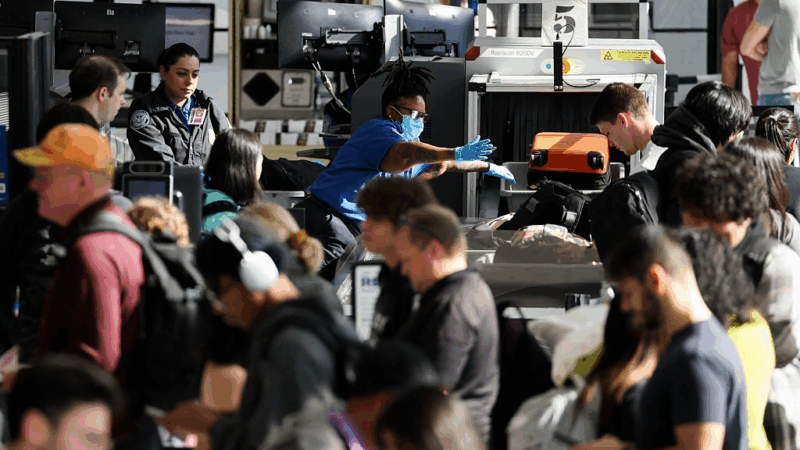
Travel industry pushes Congress to end DHS shutdown and pay federal security workers
With the busy spring break travel season looming, travel and aviation industry leaders urged Congress to end the stalemate over DHS funding before workers at TSA and ports miss a full paycheck.
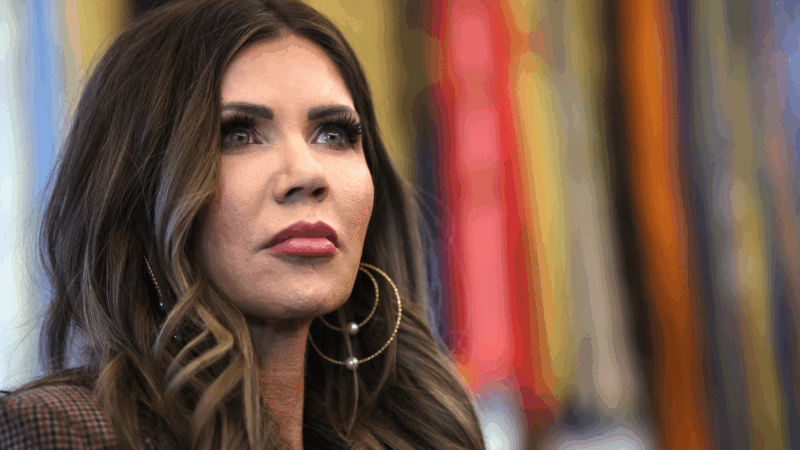
Trump fires Kristi Noem as DHS chief, names Sen. Markwayne Mullin to replace her
President Trump has fired his homeland security secretary, Kristi Noem, and said Markwayne Mullin, a senator from Oklahoma, would replace her.

They were led off course in a big race. But a fix is more complicated than prize money
Top finishers in the Atlanta half marathon are calling for U.S. track officials to ensure that Jess McClain and two other athletes aren't excluded from the world championships because of an error.
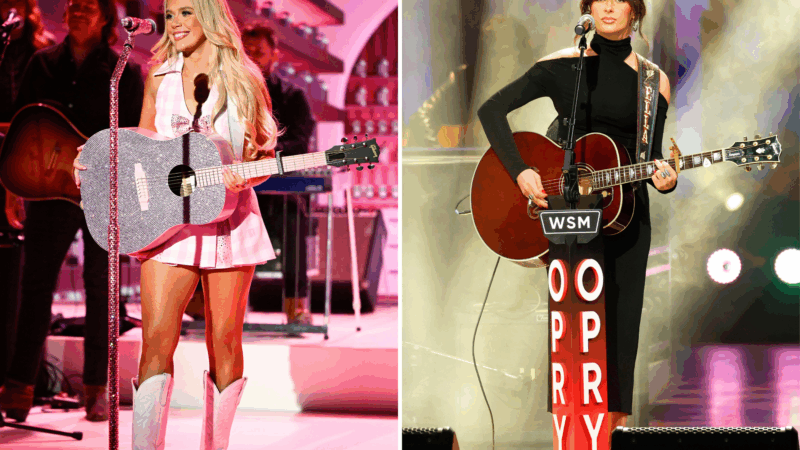
Between Megan Moroney and Ella Langley, country women rule the charts
It's a big week for women in country music — and, it turns out, for women whose songs are favored by women in figure skating.
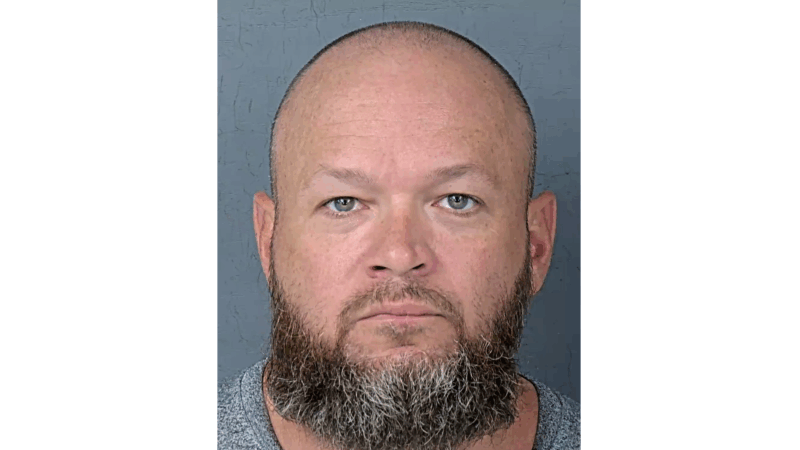
A Jan. 6 rioter pardoned by Trump was sentenced to life in prison for child sex abuse
Since receiving presidential pardons, dozens of former Capitol rioters have gotten into more legal trouble. In Florida, Andrew Paul Johnson was sentenced to life in prison for child sex abuse.

President Trump, Pam Bondi sued over sale of TikTok assets
The case, filed in a federal court in Washington, D.C., accuses the Trump administration of ignoring legislation designed to stop the spread of Chinese propaganda — and instead helping to broker a partial sale to businessmen close to Trump.
