
New Israeli ceasefire offer demands Hamas discuss disarming, but group rejects it
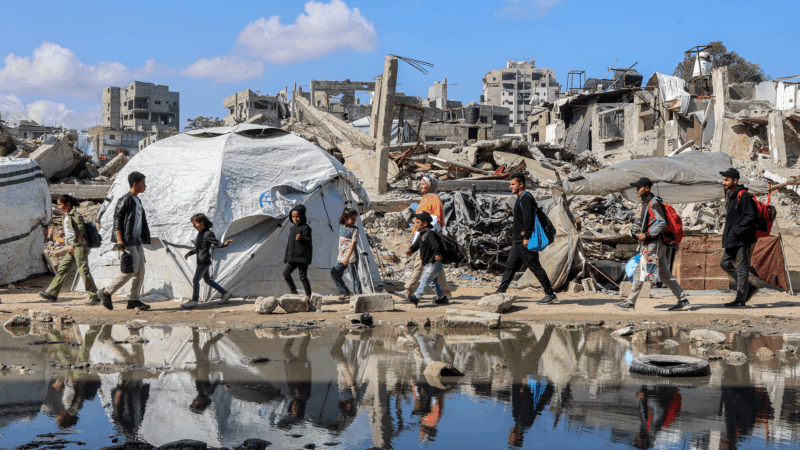
TEL AVIV, Israel and DUBAI, United Arab Emirates — Hamas is rejecting a new Israeli proposal to pause the war in Gaza, free more Israeli hostages and negotiate the disarmament of Palestinian militant groups in Gaza, a Hamas official told NPR.
The Hamas official spoke on condition of anonymity because the group had not yet presented its formal response to ceasefire mediators.
Earlier Tuesday, officials involved in mediating Gaza ceasefire talks had expressed optimism that a deal could be reached within weeks, Egyptian mediators told NPR.
Mediators have feared that any potential temporary ceasefire could be shattered by Israel if the deal did not include U.S. guarantees for a permanent end to the war.
Israel’s latest ceasefire proposal presented to Hamas included a willingness to negotiate a permanent end of the war, but on condition of a new demand that Hamas, and all militant groups in Gaza, be disarmed. That’s according to Egyptian mediators, a senior Hamas official and an additional official involved in the talks.
The officials spoke on condition of anonymity in order to discuss the details of the closed-door negotiations.
Hamas had said on Monday that it was studying Israel’s latest offer, which was presented by mediators to a Hamas delegation in Cairo over the weekend. Israel has not publicly released details from the negotiations.
Israel proposed half the number of hostages presumed alive to be released within 1 week
As part of the new 45-day ceasefire proposal offered by Israel, Hamas would release 10 living hostages, which is about half the number of hostages presumed alive, according to the Egyptian officials. The first to be released would be Israeli soldier Edan Alexander, who holds U.S. citizenship.
In exchange, Israel would release nearly 1,400 Palestinian detainees and prisoners serving life sentences during those six weeks.
If the sides agree on a permanent end to the war during those six weeks, including an agreement by Hamas to lay down its arms permanently, the remaining hostages held in Gaza would also be released, according to the Israeli offer.
The Egyptian officials say Hamas is agreeing to release more hostages, but maintains any agreement must ensure a permanent end to the war, full Israeli withdrawal from Gaza and the reconstruction of the territory, where more than 90% of homes have been damaged or destroyed, according to United Nations estimates.
Hamas said in a statement Tuesday that it had lost contact with Alexander’s guards in Gaza due to Israeli bombardment of their location. Israel had no immediate comment.
A timeline of Israel’s proposed ceasefire, according to mediators
- Day 1: Hamas releases Edan Alexander, an Israeli soldier holding U.S. citizenship, as a gesture to the U.S.
- Day 2: Hamas releases five living hostages in exchange for Israel releasing 66 Palestinian prisoners serving life sentences, convicted in connection with violence against Israelis, and 611 detainees from Gaza.
- Day 3: Israel and Hamas begin negotiations on the “day after” the war, including disarmament in Gaza and a permanent end of hostilities.
- Day 7: Hamas releases four additional hostages in exchange for 54 Palestinian prisoners serving life sentences and 500 Palestinian detainees held by Israel since the Hamas-led attack on Israel Oct. 7, 2023.
- Day 10: Hamas provides information on all remaining living hostages in exchange for Israel providing information on Palestinian detainees.
- Day 20: Hamas releases the bodies of 16 deceased hostages in exchange for the bodies of 160 deceased Palestinians.
- Within 45 days: The sides must complete negotiations for a permanent end of war. Only then would Hamas release all remaining living and dead hostages. In total, 59 living and dead hostages remain in Gaza today, according to Israel.
Israel continues to ban food and supplies to Gaza
As part of a ceasefire, mediators say Israel has proposed easing a weeks-long blockade on vital supplies like food, fuel and medicines entering Gaza, but Israel is demanding a new mechanism for distributing humanitarian aid. Israel has not publicly disclosed the details of this mechanism, but has been looking at ways to keep aid out of the hands of Hamas.
U.N. Secretary General António Guterres says Israel, as the occupying power under international law, must open crossings into Gaza and ensure lifesaving aid reaches people there. Gaza’s bakeries have shut down without flour and aid groups say supplies are being depleted.
Guterres says Israel’s proposed new aid mechanisms “risk further controlling and callously limiting aid down to the last calorie and grain of flour.”
Growing calls among Israeli military veterans to end the Gaza war
Israel’s government, led by Prime Minister Benjamin Netanyahu, is facing growing calls from reservists and former military officers to change course in Gaza and halt the fighting in order to immediately free all hostages taken in the Oct. 7, 2023, attack on Israel. Hamas-led militants killed nearly 1,200 people and took 251 hostages in that attack, according to Israeli authorities. Gaza health officials say Israel’s war has killed nearly 51,000 Palestinians.
It is rare for Israeli soldiers to speak out against the military, but hundreds of Israeli paratroopers, Navy SEALs, military students and retired air force officers have released letters in recent days critical of Netanyahu’s handling of the war in Gaza.
In a letter published this week, hundreds of Navy SEALs demanded the return of the hostages even at the cost of “an immediate halt to the fighting.”
Last week, the Israeli military said it would fire any active duty air force reservists who signed an open letter by fellow air force reservists that argues the war is serving Netanyahu’s political interests instead of prioritizing the return of hostages.
Israel’s far-right government has adopted President Trump’s vision for Gaza and is encouraging Palestinian displacement from the territory. Israel describes it as a plan of “voluntary migration.”
Since resuming the war last month, Israel’s military has seized large swaths of territory in Gaza, with hundreds of thousands of Palestinians displaced again. More than 1,600 Palestinians, a third of them children, have been killed by Israeli fire since the ceasefire was shattered, according to Gaza’s health ministry.
Netanyahu paid a surprise visit to the northern Gaza Strip on Tuesday to visit Israeli troops serving there, and “emphasized the importance of continuing the military pressure on the Hamas terrorist organization,” according to a statement from his office.
“We insist that our hostages be released and we insist on achieving all of our objectives for the war, and are doing so thanks to our heroic fighters,” Netanyahu said during the visit.
Daniel Estrin reported from Tel Aviv and Aya Batrawy reported from Dubai. Abu Bakr Bashir contributed to this report from London. Hadeel Al-Shalchi contributed from Tel Aviv.

Live Nation and Justice Department reach settlement in antitrust case
The trial, which began a week ago in a New York City courtroom, aimed to break up Live Nation and its subsidiary, Ticketmaster.

Microshelters for Birmingham’s unhoused set to open soon
The pilot program called Home For All involves building 14 small pallet homes to house those who would otherwise be living on the streets.

Chimps’ taste for fermented fruit hints at origins of human love of alcohol
Scientists analyzed the urine of wild chimpanzees who'd feasted on fallen fruit to see how much alcohol they consumed from the fermented sugars.
Iran attacks Israel, Gulf states, after naming new leader on Day 10 of war
The price of crude oil briefly neared $120 a barrel Monday as Iran named Mojtaba Khamenei the supreme leader and then launched new attacks at Israel and Gulf states.

World shares tumble as Iran war pushes crude prices over $110 a barrel
World shares tumbled on Monday, with Japan's benchmark Nikkei 225 index plunging more than 5%, after oil prices spiked at nearly $120 a barrel.

The next redistricting battle might be who is counted in state legislative districts
A Republican push to alter the census may lead to a radical shift in redistricting for state legislatures — drawing districts that don't take into account children and non-U.S. citizen adults.
