
Many Americans say the U.S. is not a moral leader but want it to be: NPR/Ipsos poll
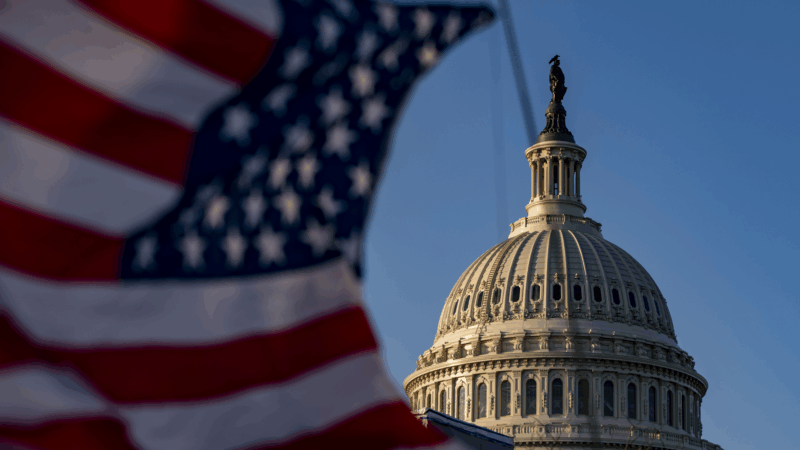
Americans from across the political spectrum say the U.S. should be the moral leader of the world, but far fewer believe that it actually is today than previously, according to a new NPR/Ipsos poll.
In the nationwide survey, 61% of respondents said that the U.S. should be a moral leader, but only 39% say it actually is one. That latter figure is sharply down from 60% in 2017 in a similar survey of American attitudes.
Loading…
The latest survey also shows that nearly half the country prefers Washington to stay out of the affairs of other countries.
Loading…
The polling was conducted in December, before the Jan. 3 U.S. military operation in Venezuela and the capture of its president, Nicolás Maduro. A separate poll that Ipsos conducted with the Reuters news agency on that issue suggests public opinion is roughly split into three equal parts: one-third approving, a third unsure and a third disapproving.
Providing a bigger picture of Americans’ foreign policy perspectives, the NPR/Ipsos poll suggests that 46% of Americans want U.S. policy to focus on “enriching America and Americans,” while 32% prioritize promoting democracy and human rights in other countries — with the democracy viewpoint dropping from 42% in 2017.
Loading…
The latest NPR/Ipsos survey polled a nationally representative sample of 1,021 Americans ahead of the end of President Trump’s first year in office in his second term. It is a sequel to a similar survey conducted in 2017. The margin of error is plus or minus 3.3 percentage points for all respondents.
U.S. losing influence, China gaining it

The results also offer a window into Americans’ perception of their country’s relative strength and, overall, its global leadership.
Americans overwhelmingly see the U.S. as the world’s top military power (64%) and the “superpower” in the world today. Half the people in the latest survey (50%) think the U.S. has been losing influence on the global stage in the last five years, although Republicans disagree sharply with Democrats and independents on this question.
By contrast, 57% of the respondents said China has been gaining influence.
Loading…
This view is broadly similar among Americans from across the political spectrum, with 40% of Americans agreeing that China is the leader in technology development, whereas only 23% of them think the U.S. is.
Trump’s first year in his second term has been marked by strains with conventional partners and alliances such as NATO, the imposition of massive tariffs on almost all trading partners, and military forays and campaigns in Iran, Syria, Yemen and Venezuela.
His unique way of governance comes at a time when views of America’s moral leadership around the world are highly polarized, says Mallory Newall, Ipsos’ vice president of public affairs, whose team conducted the poll.
“Americans overwhelmingly believe that the U.S. should be the world’s moral leader,” Newall says. “However, the current assessment is less rosy. Just 2 in 5 believe the U.S. is actually fulfilling this role, which represents serious erosion from 2017. What’s more, there is significant partisan division here. Democrats have grown much more pessimistic about the standing of the U.S. on the world stage, while Republicans still see America as a moral leader.”
Partisan split on U.S. priorities and Ukraine aid

The survey also suggests partisan splits on major foreign policy issues, particularly when it comes to the priorities of America’s foreign policy. Sixty-seven percent of Republicans — and 45% of independents — think American foreign policy should focus on enriching America and its citizens, while only 29% of Democrats polled believe so.
Instead, the majority (52%) of Democrats say the U.S. should prioritize promoting democracy and human rights in other countries, while that appetite is much lower among the Republicans (16% polled).
On Ukraine, 60% of Democrats and 43% of independents say the U.S. is not giving Kyiv enough support, while 31% of Republicans say it is giving too much. And 62% of Democrats believe the U.S. is giving Russia too much support, while 32% of Republicans say the U.S. is doing so.
Uncertainty dominates Americans’ views on defending Taiwan
How Washington should be involved in foreign conflicts continues to remain a deeply divided issue.
In the latest survey, 36% of Americans believe the U.S. would have a responsibility to defend Taiwan, including sending troops, should China use military force to take the self-governing island. But perhaps most tellingly, 41% say they don’t know whether the U.S. should defend Taiwan militarily if China uses force — the single largest response category.
Bill would move Alabama to closed primaries
Right now, any Alabama voter can participate in a primary election. Lawmakers in Montgomery took up a bill this week that would change that system.
4 confirmed dead after U.S. military aircraft goes down in Iraq
The U.S. Central Command confirmed that at least four of six crew members on the KC-135 aircraft were dead, after the refueling plane went down in western Iraq on Thursday.

It’s Chalamet vs. ballet in this week’s news quiz. Are your answers en pointe?
Meanwhile, if you've been paying attention to medicine, basketball and the British Parliament, you'll get at least three questions right this week.

Bucking stigma, more places turn to factory-built for affordable housing
Mobile homes have long been zoned out of cities and suburbs. But with updated designs and a housing shortage, they're increasingly being welcomed as more-affordable starter homes.
Trump wants more apprenticeships. An Arkansas manufacturer is giving it a try
President Trump has touted apprenticeships as part of his promise of a golden era for American workers. But are his administration's investments enough?
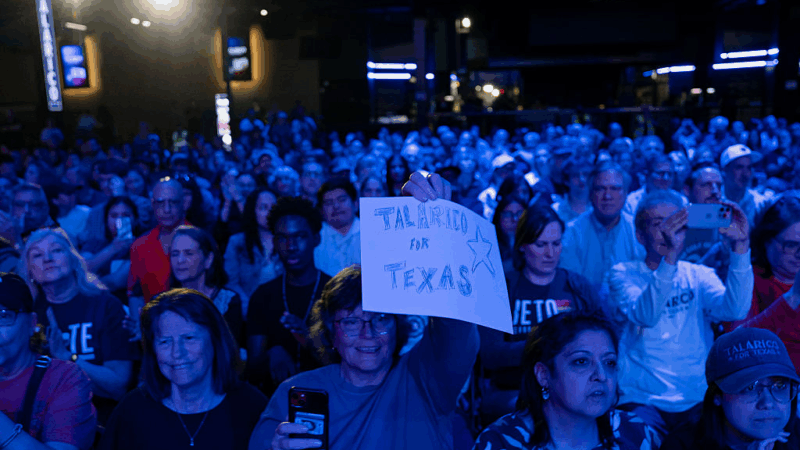
Democrats set a turnout record in Texas, so is this the year it turns blue?
Latinos helped Texas Democrats set the new record for a primary, but the state has been a white whale for the party for decades.
