
Longtime civil rights leader Rev. Jesse Jackson dies at 84
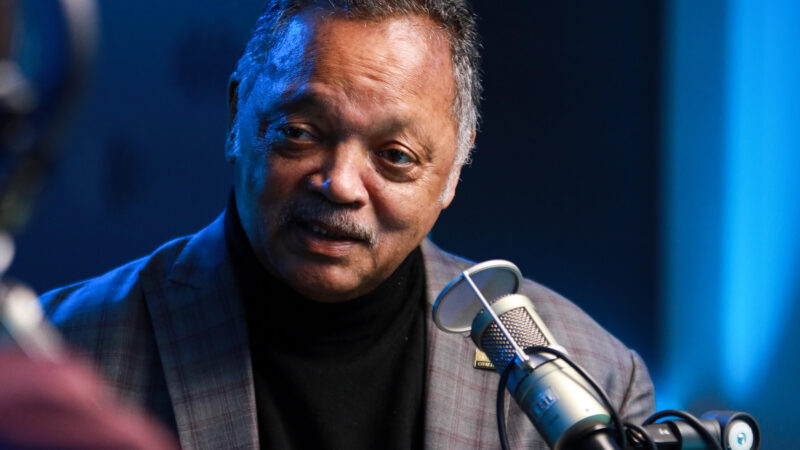
The Rev. Jesse Jackson, an American civil rights leader, minister, and politician, who was a protégé of Martin Luther King Jr. and in the 1980s reshaped Democratic politics with two galvanizing presidential campaigns, died Tuesday at the age of 84.
“Our father was a servant leader — not only to our family, but to the oppressed, the voiceless, and the overlooked around the world,” the Jackson family said in a statement. “We shared him with the world, and in return, the world became part of our extended family.”
According to the Jackson family, public commemorations will take place in Chicago.
Jackson was born Oct. 8, 1941, in a tiny house in Greenville, S.C., where he began his lifelong work fighting for civil rights.
While visiting home for Christmas break during his freshman year at University of Illinois, Jackson needed to borrow a book but couldn’t get it from the town’s white-only library. Six months later, on July 16, 1960, he and seven other students held a sit-in at the library and were arrested for protesting. After his experience as a member of the “Greenville Eight,” Jackson transferred to North Carolina Agricultural & Technical College, a historically Black school in Greensboro, N.C.
His burgeoning activism would bring him in 1965 to march alongside Martin Luther King, Jr. and others in Selma, Ala., answering King’s call for supporters of a local voting rights campaign. Jackson became a close ally of King — eventually leaving his graduate studies at the Chicago Theological Seminary to join King’s Southern Christian Leadership Conference. He became the Chicago coordinator and a year later, in 1967, the national leader of the SCLC’s Operation Breadbasket, which was dedicated to improving the economic conditions of Black communities in the U.S.
In April 1968, Jackson traveled with King to Memphis, Tenn., where he witnessed the civil rights leader’s assassination.

King’s death marked the beginning of the end for Jackson’s association with the SCLC. By 1971, he split with the group and formed his own organization called Operation PUSH. The group continued Jackson’s work to increase Black Americans’ political strength and political opportunities.
Jackson later merged Operation PUSH with his National Rainbow Coalition to form the Rainbow PUSH Coalition, which became a prominent civil rights organization.
Throughout the 1970s and 1980s, Jackson, who became an ordained Baptist minister in 1968, increasingly became an influential player on the national stage.
In 1983, Jackson organized a voter registration drive in Chicago that is credited as being the key factor for the election of the city’s first Black mayor, Harold Washington.
Presidential bids
In November 1983, he announced his first bid for president — becoming the second Black person to seek a major party’s nomination after Congresswoman Shirley Chisholm in 1972. His rousing speech at the 1984 Democratic Convention in San Francisco appealed to a “Rainbow Coalition” of disenfranchised Americans and people of color.
“This is not a perfect party. We’re not a perfect people,” Jackson said. “Yet, we are called to a perfect mission. Our mission to feed the hungry, to clothe the naked, to house the homeless, to teach the illiterate, to provide jobs for the jobless, and to choose the human race over the nuclear race.”
Though Jackson had significant support for his bid, with his campaign registering more than a million new voters and winning 3.5 million votes, his run for president was not without controversy. Jackson drew heated criticism for making a disparaging remark about New York’s Jewish community and for his relationship with Nation of Islam leader Louis Farrakhan, who has said the Jewish community is to blame for Black oppression.
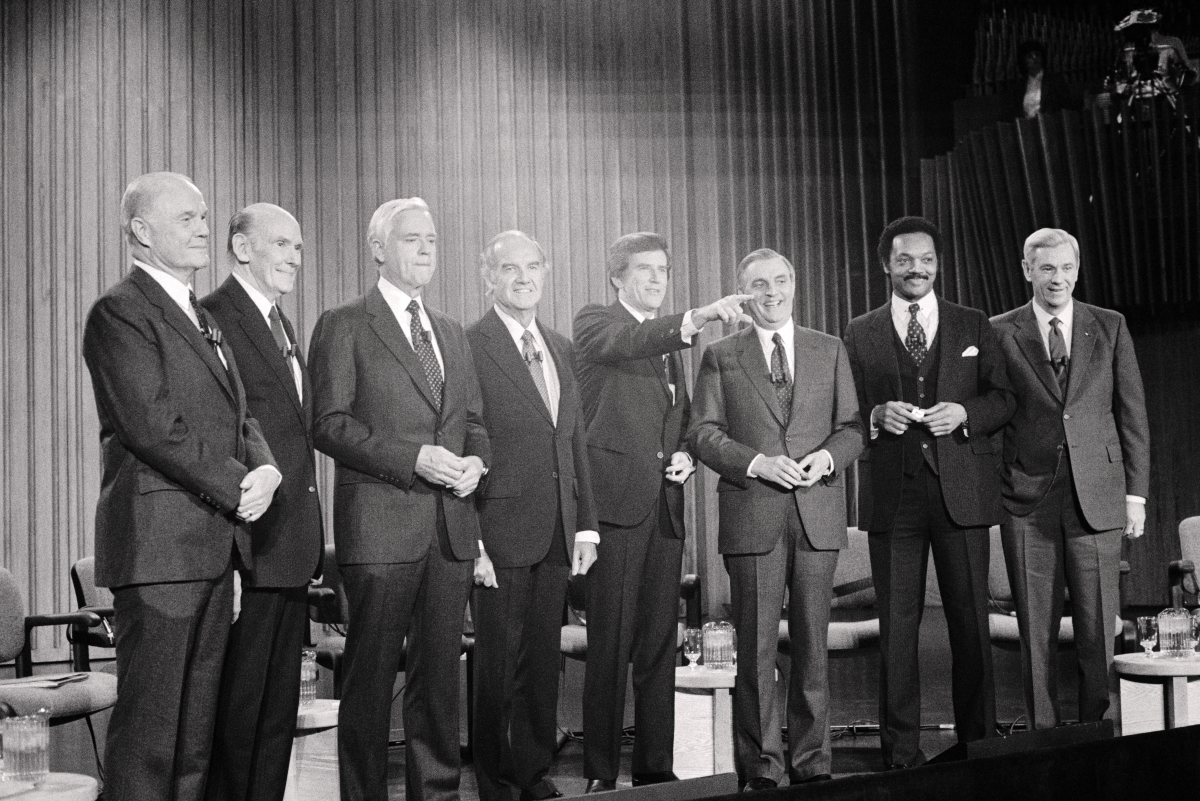
Jackson would apologize for his comments and distance himself from Farrakhan, but those efforts were not enough to clinch the Democratic nomination. He placed third in the Democratic primary behind former Vice President Walter Mondale and Sen. Gary Hart. Still, it was a landmark achievement for Jackson and a growing Black political movement.
In 1988, he ran again, expanding his outreach to more White Americans, and reached an emotional crescendo during an impassioned speech at that year’s Democratic convention. Although Jackson won major presidential primaries, the first African-American to do so, he came in second to the Democratic Party nominee Massachusetts Gov. Michael Dukakis. Until Barack Obama’s election in 2008, Jackson was the most successful Black U.S. presidential candidate.
Though Jackson never ran for the presidency again he remained a powerful player in the Democratic Party, pushing for the leaders to adopt a platform that recognized issues important to Black voters.
Later life
Jackson traveled around the globe throughout his life using his voice to expose international problems and highlight civil rights abuses. In several instances, he negotiated and secured the release of American hostages held captive abroad — most notably from Syria, Cuba and Serbia. From 1992 to 2000 he also hosted a weekly discussion show on CNN, “Both Sides with Jesse Jackson,” where he addressed current social and political issues.
In 2000, Jackson received the Presidential Medal of Freedom, the highest honor a civilian in the U.S. can receive. But controversy was not far behind. A year later, news that Jackson fathered a daughter with a former member of his staff became public.

When the scandal broke he said, “This is no time for evasions, denials or alibis. I fully accept responsibility and I am truly sorry for my actions.”
Jackson found himself apologizing again in 2008, this time to Obama, for crass remarks he made about the presidential candidate in an aside to a reporter on a Fox News program. Obama accepted the apology. And despite other comments critical of the tone of some of Obama’s campaign speeches, Jackson was present at his victory party at Grant Park in Chicago and wept.
“I knew that people in the villages of Kenya and Haiti, and mansions and palaces in Europe and China, were all watching this young African-American male assume the leadership to take our nation out of a pit to a higher place,” Jackson told NPR after Obama’s election night.
Jackson saw the rise and painful fall of the promising political career of his oldest son, Jesse Jackson, Jr., who was elected to Congress from Illinois in 1995 and resigned in 2012 citing health issues. After leaving office, he was investigated for misuse of campaign funds and pleaded guilty in 2013 to spending $750,000 in campaign funds for personal use. He was sentenced to 30 months in prison.
“I speak really today as a father,” Jackson, Sr. said at the courthouse the day of the sentencing. “Most of my career has been spent outgoing – helping someone else on something I really understood socially and politically. But this one, of course, is home.”
In 2017, Jackson announced he had Parkinson’s disease, a degenerative disorder that affects movement. In November, his organization revealed Jackson was diagnosed in April with progressive supranuclear palsy, a rare neurological disease similar but different from Parkinson’s disease. Despite his illness, Jackson often showed up at protests against police brutality, calling for justice for victims of police shootings.
In August 2020, Jackson spoke at a news conference in Kenosha, Wisc., where police shot Jacob Blake, a Black man, several times.
“Today, there’s a moral desert, top-down. The acid rain is coming, top-down,” he said. “That kind of moral desert hurts all of America.”

He compared the demonstrations that summer to those that occurred during the Civil Rights Era, comments that echoed earlier remarks he made to NPR that June about the nationwide protests that erupted after another Black man, George Floyd, was murdered by a white police officer in Minneapolis.
The marches were “hopeful signs,” Jackson said. “The marchers are full of hope. They believe something can happen. On the move, we’re not going backwards.”
In 2021, Jackson contracted COVID-19. He was hospitalized and spent several weeks in a rehabilitation facility. He stepped down as president of Rainbow Push Coalition in 2023.
On Nov. 12, the coalition announced Jackson was hospitalized for PSP, which affects body movements, balance, vision, speech and swallowing.
Jackson is survived by his wife, Jacqueline, and six children.

NASA targets Artemis II crewed moon mission for April 1 launch
A six-day launch window opens on April 1 from NASA's Kennedy Space Center in Florida. The lunar orbital mission would be the first time humans have returned to the moon since Apollo 17 in 1972.

Auburn football player uses NIL funds to open a community hub in Birmingham
Jourdin Crawford, a freshman defensive lineman at Auburn, used earnings from a Name, Image, and Likeness deal to give back to his hometown.

Fear of Iranian mines in the Strait of Hormuz could further slow the flow of oil
Attacks by Iran have already nearly halted the flow of oil through the vital waterway as commercial ship crews fear being hit by missiles, drones or mines.
Bruno Mars adds yet another milestone to his career with ‘The Romantic’
Bruno Mars is the most-listened to artist in the world on Spotify. He's won 16 Grammys. In case you thought there were no battles left for him to win, this week he unlocked another achievement.

There’s more than one path to a confessional song
On new albums by viral sensation Yebba and studio whiz Pimmie, it's clear modern R&B has been clearing space for vastly different stripes of singer-songwriter.

Suspect in attack at Michigan synagogue is dead, officials say
Security officers at Temple Israel had "engaged the threat" that apparently started with a vehicle ramming into the building, according to Oakland County Sheriff Mike Bouchard.
