
Lawyer in SCOTUS case against Trump’s tariffs says his clients want a refund
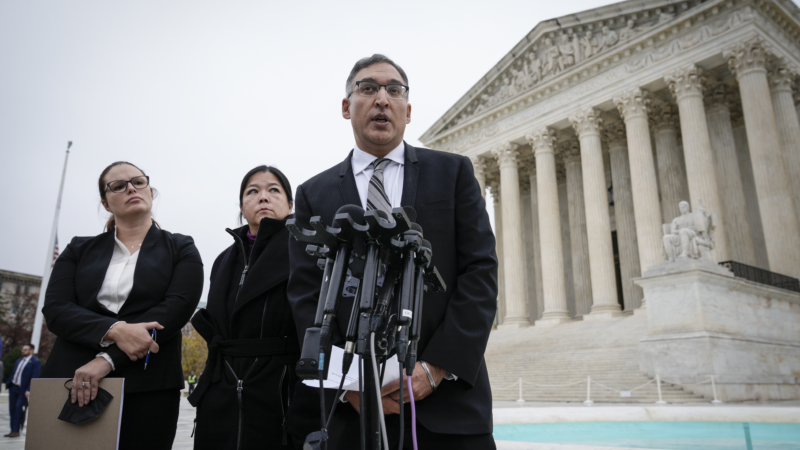
Neal Katyal, one of the attorneys who argued on behalf of plaintiffs in the U.S. Supreme Court case against Trump’s tariffs, told Morning Edition that his clients want a refund from the federal government.
“There’s a pretty commonsense principle, which is if you’ve collected a bunch of money illegally and the court says it’s illegal, then you’ve got to give it back,” Katyal said. “It’s not a finders keepers rule in this country. We have a system of justice.”
Last week, the Supreme Court struck down President Trump’s sweeping use of emergency powers to impose tariffs under the International Emergency Economic Powers Act (IEEPA). The 6-3 ruling is a major setback for the president’s economic policy agenda. The next day, Trump announced in a social media post that he would raise global tariffs from 10% to 15% under a different law. While discussing the ruling with NPR’s Steve Inkseep, Katyal, who represented U.S. businesses that objected to the tariffs, said that under the U.S. Constitution “it is up to Congress to set the tariffs and not the president acting on his own.”
Click the play button in the blue box above to listen to the full conversation.
Transcript:
STEVE INSKEEP, HOST:
One of the lawyers who argued the tariff case before the Supreme Court is Neal Katyal. He represented businesses that objected to the tariffs as beyond the president’s authority. Welcome to the program.
NEAL KATYAL: Thank you. Big fan of the program, so thanks for having me on.
INSKEEP: Do your clients want a refund?
KATYAL: Of course. And indeed, the federal government and the Trump administration have already agreed that they would give our clients that refund. They’ve said to the court in a filing that we would get the refund and interest on that. So that’s already decided as far as our clients.
INSKEEP: As far as your clients. Do you think that is likely to apply to the rest of the country?
KATYAL: I do. I think basically there’s a pretty common-sense principle, which is if, you know, you’ve collected a bunch of money illegally and the court says it’s illegal, then you got to give it back. You can’t just, you know, it’s not a finders-keepers rule in this country. We have a system of justice. And here the Supreme Court has unequivocally said that these tariffs were unconstitutional and illegal and void. So I think the federal government has no choice but to give that money back.
INSKEEP: Although the court did not explicitly order that or set up a mechanism for that to happen, right?
KATYAL: Oh, no, but we didn’t ask for that. We were very clear. We asked for basically six things in the case. The Supreme Court agreed with every single one, 100%. The refunds, you know, do follow as a matter of course, we think, and the Supreme Court didn’t get into it because there’s a congressional statute that authorizes refunds already. And, you know, I sure hope that the federal government doesn’t try and play games with this money because this is the money of the American people.
INSKEEP: I want to acknowledge that multiple justices wrote opinions in this case, some of which differ, but some do seem to intend a larger message here, even beyond the gravity of this case, about the president and Congress. What is that message as you see it?
KATYAL: Yeah. I think it’s the same message from my very first Supreme Court case, which was about Guantanamo and the military tribunals there. And there, I said, look, I don’t know if we need to have these military tribunals or not, but the one thing I’m sure of is that you can’t just set up this zone at Guantanamo without the approval of Congress. And the Supreme Court agreed with us in that case back in 2006.
And similarly, here, the argument was the same. It was, maybe these tariffs are a good idea, maybe they’re a bad idea. People can differ on that. But under our Constitution, it is up to Congress to set the tariffs and not the president acting on his own. And so I think that message, it’s so central to the rule of law. And I think, you know, one of the most interesting things about the case is that in a lot of these high-profile cases you think they’re going to be 5-4 decisions.
But this was actually 6-3 with two of Donald Trump’s own appointees. He appointed three people to the court, two of them, Amy Coney Barrett and Justice Gorsuch, ruling against President Trump.
INSKEEP: I want to ask about Justice Gorsuch that you just mentioned. Neil Gorsuch wrote this opinion that concluded with a passage about Congress. This is effectively a ruling in the favor of the power of Congress, and he seemed to be saying, if I can paraphrase, come on, guys. Do your job, make an effort. You can govern here.
KATYAL: I think every American should read those last lines from Justice Gorsuch. It was exactly our litigation strategy throughout, and Justice Gorsuch totally picked up on that, picked up on the long, long tradition going all the way back to the federalist papers of why our founders divided power and why they insisted that Congress be in the driver’s seat. So it was, I think, his finest moment on the court and the finest moment of the court in a long time because it is really vindicating that founding vision.
I think what I take from this, and, you know, I had supported his confirmation and got a lot of criticism, particularly from the political left, who said he was just going to be a Donald Trump lackey. Sometimes he’s going to be against the president, including the president that nominated him, as we saw in this case.
INSKEEP: The president has responded to this ruling by raising tariffs on Friday and again on Saturday, relying on a different law. What do you think of those moves?
KATYAL: Well, he’s certainly entitled to try, but the problem is his own Justice Department filed briefs in our case saying that this law that he’s relying on, Section 122 of the 1974 Trade Act, doesn’t allow him to do this. So he’s got to somehow walk away from that position. And I think this just underscores the fundamental problem with the president’s treatment of tariffs. If he thinks these tariffs are so important, if he wants 15% or 20% or 145% as he’s wanted, go to Congress, make the case.
That’s the American way. That’s what our Constitution demands. And notably, that’s what President Trump did in his first term. He went to Congress. He tried to seek the power to tariff. Congress said no. And so now he’s doing all these unilateral games instead of doing what the Constitution requires. And if he’s so sure the economy is going to die and America’s going to become a third world country without the tariffs, then just go to Congress and make that case.
I mean, Congress isn’t exactly a bunch of left-wing radicals, so they’re governed both houses by members of his party.
INSKEEP: So if you feel that the new tariffs the president has imposed in the last few days are also illegal – they would seem to affect your clients since they affect everybody – might your clients sue again?
KATYAL: We very well may.
INSKEEP: Neal Katyal, thanks so much.
KATYAL: Thank you so much.
INSKEEP: He’s the lead attorney for five American businesses who successfully challenged President Trump’s tariffs before the Supreme Court.
The FDA creates a quicker path for gene therapies
The Food and Drug Administration aims to evaluate treatments for rare diseases based on plausible evidence that they would work — without requiring a clinical trial first.

BAFTAs apologize after guest with Tourette syndrome uses racial slur during ceremony
A man with Tourette syndrome shouted a racial slur and other offensive remarks during the BAFTA awards ceremony Sunday. The BBC did not edit out his outbursts in its delayed broadcast.

‘Everything was in pieces:’ Lindsey Vonn describes grueling surgery on broken leg
In a recent video, the Olympic skier credits her surgeon with saving her leg from potential amputation.

A new lawsuit alleges DHS illegally tracked and intimidated observers
Observers watching federal immigration enforcement in Maine who were told by agents they were "domestic terrorists" and would be added to a "database" or "watchlist" are now part of a new federal class action lawsuit.

Kate Hudson on regret, rom-coms and finding a role that hits all the notes
Hudson always wanted to sing, but feared it would derail her acting career. Now she's up for an Oscar for her portrayal of a hairdresser who performs in a Neil Diamond tribute band in Song Sung Blue.

A powerful winter storm is roiling travel across the northeastern U.S.
Forecasters called travel conditions "extremely treacherous" and "nearly impossible" in areas hit hardest by the storm, and air and train traffic is at a standstill in many parts of the region.
