
Joan Didion leaves one more piece of writing to faithful fans
In November 1999, writer Joan Didion started seeing Roger MacKinnon, a New York psychiatrist, on the recommendation of the psychiatrist who was treating her daughter Quintana for borderline personality disorder, depression, and alcoholism. Both doctors felt that the mother-daughter dynamic and powerful co-dependency were central to Quintana’s problems.
After six appointments with Dr. MacKinnon, Didion began writing detailed reports of her sessions, which she addressed to her husband, John Gregory Dunne. These notes, which span just over two years, were found in a portable filing cabinet in her home office after her death in December 2021.
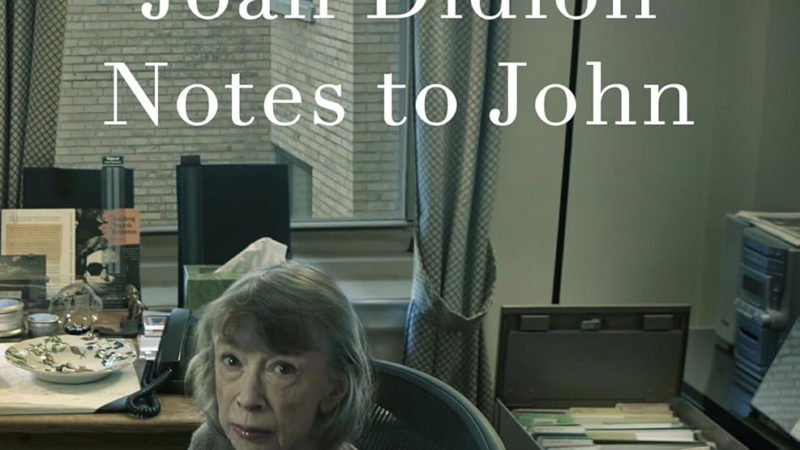
Published as Notes to John — and adorned by Annie Leibovitz’s striking jacket photograph of Didion, frail but tenacious, at her desk with the rolling filing cabinet behind her — the book is an intimate chronicle of the author’s struggle to help her daughter, even if it meant digging into her own long-unexamined neuroses. Written with her signature precision though without her usual stylistic, incantatory repetitions, it is the least guarded of Didion’s writing.
While the decision to publish Notes to John — made by Didion’s heirs, her brother’s children — raises questions about privacy and milking the seemingly endless appetite for anything Didion-related, there are plenty of arguments in favor of doing so.
For starters: Surely if Didion, a fiercely controlled writer of sound mind, had felt strongly about destroying or restricting access to these pages, she would have. One assumes she would have been more guarded were Quintana still alive. But her daughter, husband, parents, brother, and even her psychiatrist all predeceased her by many years. If she had known these notes were headed for publication, she might have wanted to edit or polish them — though their power lies partly in their rawness.
As it stands, Notes to John offers readers a key to Didion’s persona and her work. It’s not a stretch to trace the genesis of The Year of Magical Thinking and Blue Nights her soul-searching memoirs about the grievous losses of her husband and her daughter, respectively, and the crippling sense of her own vulnerability — to her sessions with Dr. MacKinnon. Also, not to be minimized, this journal of therapy, which captures Didion’s despair over Quintana’s alcoholism, may offer insights to other parents grappling with their own children’s substance abuse.
MacKinnon, who collaborates with Quintana’s psychiatrist, comes across as a superb therapist as he deftly leads Didion to recognize how her lifetime habit of setting aside her worries by turning to work was “an extremely effective anti-anxiety agent,” but closed her off to others, including her daughter.
Their sessions address Didion’s childhood with a depressed father, her tendency to catastrophize, her overprotective yet remote parenting, and her denial regarding aging and mortality. But when Dr. MacKinnon suggests that Didion felt guilt over focusing on her work, she pushes back forcefully: “I never ever felt guilty about working.”
He pushes her, too. He repeatedly suggests how her extreme closeness with Dunne might make a sensitive, adopted child like Quintana feel like a third wheel, and how Didion’s matchstick frailty led Quintana to feel from a young age that she needed to protect and take care of her mother.
Didion quotes Dr. MacKinnon’s astute comment: “Everything about your emotional tone seems fragile. But you’re not. You’re really extremely strong.” He advises her to let Quintana know this — and to give her 34-year-old daughter room to make her own mistakes: “You can only love her. You can’t save her.”
In March 2000, further addressing Quintana’s worries about her mother’s ability to cope on her own, Dr. MacKinnon asks with eerie prescience: “You’re obviously very close to your husband, but what would happen to you if something happened to him?”
Of course, Didion answers that question in The Year of Magical Thinking, written not quite four years later, after Dunne died of heart failure in December 2003. This was shortly after their return from visiting Quintana in a nearby ICU, where she was in a coma battling sepsis. Magical Thinking is in part a chronicle of Didion’s harrowing first year of widowhood as Quintana succumbed to a cascade of dire illnesses that eventually led to her death in August 2005.
Notes to John raises plenty of questions. Did husband and wife discuss each weekly session based on her notes? Did his responses feed into her responses to Dr. MacKinnon? Didion was an accomplished journalist, but how accurate are her summaries and quotes from Dr. MacKinnon? What did she leave out?
Didion’s last “note” was about a session in January 2002, though she continued to see Dr. MacKinnon for another 10 years. One can’t help but wonder about their conversation about her daughter’s wedding in August 2003. This was just six months after Didion’s disheartening meeting with an inebriated, insolent Quintana and her exasperated psychiatrist, the report of which, included in this book, was found in Didion’s computer.
Rereading Magical Thinking and Blue Nights in tandem with Notes to John, one is struck by how much Didion channeled from her therapy into these books. As a trilogy, the three volumes underscore what Didion demonstrated repeatedly throughout her remarkable career: While she loved what she called the rituals of marriage, motherhood, and domestic life, she was always a writer first and foremost. Writing was how she processed everything.
Heller McAlpin has been reviewing books for NPR since 2009.

U.S-Israeli strikes continue across Iran, Iranian drones hit Azerbaijan
The U.S. and Israel said they conducted new strikes inside Iran overnight, targeting ballistic missile launchers. Iran claimed it struck a U.S. oil tanker in the northern Persian Gulf.
In lawsuit, Minnesota accuses Trump administration of ‘weaponizing’ Medicaid funding
The federal government said the state should do more to fight fraud and is holding back funds. Minnesota officials say the attack is unfair as the state's fraud rate is well below national averages.

Wall Street is betting on tariff refunds after Supreme Court ruling
When the Supreme Court struck down many of President Trump's tariffs, it left importers wondering how long they'd have to wait to get their money back. Hedge funds are offering to help out.

Announcing the 2025 NPR College Podcast Challenge Honorable Mentions
Here are some of the best entries in NPR's 2025 College Podcast Challenge.

A run for their money: Young candidates rival older incumbents in midterm fundraising
As a growing crop of young candidates challenge longtime Democratic incumbents, some are not just breaking through in the money race, but outraising their opponents altogether.

When ICE came, Minneapolis created underground health networks. Should other cities?
The Trump administration's immigration crackdown in Minneapolis forced some families into hiding and catalyzed informal medical networks to deliver critical health care services inside homes.
