
Israel strikes in Damascus as Syrian forces clash with Druze groups

DAMASCUS, Syria — Clashes raged in the southern Syrian city of Sweida on Wednesday after a ceasefire between government forces and Druze armed groups collapsed and as Israel threatened to escalate its involvement, saying it’s in support of the Druze religious minority.
Meanwhile, the Israeli army said that it struck near the entrance to the Syrian Ministry of Defense in Damascus. Israel has launched a series of airstrikes on convoys of government forces in southern Syria since the clashes erupted and has beefed up forces on the border, saying that it is acting to protect the Druze.
Syria’s Defense Ministry had earlier blamed militias in Sweida for violating a ceasefire agreement that had been reached Tuesday, causing Syrian army soldiers to return fire and continue military operations in the Druze-majority province.
“Military forces continue to respond to the source of fire inside the city of Sweida, while adhering to rules of engagement to protect residents, prevent harm, and ensure the safe return of those who left the city back to their homes,” the statement said.
A rebel offensive led by Islamist insurgent groups ousted Syria’s longtime despotic leader, Bashar Assad, in December, bringing an end to a nearly 14-year civil war. Since then, the country’s new rulers have struggled to consolidate control over the territory.
The primarily Sunni Muslim leaders have faced suspicion from religious and ethnic minorities. The fears of minorities increased after clashes between government forces and pro-Assad armed groups in March spiraled into sectarian revenge attacks in which hundreds of civilians from the Alawite religious minority, to which Assad belongs, were killed.
Reports of killings and looting in Druze areas
The latest escalation in Syria began with tit-for-tat kidnappings and attacks between local Sunni Bedouin tribes and Druze armed factions in the southern province, a center of the Druze community.
Government forces that intervened to restore order have also clashed with the Druze, while reports have surfaced of members of the security forces carrying out extrajudicial killings, looting and burning civilian homes.
No official casualty figures have been released since Monday, when the Syrian Interior Ministry said 30 people had been killed. The U.K.-based war monitor Syrian Observatory for Human Rights said more than 250 people had been killed as of Wednesday morning, including four children, five women and 138 soldiers and security forces.
The observatory said at least 21 people were killed in “field executions.”
The Druze religious sect began as a 10th-century offshoot of Ismailism, a branch of Shiite Islam. More than half the roughly 1 million Druze worldwide live in Syria. Most of the other Druze live in Lebanon and Israel, including in the Golan Heights, which Israel captured from Syria in the 1967 Mideast War and annexed in 1981.
Israel threatens to scale up its intervention
In Israel, the Druze are seen as a loyal minority and often serve in the military. In Syria, the Druze have been divided over how to deal with the country’s new leaders, with some advocating for integrating into the new system while others have remained suspicious of the authorities in Damascus and pushed for an autonomous Druze region.
On Wednesday, Israeli Defense Minister Israel Katz said in a statement that the Israeli army “will continue to attack regime forces until they withdraw from the area — and will also soon raise the bar of responses against the regime if the message is not understood.”
Prime Minister Benjamin Netanyahu said in a statement Tuesday night that Israel has “a commitment to preserve the southwestern region of Syria as a demilitarized area on Israel’s border” and has “an obligation to safeguard the Druze locals.”
Israel has taken an aggressive stance toward Syria’s new leaders since Assad’s fall, saying it doesn’t want Islamist militants near its borders. Israeli forces have seized a U.N.-patrolled buffer zone on Syrian territory along the border with the Golan Heights and launched hundreds of airstrikes on military sites in Syria.
Some Middle East flights resume, but thousands of travelers are still stranded by war
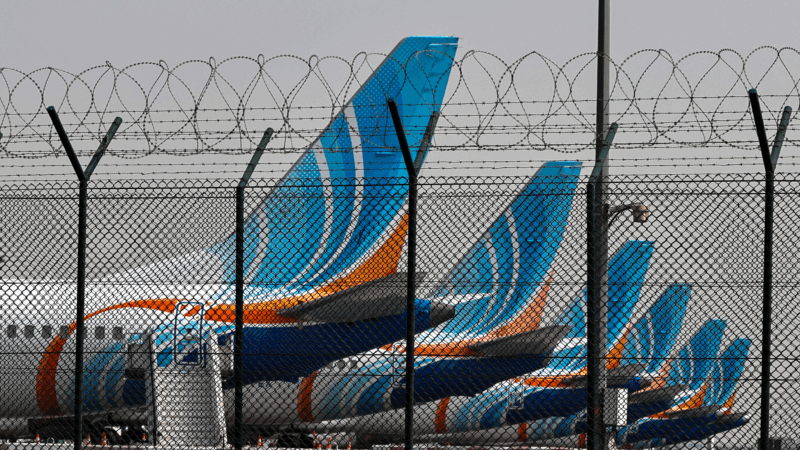
Limited flights out of the Middle East resumed on Monday. But hundreds of thousands of travelers are still stranded in the region after attacks on Iran by the U.S. and Israel.

‘Hamnet’ star Jessie Buckley looks for the ‘shadowy bits’ of her characters
Buckley has been nominated for a best actress Oscar for her portrayal of William Shakespeare's wife in Hamnet. The film "brought me into this next chapter of my life as a mother," Buckley says.

How, who, and why: NPR flips its famous letters to defend the right to be curious
NPR is standing up for the public's right to ask hard questions in a national campaign dubbed "For your right to be curious." At NPR's headquarters, on billboards in New York City, Chicago, and Washington, D.C., and across social media, NPR's three iconic letters transform into "how," "who," and "why" — a bold declaration of its commitment to fight for Americans' right to ask questions both big and small.

Hegseth: ‘We didn’t start this war but under President Trump we’re finishing it’
The remarks are the first to reporters since the U.S.-Israeli military operations against Iran began Saturday despite weeks of talks designed to stave off a conflict.

Ivermectin is making a post-pandemic comeback, among cancer patients
The anti-parasitic drug became a household name during the COVID-19 pandemic, and it is now being embraced as an alternative treatment for cancer. It is as politically polarizing as ever.
Rep. Adam Smith on the U.S. strikes on Iran and the debate over Trump’s war powers
NPR's Leila Fadel asks Democratic Rep. Adam Smith of Washington, the ranking member on the House Armed Services Committee, about President Trump's unilateral authorization to strike Iran.
