
Israel says it has begun a pull-back of troops in Gaza
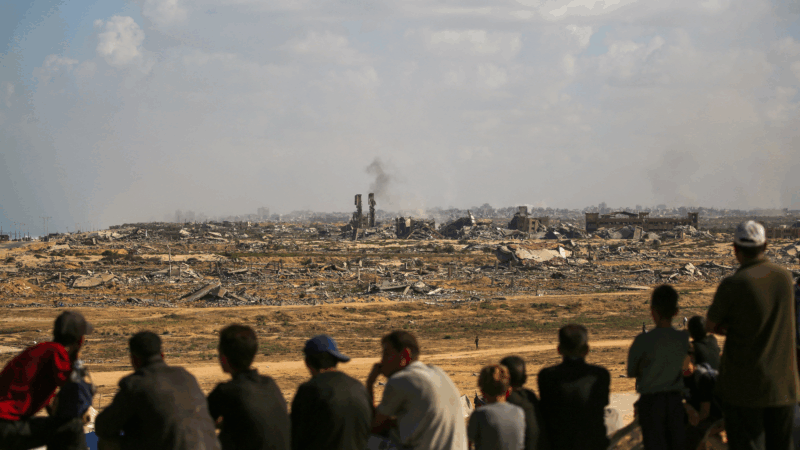
Israeli forces have begun a pull-back of troops from Gaza Friday after Israel’s cabinet approved a plan for a ceasefire aimed at ending the devastating two-year-old war.
Israeli prime minister Benjamin Netanyahu’s office said in a brief statement early Friday that the cabinet had approved the “outline” of a deal to release the hostages – a key part of the initial agreement.
“The government has now approved the framework for the release of all the hostages – both the living and the deceased,” the statement read. It did not detail other more contentious parts of the pact hammered out Wednesday.
Hamas is believed to hold 20 living hostages and the bodies of another 26 while the fate of two more is unknown. The handover of the living hostages is expected to begin Monday.
Israel has pledged to release about 250 Palestinian prisoners and detainees, including women and children and about 1,700 Palestinians detained in Gaza since the war began, according to Hamas officials.
Many have been held without charge. Most of the prisoners held in Israel are expected to be deported and not allowed to return home to the Israeli-occupied West Bank.
Israeli forces began pulling back from the coastal highway into Gaza city overnight after the cabinet approval of the ceasefire, which requires troops to retreat to a buffer zone.
The official Israeli gazette of cabinet decisions said the ceasefire began upon cabinet approval of the agreement overnight Friday.
Palestinian residents have been massing near Gaza city hoping to return to their damaged and destroyed homes.
“I feel reborn,” says Mohammad Rajab, 33, who said the Israeli army was so far preventing people from returning. “Despite all the sadness and the huge destruction we are looking ahead and thinking about how we will build our lives, our future, our children’s future, and rebuild everything that was destroyed and move away from war.”
“Israel has no goals to achieve nor do the Palestinians have anything more to lose,” he said.
In the southern Gaza strip, tank shelling was heard and smoke seen rising in Khan Younis Friday morning, according to residents. It was not clear whether any attacks fell within the bounds of the ceasefire agreement on the Israeli pullback.
The war, sparked two years ago by Hamas’s Oct. 7 attack on Israel, has killed at least 67,000 Palestinians, many of them women and children, in Israeli attacks.
About 1,200 Israelis and foreigners were killed in the Oct 7 attack.
A U.N. independent commission determined last month that Israel has committed genocide in Gaza. Israel rejects that characterization.
The war also sparked dramatic power shifts in the region, including weakening Iran-backed Hezbollah in Lebanon and helping to result in the overthrow of Syrian dictator Bashar al-Assad.
It also deepened Israel’s international isolation, and made Israel and President Trump’s goal of more Arab countries normalizing relations with the Jewish state less attainable.
The ceasefire announced Wednesday still leaves questions over who will govern Gaza, reconstruction of the devastated Palestinian territory and whether Hamas would keep its weapons.
Two senior U.S. officials who briefed reporters on condition of anonymity said the U.S. would contribute about 200 troops as part of a multi-national effort to help support and monitor the ceasefire deal. They said the U.S. Central Command would establish a civil-military coordination center that would also be involved in movement of humanitarian aid.
The U.S. would coordinate with Israel forces and no American troops would be sent into Gaza.
Other countries contributing troops are expected to include Egypt, Qatar, Turkey and the United Arab Emirates.
President Trump is expected to travel to the region this weekend. The Israeli Knesset has formally invited him to address the assembly – the first such address by a U.S. president since 2008.
A key part of the ceasefire deal would allow food and medicine to flow into Gaza. International experts this year declared famine in the Palestinian enclave as a result of Israeli restrictions on aid.
Other countries expressed their support for the ceasefire and willingness to help.
The European Union’s top diplomat, Kaja Kallas said an EU humanitarian team is ready at Egypt’s now-closed Rafah border crossing with Gaza to help facilitate aid movement. He said the EU assistance mission to the Palestinian Authority police in the West Bank could also support a “stabilization force” in Gaza.
Anas Baba contributed reporting from Gaza.
Pentagon tightens controls over Stars and Stripes after calling it “woke”
The new rules for the independent military newspaper are the Defense Department's latest effort to put extraordinary restrictions on journalists covering the agency.

‘War of the Worlds’ remake sinks to the bottom at this year’s Razzie Awards
The surveillance industry version of HG Wells' 1898 classic sci-fi novel stars Ice Cube, and won accolades for worst picture, actor, director and more.
Russian strike on Kyiv region kills 4 and wounds 15, with peace talks stalled
The strikes comes after the United States paused ceasefire talks between Russia and Ukraine due to the war with Iran.
As the risk of measles grows, why are parents so divided on vaccines?
In South Carolina, some parents embrace vaccines, others opt out. Why do people make such different choices? A mix of politics, distrust and misinformation is pushing neighbors apart.

Brazil’s ex-President Bolsonaro is in intensive care with pneumonia, hospital says
One of Bolsonaro's doctor's described the former Brazilian president's medical condition as "serious."

Opinion: An ancient, sophisticated palate
Researchers looking at foodcrusts on the pottery shards of ancient humans say there's evidence of a wide variety of ingredients, indicating that they may have been experimenting with "recipes."
