
Inside Ukraine’s last maternity ward in a region surrounded by Russian forces
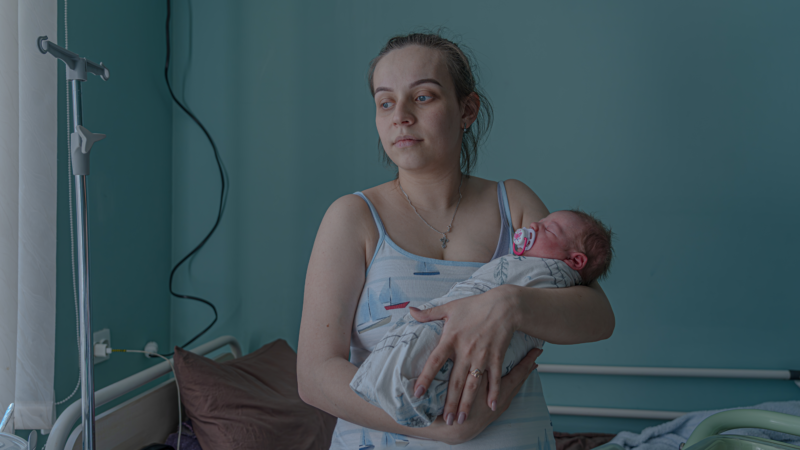
SLOVIANSK, Ukraine — The squalling cries of newborns echo through the hallway of Sloviansk City Clinical Hospital in the beleaguered Donetsk region of eastern Ukraine.
Sitting by the window in her room, young mother Anastasia cradles her 1-day-old daughter Vasilisa. While she’s happy to share this private moment with NPR, she doesn’t wish to share the family’s surname.
Anastasia also has an 18-month-old at home. Despite the war, the 25-year-old mother wants to stay in the town where she grew up and her entire family still lives.
“If things get really bad, of course we will leave,” she says. “But as long as it’s bearable, it’s always better to be at home than somewhere else.”
With Russian forces now occupying two-thirds of this province, Sloviansk has the last working maternity ward in Ukrainian controlled Donetsk.
This industrial town, once known for its salt mines and mud bath spas, has been under constant Russian assault since 2014, when Kremlin-backed separatist forces briefly took control of the town. Today, Sloviansk is tired and tattered, but many residents say they are determined to hang on.

Peace, no matter what
Anastasia was 14 when the Russian-backed separatists took control for three months before being routed by Ukrainian forces. The town finds itself again under attack since Russian President Vladimir Putin launched a full-scale invasion of Ukraine in 2022.
Her children are not yet old enough for her to have to explain the daily air raid sirens or why buildings lie in rubble. But she wants them to know peace.
“I don’t care what kind of peace we have,” Anastasia says. “I just want my children to live healthy with nothing flying over their heads.”
Loading…
Some Ukrainians in the mainly Russian-speaking eastern part of the country traditionally felt closer to Russia than to Ukraine, whose capital of Kyiv is more than 400 miles away in the north-central region. That has changed with the full-scale war.
Dr. Valentina Hlushchenko, who is showing NPR around the hospital, says the question of whether the region should be part of Russia or Ukraine ripped families apart in 2014 when the conflict began. So they don’t discuss it anymore.

“We already experienced this pain in 2014 — it split husbands and wives, pitted brother against brother,” she says. “And since the full-scale invasion in 2022, it’s been a complete catastrophe. So it’s a closed topic. We don’t have these conversations so as not to hurt or offend people. Everyone just tries to live their lives.”
Hlushchenko says people hold on in the town as long as they can for services, or their pensions. Going somewhere else could also mean having to pay rent.
“We must provide care to Ukrainians until the last moment”
A large map of Ukraine hangs on the wall over hospital director Volodymyr Ivanenko’s desk. He says when Russia invaded in 2022, many of the staff fled. But almost everyone has returned and now they’re operating at 90% capacity, working through missile strikes and electricity and water cuts.
“We are a Ukrainian health institution and we must provide care to Ukrainians until the last moment,” he says. “Whether it’s dangerous or not is another issue.”

Ivanenko says several doctors were killed when a missile hit the hospital in 2023.
But he says the hospital must continue its work.
“We know the consequences perfectly well, because almost every day we treat civilians and we see the nature of their injuries,” he says. “But it’s a job, just like sitting in a trench. You have to live and work for something.”
Heavily pregnant Khrystyna Deshchenko is sitting in the hallway on a bench next to her husband, Valentyn. She says her contractions have started. The couple is from nearby Kramatorsk, where Russian missile strikes have killed hundreds of civilians over the past three years.
The couple says they are very worried about the safety of their first child and believe the future does not bode well for Donetsk province. They say they plan to move to a safer place farther west, like the Kyiv suburbs.

“Here in the east things happen very fast,” says Valentyn Deshchenko. “Sometimes there is no time to even sound an alarm when a ballistic missile is fired. So life here can be a bit miserable.”
He says before President Trump was elected, he thought any peace deal with Russia would freeze territory along the contact line between the warring countries, leaving Ukraine in control of part of Donetsk province. But now he thinks Ukraine will lose it all.
“Trump and Russia will take it away. All our hope is gone,” he says.
“It’s scary for the child. But we’re still here”
Even amid war, the joyful sounds of children shouting and laughing float from a playground next to Sloviansk town hall. The building’s entrance is buttressed by sandbags. A child rides a tricycle out front where giant portraits stand of the town’s sons who have fallen in battle.
Olena Hunchenko tightly grips the hand of her 1-year-old daughter, Zlata, who has just learned to walk. She explains what it’s like to raise a child in Sloviansk.

“Well, let’s just say it’s very dangerous,” she says. “Sometimes when it’s loud, it’s scary for the child. But we’re still here.”
Hunchenko was born and raised in what she says used to be an idyllic small town. She says if the Russians ever do capture Sloviansk, her family would leave — especially because her husband is in the Ukrainian military.
Before the war, Sloviansk had a population of around 140,000, but it has dropped dramatically since the full-scale invasion down to 57,000, according to the area’s Ukrainian military administration. At one point, the front line was only a few miles from here. Today, the Russians have been pushed back at least 50 miles away. But Russian forces have been making incremental gains, slowly inching back toward Sloviansk.
Five-year-old Artem is pretending to be a policeman, yelling out to another child to pull his car over to the side of the road and pay a fine for speeding. His father, Dmytro Kluchnikov, looks on, smiling.
The 38-year-old grew up in Sloviansk. He says the family left briefly in 2022, moving to a town farther west. “But it was expensive and they treated us like outsiders,” he says. Here, everything is ours. There’s no place like home.”
The conversation is suddenly pierced by the wail of air raid sirens.

“He knows the Russians are bombing us and sending drones,” Kluchnikov says of his son. “He hates them. They’re the bad guys.”
He speaks in Ukrainian even though he says his Russian is stronger. But he doesn’t want to speak what he calls the language of the invaders anymore.
So will they stay if the Russians ever take Sloviansk?
“We understand they want all of Donetsk,” he says. “If for any reason they get it, we will leave.”
Kluchnikov says he is very angry about all the people the Russians have killed, including children.
“How can we accept these killers of civilians?” he asks. “No, absolutely not. We will never live in the country of the killers.”

Kateryna Malofieieva contributed reporting from Sloviansk, Ukraine. NPR’s Hanna Palamarenko and Polina Lytvynova contributed from Kyiv.
House Dem. Leader Jeffries responds to air strikes on Iran by U.S. and Israel
NPR's Emily Kwong speaks to House Minority Leader Hakeem Jeffries (D-NY), who is still calling for a vote on a war powers resolution following a wave of U.S.- and Israel-led airstrikes on Iran.
Iran’s Ayatollah Ali Khamenei is killed in Israeli strike, ending 36-year iron rule
Khamenei, the Islamic Republic's second supreme leader, has been killed. He had held power since 1989, guiding Iran through difficult times — and overseeing the violent suppression of dissent.

Found: The 19th century silent film that first captured a robot attack
A newly rediscovered 1897 short by famed French filmmaker Georges Méliès is being hailed as the first-ever depiction of a robot in cinema.
‘One year of failure.’ The Lancet slams RFK Jr.’s first year as health chief
In a scathing review, the top US medical journal's editorial board warned that the "destruction that Kennedy has wrought in 1 in office might take generations to repair."
Here’s how world leaders are reacting to the US-Israel strikes on Iran
Several leaders voiced support for the operation – but most, including those who stopped short of condemning it, called for restraint moving forward.
How could the U.S. strikes in Iran affect the world’s oil supply?
Despite sanctions, Iran is one of the world's major oil producers, with much of its crude exported to China.
