
ICE is reopening shuttered prisons as detention centers. Many have a troubled past
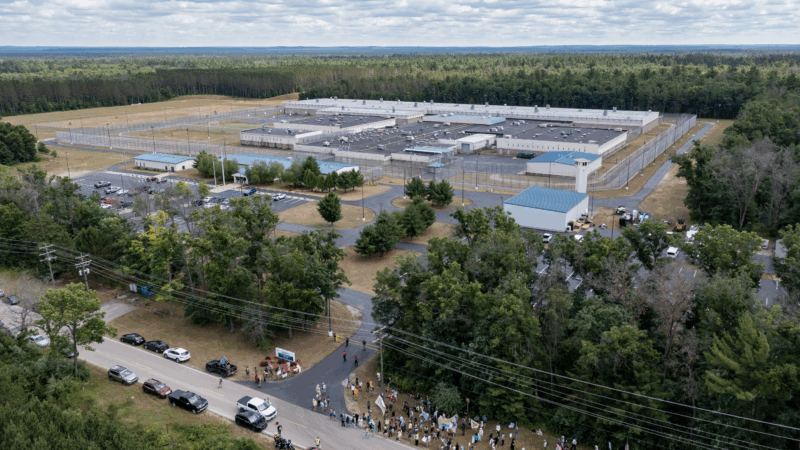
There are empty prison buildings all over the country. They shut down for a variety of reasons: staffing issues, allegations of abuse, even simply that there are fewer people in prison today than a few decades ago. Some prisons have sat vacant for years.
But the Trump administration is now holding more than 65,000 people in immigration detention — the highest level in history, and that has created huge demand for these properties.
“There’s definitely been this pattern over the last nine months of the Trump administration looking to shuttered state prisons, shuttered former federal prisons as a way to quickly expand ICE detention,” says Setareh Ghandehari, advocacy director at the Detention Watch Network, a non-profit seeking to end immigration detention.
She says this trend isn’t new, but President Trump’s immigration crackdown has accelerated the pace. That worries Ghandehari: Many of these prisons faced allegations of poor conditions while they were open, and they’re reopening at a time when the government has cut oversight measures.
“A lot of them have a long history of really deplorable conditions. And a lot of times, they shut down only to reopen and detain a different population. It’s just this continual cycle and conditions never get better,” Ghandehari added.
NPR identified at least 16 shuttered facilities across a dozen states that have reopened as Immigration and Customs Enforcement detention centers since President Trump took office in January. Most were state or federal prisons, though some had been ICE detention centers. Almost all the properties were owned or operated by private prison companies, and many had a troubled past.
In Texas this year, the private prison company CoreCivic reopened a shuttered ICE detention center in Dilley. In 2017, immigrants there reported poor conditions, such as a lack of clean water and inadequate medical care. In 2024, the facility closed. Today, a lawsuit alleges much of the same.
“Our facilities are subject to multiple layers of oversight and are monitored very closely by our government partners to ensure full compliance with policies and procedures, including any applicable detention standards,” Brian Todd, a spokesperson for CoreCivic, told NPR in a statement.
In Georgia this year, ICE reopened the Irwin County Detention Center in Ocilla. That facility, previously an ICE detention center managed by the private prison company LaSalle Corrections, had closed in 2021 amid allegations of medical abuse against the women held there, according to a bipartisan Senate investigation.
And in Michigan, the North Lake Processing Center in Baldwin, owned by the private prison company GEO Group, has closed and reopened several times over the last few decades.
In the late nineties, North Lake was a juvenile detention facility. The University of Michigan documented allegations of understaffing, medical neglect and abuse during that time.
Later, it became a federal prison. During COVID, prisoners there held hunger strikes, alleging inadequate food and medical care, and a vindictive use of solitary confinement.
It closed in 2022 after the Biden administration banned privately-owned prisons in the federal system. But this past June, North Lake opened again — this time, as an ICE facility.
“There are all these echoes of past injustices and so much of what we’re hearing right now from people held there is exactly the same,” says JR Martin, a member of the advocacy group No Detention Centers in Michigan.
Jose Contreras Cervantes was detained at North Lake this fall. He was arrested during a traffic stop on suspicion of being in the U.S. without authorization. Contreras Cervantes has a wife and three young children, and he also has Leukemia.
He says he told officials he was taking oral chemotherapy pills. But for nearly a month, he says he did not receive them, according to a lawsuit filed by the ACLU of Michigan. When the chemotherapy pills did start coming, they were inconsistent, and sometimes he wouldn’t receive his nausea pills, so he would vomit up the chemo regimen. He worried his cancer would spread.
“Every minute, every second that went by felt like a ticking clock to me,” Contreras Cervantes told NPR in Spanish.
A spokesperson for GEO Group told NPR in a statement that they act in compliance with federal detention standards and that their services are monitored by the federal government.
“We are proud of the role our company has played for 40 years to support the law enforcement mission of U.S. Immigration and Customs Enforcement,” the spokesperson said. “The support services GEO provides include around-the-clock access to medical care, in-person and virtual legal and family visitation, general and legal library access, translation services, dietician-approved meals, religious and specialty diets, recreational amenities, and opportunities to practice their religious beliefs.”
A spokesperson for the Department of Homeland Security, which oversees ICE, told NPR that any claims of poor conditions at North Lake are false, and that all detainees have access to medical care.
“At no time during ICE detention is an alien denied emergent care. It is a longstanding practice to provide comprehensive medical care from the moment an alien enters ICE custody,” the spokesperson added. “This is the best healthcare that many aliens have received in their entire lives.”
Yet the allegations made by Contreras Cervantes do not surprise Eunice Cho, senior counsel at the ACLU’s National Prison Project, especially because in March, DHS made sweeping cuts to the divisions that oversee conditions in ICE facilities.
“Immigration detention has always been a dangerous place. It has been an abusive place across administrations,” Cho says. “What we are seeing is the clear degradation of accountability measures over conditions of confinement in detention facilities.”
The vast majority of people in ICE custody are in facilities run by for-profit companies, and Cho says that can create an incentive to cut corners.
“There is always a profit motive involved in trying to fill the facility with people. And the people who are profiting are the private prison companies,” she says.
During the first nine months of this year, GEO Group reported a total revenue of nearly $2 billion – about 5% more than the same period last year.
In late October, a judge ordered Contreras Cervantes to be released. He’s back at home, pursuing options with an immigration attorney, and receiving treatment for his cancer.

A drop in CDC health alerts leaves doctors ‘flying blind’
Doctors and public health officials are concerned about the drop in health alerts from the Centers for Disease Control and Prevention since President Trump returned for a second term.
Photos: Highlights from the Winter Olympics opening ceremony
Athletes from around the world attended the 2026 Winter Olympics opening ceremony in Milan.

Alabama sets execution for man in auto parts store customer’s death
Gov. Kay Ivey on Thursday set a March 12 execution using nitrogen gas for Charles “Sonny” Burton. Burton was convicted as an accomplice in the shooting death of Doug Battle, a customer who was killed during an 1991 robbery of an auto parts store in Talladega.

Trump posts racist meme of the Obamas — then deletes it
Trump's racist post came at the end of a minute-long video promoting conspiracy theories about the 2020 election.

Hyperpop, poetry, BDSM or a Moroccan rave allegory? Choose your own cinematic adventure
Charli xcx is on more screens this weekend while Pillion tells a sweet BDSM story.

‘Pillion’ is a wildly entertaining dark comedy about sex and power
A mild-mannered young man enters into a dominant-submissive relationship with the leader of a gay biker gang. Pillion approaches the subject without judgment and with a great deal of sly humor.
