
How Minnesota faith communities are resisting aggressive immigration operations
MINNEAPOLIS — At Our Saviour’s Lutheran Church in south Minneapolis, Pastor Martha Bardwell gathered congregants outside the church on Sunday to plant a sign in the snow. The marker notes that Immigration and Customs Enforcement agents detained a man at that spot just days earlier.
Standing on the sidewalk, Bardwell led a prayer, asking for healing amid what she described as “the pain and the violence and the terror in our streets.”
Church member Aneesa Parks helped create the sign. She began making them with a group of friends as immigration detentions surged around the Twin Cities last month. The Department of Homeland Security says more than 1,500 people have been arrested during the operation.
“We wanted to figure out how we could make a public witness to where people were taken,” Parks said.
The signs draw inspiration from “stumble stones,” small plaques embedded in sidewalks across Germany to mark locations where Jews and others were abducted during the Holocaust. The stones are intentionally subtle, often noticed only when someone nearly trips over them.


“What would be the best way to memorialize where people were taken?” Parks asked. “We just started experimenting.”
Instead of subtlety, the Minneapolis signs are fluorescent yellow, orange and green, designed to stand out sharply against winter snow.
“The signs just say a person was taken by ICE here,” Parks said. “We felt like the here was important to notice – that it is on residential streets. It’s at bus stops. It’s in clinics. It’s here.”
Concrete acts of resistance
As federal immigration enforcement actions intensify across the Twin Cities, communities of faith are at the forefront of resistance, organizing public witness, mutual aid and political action rooted in long-standing religious commitments.
Faith leaders say their resolve to counter the ICE crackdown has increased since the killing of Renee Macklin Good by a federal immigration agent in Minneapolis last week. Macklin Good’s wife Becca Good described her as a Christian motivated by her faith to help others.
Beyond symbolic action like erecting signs, congregants are also offering practical support. Some volunteers are following ICE agents into neighborhoods, blowing whistles and honking horns to alert people to the federal presence. Others are driving immigrants to work to help them avoid public transportation, where enforcement actions have occurred.
Our Saviour’s member Dave Comstock, one of those volunteers, believes his faith demands risk.
“Jesus is pretty clear about what our job is if we choose to follow him. We choose to take risks.” Comstock said. “We choose to stand against the Empire. And we choose to stand on the side of the people who are oppressed, the people who are forgotten, the people who are hungry, the people who are in prison.”

That commitment, he added, requires showing up consistently — not just speaking out.
The motivation is similar for Comstock’s spouse, Carol Hornbeck, who draws inspiration from a specific verse of the hymn “How Firm A Foundation.”
“I will be with thee, thy troubles to bless,” she recited from memory, “and sanctify to thee thy deepest distress.”
Hornbeck says the idea that her resistance work is hard but holy gives her strength and resolve.
Faith-based organizing in Minnesota has deep roots
JaNaé Bates Imari, a Christian minister and co-executive director of the multifaith political and social justice organization Isaiah, said people of faith have a particular responsibility in moments like this.
“It is a sin for any person, especially a person of faith, to watch what is happening and stay in silence.”
Isaiah has worked for decades to unite religious communities around policy advocacy and civic engagement. Bates Imari said the organization is again mobilizing congregations, drawing on the same networks that organized after George Floyd’s murder in 2020 and helped pass progressive legislation, including paid family and medical leave.
“People of faith have a very specific moral call and moral witness in these times,” she said, adding that the work extends beyond responding to high-profile violence. “God is holding us together, even when it feels like everything is falling apart.”
That message was echoed at a recent singing vigil that wound through the streets of south Minneapolis, near the site where Macklin Good was killed last week. The lyric “We belong to them, and they belong to us” echoed in the cold January air.
The procession of several hundred people included one man holding a hand-lettered sign that read “Jesus was an immigrant” and others carrying large, homemade crosses. One older woman navigated the icy streets while using a walker. Another pushed her Pomeranian in a dog stroller. Parents held the hands of their small children.

The vigil began at San Pablo Church and paused along the route at sites where federal agents had recently detained people. Organizers said they hoped to bring comfort to a neighborhood shaken by violence and cowed by fear. As they walked along the Lake Street business corridor, cars honked in support. On side streets, residents emerged onto their front porches, some wrapped in blankets, to wave or applaud.
San Pablo is a vibrant, predominantly immigrant congregation that is also welcoming of LGBTQ+ people. It was founded by Swedish immigrants in the late 19th century. Services are now bilingual, held in both Spanish and English. Pastor Hierald Osorto cautions against portraying his congregation solely as fearful or reactive.
“I don’t want our communities to only be responding to crises,” Osorto said. “We need to be clear about who we are and why we exist where we exist.”
That why includes serving neighbors in need, bearing each other’s burdens, celebrating each other’s joys and insisting on the dignity of all people.

On Sunday afternoon, his church building was crowded with people worshiping, singing, eating and caring for one another while ICE agents drove dark-windowed SUVs through the neighborhood.
“The fact that this is a bustling place,” Osorto said, “reminds me of the ways that God shows up.”
Chicagoans pay respects to Jesse Jackson as cross-country memorial services begin
Memorial services for the Rev. Jesse Jackson Sr. to honor his long civil rights legacy begin in Chicago. Events will also take place in Washington, D.C., and South Carolina, where he was born and began his activism.

In reversal, Warner Bros. jilts Netflix for Paramount
Warner Bros. says Paramount's sweetened bid to buy the whole company is "superior" to an $83 billion deal it struck with Netflix for just its streaming services, studios, and intellectual property.

Trump’s ballroom project can continue for now, court says
A US District Judge denied a preservation group's effort to put a pause on construction

NASA lost a lunar spacecraft one day after launch. A new report details what went wrong
Why did a $72 million mission to study water on the moon fail so soon after launch? A new NASA report has the answer.
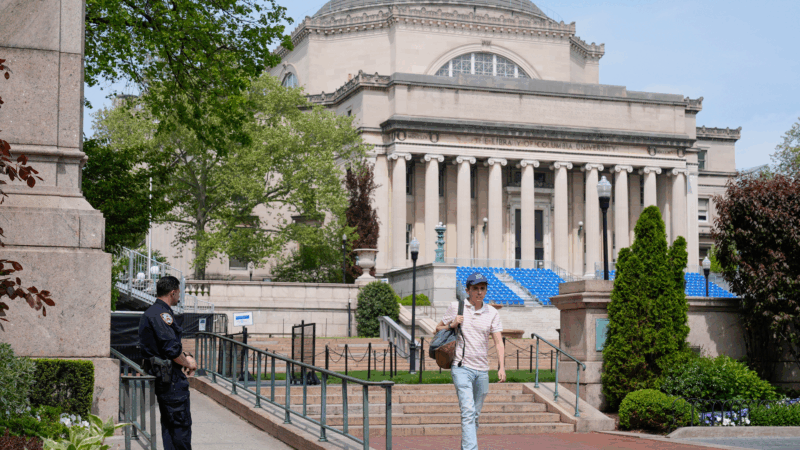
Columbia student detained by ICE is abruptly released after Mamdani meets with Trump
Hours after the student was taken into custody in her campus apartment, she was released, after New York City Mayor Zohran Mamdani expressed concerns about the arrest to President Trump.

These major issues have brought together Democrats and Republicans in states
Across the country, Republicans and Democrats have found bipartisan agreement on regulating artificial intelligence and data centers. But it's not just big tech aligning the two parties.
