
How could the U.S. strikes in Iran affect the world’s oil supply?
The U.S. and Israel’s military strikes against Iran pose serious risks to oil markets and by extension the global economy, although the extent of the impact on oil production and trade is not yet clear.
Trading markets are currently closed, so the effect on oil prices won’t be easy to quantify until they open late on Sunday. But crude prices have been creeping up for weeks based largely on concerns about the threats to oil supplies and trade if the U.S. did attack Iran.
Despite ongoing sanctions, Iran still is a significant oil exporter. As of December, it managed to export around 1.9 million barrels per day despite U.S. efforts to block exports, according to the International Energy Agency.
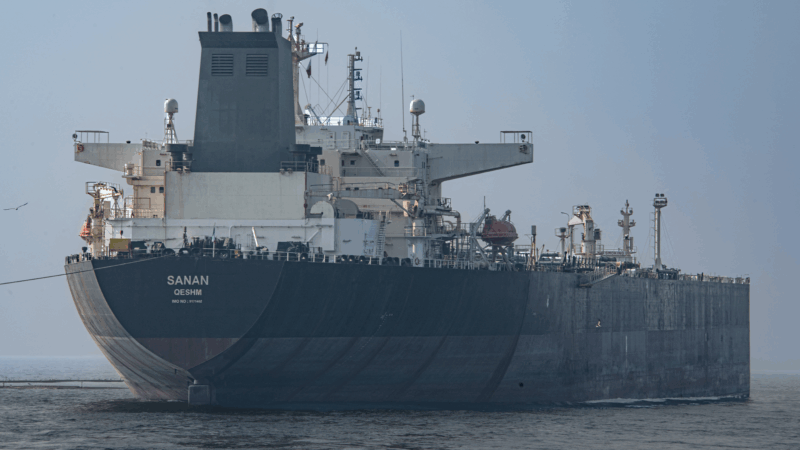
Most of Iran’s exported oil goes to China and is carried on so-called “shadow ships,” tankers that actively conceal their activities to evade sanctions or other restrictions. The U.S. has recently escalated its sanctions enforcement on shadow fleets in an attempt to limit their activities.
But China remains fairly insulated from a disruption in Iranian oil imports, says Antoine Halff, chief analyst at Kayrros, a climate and environmental analytics firm. “China has very large reserves, both strategic reserves and commercial reserves,” he says.
For that reason, Halff says, “You take Iran out, you’re not really starving the rest of the world.”
The main reason oil markets are nervous about U.S. strikes relates to how Iran might respond, says Raad Alkadiri, a managing partner at 3TEN32 Associates, a political risk consultancy.
”The issue will be sort of what that does in the longer term and the potential spillover effects,” Alkadiri says.
Iran controls the Strait of Hormuz, a vital shipping route. About 20 million barrels of oil and oil products pass through every day, according to the U.S Energy Information Administration, from countries such as Saudi Arabia and Iraq. That’s about 20% of global oil demand. If Iran closes the Strait and disrupts the flow of that oil, the impact on global prices would be immediate and dramatic, Alkadiri says.
Still, the world is currently oversupplied with oil, which helped keep prices from rising too sharply in recent weeks, even as concern has mounted over the risk of a crisis.
During heightened conflict between Iran and Israel last year, both sides avoided targeting oil production or export facilities, and the Strait of Hormuz remained open. Oil prices remained relatively stable. If the strait is closed, particularly for a prolonged length of time, it would be a different story.
Halff says a worst-case scenario for oil markets revolves around Iran striking its neighbors.
”The number one concern for the oil market and for the energy market is whether Iran would retaliate in any way against producer countries in the Gulf. Against Saudi facilities or Kuwaiti facilities, UAE facilities or even Qatar,” Halff says.
“There’s a stronger likelihood of this,” he continues. “And the impact of this would be much, much greater.”
Why is the U.S. attacking Iran? Six things to know
The U.S. and Israel launched military strikes in Iran, targeting Khamenei and the Iranian president. "Operation Epic Fury" will be "massive and ongoing," President Trump said Saturday morning.
Sen. Tim Kaine calls on the Senate to vote on the war powers resolution
NPR's Scott Simon talks to Sen. Tim Kaine, D-Va., about the U.S. strikes on Iran.
Iran strikes were launched without approval from Congress, deeply dividing lawmakers
Top lawmakers were notified about the operation shortly before it was launched, but the White House did not seek authorization from Congress to carry out the strikes.
Political science expert weighs in on Iran’s nuclear program in light of U.S. strikes
NPR's Scott Simon speaks to Ariane Tabatabai, the Public Service Fellow at Lawfare, about U.S. attacks on Iran and how President Trump's calls for regime change might be received there.
Week in Politics: Does Trump have political support for his actions in Iran?
We look at what President Trump's decision to attack Iran means, what kind of support he has in Iran and what this moment means for his administration.
Unlocking the secrets of an ancient plague
The first historically recorded pandemic is believed to have struck the walled city of Jirash, in what is now modern-day Jordan, in the 7th century. A new study reveals details about those who died.
