
How brightly colored do we want our food? For brands, it’s a hill to dye on
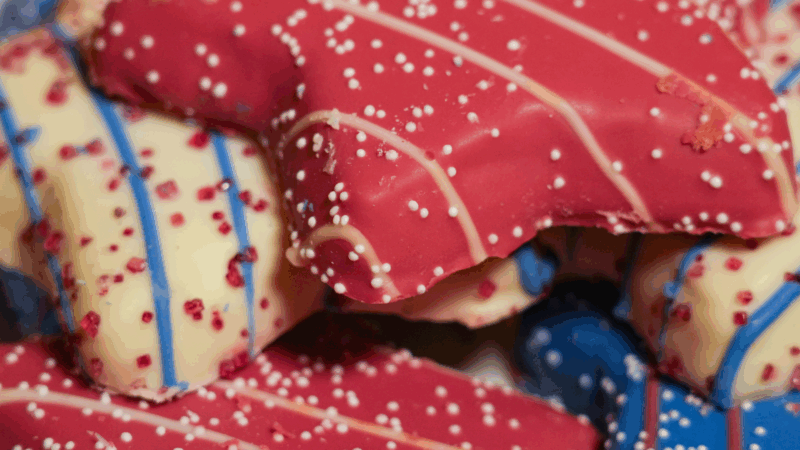
Cupcake icing and sports drinks — in all their crayon-like colors — are the final frontiers for Nick Scheidler’s team.
Scheidler leads product development at Walmart’s Sam’s Club, which in 2022 committed to — by the end of this year — remove dozens of ingredients from its store brand called Member’s Mark. That includes high-fructose corn syrup, some preservatives and artificial dyes.
The latter proved the trickiest.
“Color has been a challenge for us,” says Scheidler. “We’re not going to send muted colors out into the market, right?”
Right?
The race is on now, under pressure from Health Secretary Robert F. Kennedy Jr. and some states. Major food brands are pledging to phase out synthetic dye from snacks, candy and cereals: Kraft Heinz, Nestle, Campbell’s. Even Mars says it will try a naturally colored version of M&M.
And they’re spending millions to keep shoppers from noticing the switch to natural dyes, striving for vibrancy and saturation to match the old look, bright and vivid.
Is this investment of time and money — to make natural colors look less so — worth it? To this food executives would say: heed the saga of Trix cereal.

How Trix got trounced
Ten years ago, General Mills made a splashy pledge to remove artificial dyes from cereal and released Trix colored naturally with fruits and vegetables. The new version was duller in color than the original and missing the bluish puffs.
And many shoppers hated it. One man told the Wall Street Journal the new Trix was “basically a salad now,” as people took to social media and the news to complain.
General Mills capitulated and brought back the original Trix, artificial dyes and all.
“And this is really a problem because General Mills framed this as a consumer demand issue: This is what consumers want,” says Thomas Galligan with the Center for Science in the Public Interest, which advocates against synthetic dyes over health concerns, particularly in children.
The Trix flip set the tone. So when Kellogg later dyed Froot Loops with spices and juices, it did so in Canada, but not the U.S. Mars phased out artificial colors in M&M’s in Europe, but not the U.S. The all-American, neon-yellow Kraft Mac & Cheese removed synthetic dyes stealthily, boasting in an ad campaign that neither moms, nor kids, nor anyone else noticed.

Is love of bright foods nature or nurture?
Food dyeing dates back centuries. Think dairy farmers adding spices to cheese to turn it more yellow.
In the U.S., railroads and the spread of processed foods made a big impact, says food historian Ai Hisano. When Florida farmers had to compete with California farmers, they started dyeing their oranges to look more orange. When butter had to compete with margarine, its yellow color got a boost to appear richer.
The introduction of color advertising and of the modern supermarket began to train the American shopper what to expect, says Hisano, author of Visualizing Taste: How Business Changed the Look of What You Eat.
“Marketing and also eating processed foods regularly educates consumers how food should look,” she says.
We learn that strawberry drinks are paler than real strawberries, store-bought pickled peppers are more colorful than homemade ones, mint ice-cream is unnaturally green and blue raspberry is a recognizable flavor, despite not being an actual berry that exists.
Childhood snacks, in particular, form lifelong habits – and children are famously fond of brightly colored things. (Remember Trix?) Recent research by Galligan and other scientists found synthetic food dyes in nearly 20% of packaged food and drinks sold in the U.S., especially those marketed to children.
Over time, between natural instincts and nurture by marketing, data show people do eat with their eyes first — and colors change how we evaluate taste before ever taking a bite or a sip.
“People think food tastes better if it’s brightly colored,” says Marion Nestle, a longtime public health nutritionist who’s tracked research on food dyes. “Brighter colors are perceived as tasting better, whether the taste changes or not.”

No dusty dullness
When Scheidler’s team at Sam’s Club began testing natural dyes in snacks and sweets, they turned to some of the tried-and-true options. Turmeric makes things yellow; beets produce red; a seed called annatto can give orange; blue can come from spirulina, an algae.
But adding savory-tasting dyes to treats like cakes or candies often requires masking their flavors with sweeteners or other new ingredients. Natural dyes tend to be costlier and more finicky, less stable.
“There were so many revisions,” Scheidler says. Sometimes, natural dyes wouldn’t stick. Or sometimes, “the colors were muted, and they got continuously lighter over time.”
In one instance — a frosted star cookie — it’s taken 30 times more natural color concentration to achieve the right vibrant hue, Scheidler says, because of how dyes react to the fat content of the icing.
Is the fuss really worth it, still, in what seems like a new turning point on synthetic dyes in the American zeitgeist?
The irony is that without vivid color, many snacks and cereals look faded and, well, obviously processed. Sports drinks can look murky and dusty. And as long as rival options look as brightly colored as ever, many food makers aren’t willing to be the first to go dull.
As of June, Sam’s Club was 96% of the way to its goal of ridding its food of artificial colors and other ingredients. Scheidler expects to hit the end-of-the-year deadline. Along the way, his team has run a regular survey of shoppers on updated ingredients – and their comments are unwavering:
“Color and appearance are still very important parts of what they’re searching for in a product,” he says.

Bill making the Public Service Commission an appointed board is dead for the session
Usually when discussing legislative action, the focus is on what's moving forward. But plenty of bills in a legislature stall or even die. Leaders in the Alabama legislature say a bill involving the Public Service Commission is dead for the session. We get details on that from Todd Stacy, host of Capitol Journal on Alabama Public Television.

My doctor keeps focusing on my weight. What other health metrics matter more?
Our Real Talk with a Doc columnist explains how to push back if your doctor's obsessed with weight loss. And what other health metrics matter more instead.
Baz Luhrmann will make you fall in love with Elvis Presley
The new movie is made up of footage originally shot in the early 1970s, which Luhrmann found in storage in a Kansas salt mine.

Forget the State of the Union. What’s the state of your quiz score?
What's the state of your union, quiz-wise? Find out!

A team of midlife cheerleaders in Ukraine refuses to let war defeat them
Ukrainian women in their 50s and 60s say they've embraced cheerleading as a way to cope with the extreme stress and anxiety of four years of Russia's full-scale invasion.

As the U.S. celebrates its 250th birthday, many Latinos question whether they belong
Many U.S.-born Latinos feel afraid and anxious amid the political rhetoric. Still, others wouldn't miss celebrating their country
