
How a power outage in Colorado caused U.S. official time be 4.8 microseconds off
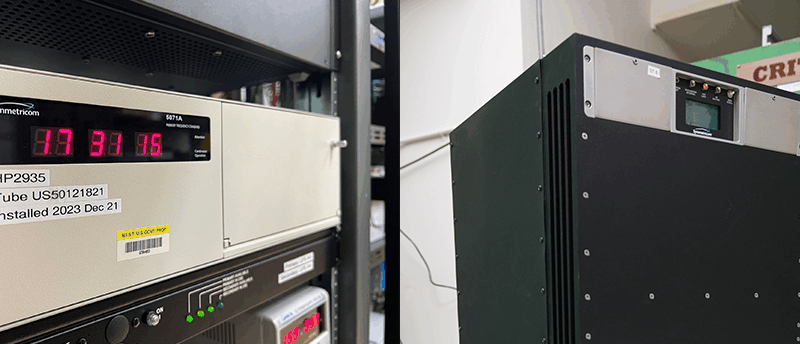
The U.S. government calculates the country’s official time using more than a dozen atomic clocks at a federal facility northwest of Denver.
But when a destructive windstorm knocked out power to the National Institute of Standards and Technology (NIST) laboratory in Boulder on Wednesday and a backup generator subsequently failed, time ever so slightly slowed down.
The lapse “resulted in NIST UTC [universal coordinated time] being 4.8 microseconds slower than it should have been,” NIST spokesperson Rebecca Jacobson said in an email.
That’s just under 5 millionths of a second.
To understand just how brief an instant that is, Jacobson noted that it takes a person about 350,000 microseconds to blink.
Since 2007, the official time of the U.S. has been determined by the Commerce Secretary, who oversees NIST, along with the U.S. Navy. The national time standard is known as NIST UTC. (Somewhat confusingly, UTC itself is a separate, global time standard to which the U.S. and other countries contribute measurements.)
NIST currently calculates the standard using a weighted average of the readings of 16 atomic clocks situated across the Boulder campus. Atomic clocks, including hydrogen masers and cesium beam clocks, rely on the natural resonant frequencies of atoms to tell time with extremely high accuracy.
All of the atomic clocks continued ticking through the power outage last week thanks to their battery backup systems, according to NIST supervisory research physicist Jeff Sherman. What failed was the connection between some of the clocks and NIST’s measurement and distribution systems, he said.
Some critical operations staff who were still on site following the severe weather were able to restore backup power by activating a diesel generator the team had kept in reserve, Sherman said.
As for whether the 4.8 microsecond “drift” had any impact, Sherman said it depends on the user. “Maybe it’s a bit obtuse to say that four microseconds is both big and small at the same time.”
The drift would likely be too minute to matter to the general public, Sherman said, but it could have more serious consequences for applications related to critical infrastructure, telecommunications, GPS signals and more. (NIST said it provides “high-end” users with access to other time-keeping networks and notified them of the disruption.)
By Saturday evening, power had been restored to the NIST facility in Boulder, and crews were working to evaluate the damage and correct the 4.8 microsecond drift in due time.

HUD proposes time limits and work requirements for rental aid
The rule would allow housing agencies and landlords to impose such requirements "to encourage self-sufficiency." Critics say most who can work already do, but their wages are low.
Paramount and Warner Bros’ deal is about merging studios, and a whole lot more
The nearly $111 billion marriage would unite Paramount and Warner film studios, streamers and television properties — including CNN — under the control of the wealthy Ellison family.

A new film follows Paul McCartney’s 2nd act after The Beatles’ breakup
While previous documentaries captured the frenzy of Beatlemania, Man on the Run focuses on McCartney in the years between the band's breakup and John Lennon's death.

An aspiring dancer. A wealthy benefactor. And ‘Dreams’ turned to nightmare
A new psychological drama from Mexican filmmaker Michel Franco centers on the torrid affair between a wealthy San Francisco philanthropist and an undocumented immigrant who aspires to be a dancer.
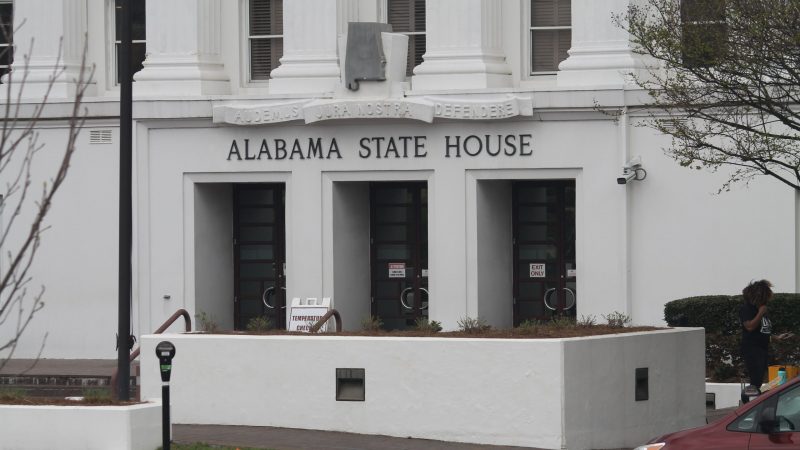
Bill making the Public Service Commission an appointed board is dead for the session
Usually when discussing legislative action, the focus is on what's moving forward. But plenty of bills in a legislature stall or even die. Leaders in the Alabama legislature say a bill involving the Public Service Commission is dead for the session. We get details on that from Todd Stacy, host of Capitol Journal on Alabama Public Television.

My doctor keeps focusing on my weight. What other health metrics matter more?
Our Real Talk with a Doc columnist explains how to push back if your doctor's obsessed with weight loss. And what other health metrics matter more instead.
