
House Republicans are investigating Jan. 6. NPR fact-checked the first hearing
A new Republican-led congressional subcommittee to investigate the Jan. 6, 2021, attack on the U.S. Capitol held its first public hearing this week, and GOP lawmakers used the opportunity to criticize the Biden administration and, at times, promote conspiracy theories about the riot. An NPR fact check has identified multiple false and misleading claims from the hearing, which coincides with a broader effort by the Trump administration to rewrite the history of the attack.
The hearing unfolded against the backdrop of Trump’s mass pardons for the Jan. 6 defendants almost one year ago. Stewart Rhodes, the former leader of the Oath Keepers who was convicted of seditious conspiracy for his role in the attack and sentenced to 18 years in prison, appeared at the front of the audience. Rhodes is one of a small group of former defendants who did not receive a full pardon from Trump, and instead received a commutation. As a result, Rhodes was released from prison but his seditious conspiracy conviction remains on his record.
The official topic for Wednesday’s hearing was “Examining the Investigation into the DNC and RNC Pipe Bombs.” On Jan. 6, just as rioters began breaching the outer perimeter of the Capitol, two bombs were discovered outside the headquarters of the Republican and Democratic national committees, diverting law enforcement resources at a critical moment.
During the Biden administration, the investigation into who planted the bombs stalled, and the lack of an arrest fueled conspiracy theories. Dan Bongino, the conservative podcaster who would later become Deputy Director of the FBI, said on his show in Nov. 2024 that he was certain the bombs were placed by “either a connected anti-Trump insider or this was an inside job.”
A year later, Bongino told a very different story.

While serving as a top FBI official, he appeared at a press conference announcing charges against Brian Cole, Jr., a 30-year-old man from Virginia accused of planting the bombs. Cole, who has pleaded not guilty, twice voted for Trump, according to his lawyer. Federal prosecutors allege that Cole confessed and said he believed votes had been “tampered” with in the 2020 election.
Bongino addressed his shifting stance on the pipe bomber case on Fox News in Dec. 2025. “I was paid in the past for my opinions,” Bongino said, “but that’s not what I’m paid for now. I’m paid to be your deputy director.” Bongino left the FBI at the beginning of Jan. 2026, and is set to return to podcasting.
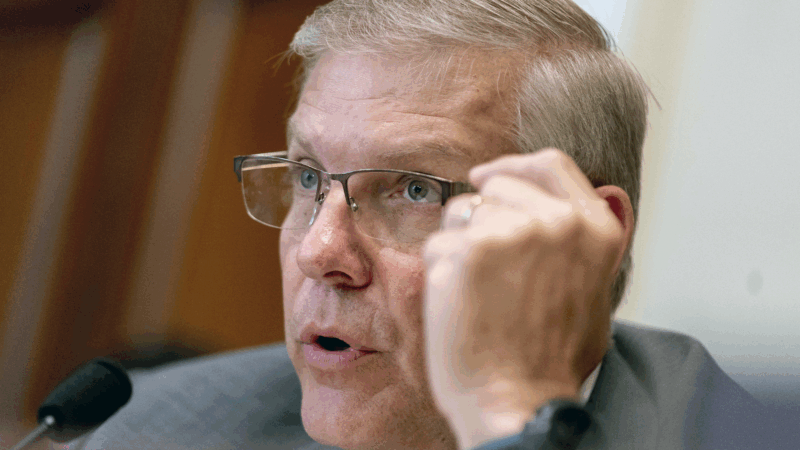
Rep. Barry Loudermilk, R-Ga., who chairs the subcommittee, has made the pipe bomb case a central focus of his inquiry. He repeatedly criticized the FBI for failing to crack the case for nearly five years and said internal documents “paint a dismal picture” of the investigation during the Biden administration.
In one of the few moments of bipartisan agreement, Rep. Jamie Raskin, D-Md., praised the FBI under Director Kash Patel for making an arrest, calling it “a rare bright spot for federal law enforcement over the last year.”
But with the pipe bombing case now moving through the courts — rather than the political arena — lawmakers sometimes veered into claims that did not match the facts.

The claim:
“The Biden FBI did have undercover agents and confidential informants embedded within the rally crowds,” said Rep. Clay Higgins, R-La., “And the Biden FBI did conspire to entrap MAGA Americans prior to J6 and then successfully entrapped several hundred Americans on J6.”
The facts:
Joe Biden was not president on Jan. 6 — Donald Trump was.
At the time of the attack, the FBI was led by Christopher Wray, a Trump appointee.
Joe Biden took office on Jan. 20, 2021, two weeks after the riot, and Wray remained FBI director for the duration of his presidency.
A Department of Justice inspector general report examined the presence of confidential FBI sources in the crowds on Jan. 6, and found that, “none of these FBI [Confidential Human Sources] was authorized by the FBI to enter the Capitol or a restricted area or to otherwise break the law on January 6, nor was any CHS directed by the FBI to encourage others to commit illegal acts on January 6.” The report also found no evidence “showing or suggesting that the FBI had undercover employees in the various protest crowds, or at the Capitol, on January 6.”
Higgins’ office did not respond to a request for comment.
The claim:
Raskin said Trump failed to act decisively to stop the riot and “did nothing to send out the National Guard under his unilateral direct control in the District of Columbia.”
In response, Loudermilk countered that Trump, “cannot just send the National Guard unless the National Guard is requested by the legislative branch.”
Referring to former Capitol Police Chief Steven Sund, Loudermilk said, “There were multiple requests made by the former chief of police for National Guard before the request to call them was given. And that was only after shots were fired in the Capitol. That request was made to the Department of Defense in the one o’clock hour on Jan. 6.”
The facts:
The president has direct control of the D.C. National Guard, and the Capitol Police requested assistance from the Guard prior to the breach of the building. Still, troops did not arrive until hours later.
Loudermilk appears to have jumbled the timeline of the National Guard’s response, which is laid out in reports from both the Capitol Police and Department of Defense Office of Inspector General.
- At 1:09 p.m. and again at 1:22 p.m., former Capitol Police Chief Steven Sund asked the House and Senate Sergeants at Arms to declare an emergency and formally request help from the Guard. By that point, rioters had breached the outer perimeter of the Capitol grounds and were assaulting police, but had not yet broken into the building.
- At 1:49 p.m., Sund called the commanding general of the D.C. National Guard directly to request the assistance of Guard troops at the Capitol.
- At 2:10 p.m., Sund relayed that he received formal authorization from the Capitol Police Board.
- At 2:13 p.m., rioters broke a Capitol window and began flooding into the building.
- At 2:44 p.m., Capitol Police officer Michael Byrd fired a single shot, striking rioter Ashli Babbitt as she attempted to breach a door to the Speaker’s Lobby, where members of Congress were trying to evacuate. Babbitt subsequently died. National Guard troops did not arrive at the Capitol until 5:55 p.m.
In an email to NPR, Loudermilk’s Deputy Chief of Staff Brandon Cockerham said that the congressman’s reference to a request made “only after shots were fired” was an allusion to a later moment in the timeline, when acting Defense Secretary Christopher Miller authorized the mobilization of the Guard.
“I believe the Chairman meant to use the word ‘authorization’ instead of ‘request’ as he was alluding to the authorized mobilization of the D.C. National Guard which came at approximately 3:04 PM,” Cockerham wrote.
The claim:
Rep. Troy Nehls (R-Texas), criticized police officers who testified before the previous Jan. 6 select committee, which was led by Rep. Bennie Thompson, D-Miss., and former Rep. Liz Cheney, R-Wyo.
“They set out to have a highly pre-scripted hearing, designated to play on the emotions of Americans,” said Nehls. “For example, the hearing with Capitol Police officers Dunn, Gonell, Fanone, Hodges — four Trump haters who gave highly scripted and pre-planned testimonies.”
The facts:
Nehls was referring to testimony by Harry Dunn and Aquilino Gonell, who served with the Capitol Police, and Michael Fanone and Daniel Hodges, who served with D.C.’s Metropolitan Police Department.
All four officers have publicly criticized Trump, in large part because of the injuries and trauma they suffered defending the Capitol on Jan. 6.
But their politics are not as simple as Nehl suggested.
Fanone, who was dragged into the crowd and repeatedly beaten and shocked in the neck by a rioter with a Taser-style device, voted for Trump in 2016.
“I was looking for a candidate that supported law enforcement,” Fanone told NPR in an interview last year. “I regret the decision. It was clearly the wrong decision in hindsight.”
Fanone suffered a traumatic brain injury and a minor heart attack due to the assaults on Jan. 6.
Nehls’ office did not respond to NPR’s request for comment.
Chicagoans pay respects to Jesse Jackson as cross-country memorial services begin
Memorial services for the Rev. Jesse Jackson Sr. to honor his long civil rights legacy begin in Chicago. Events will also take place in Washington, D.C., and South Carolina, where he was born and began his activism.
In reversal, Warner Bros. jilts Netflix for Paramount
Warner Bros. says Paramount's sweetened bid to buy the whole company is "superior" to an $83 billion deal it struck with Netflix for just its streaming services, studios, and intellectual property.
Trump’s ballroom project can continue for now, court says
A US District Judge denied a preservation group's effort to put a pause on construction

NASA lost a lunar spacecraft one day after launch. A new report details what went wrong
Why did a $72 million mission to study water on the moon fail so soon after launch? A new NASA report has the answer.
Columbia student detained by ICE is abruptly released after Mamdani meets with Trump
Hours after the student was taken into custody in her campus apartment, she was released, after New York City Mayor Zohran Mamdani expressed concerns about the arrest to President Trump.
These major issues have brought together Democrats and Republicans in states
Across the country, Republicans and Democrats have found bipartisan agreement on regulating artificial intelligence and data centers. But it's not just big tech aligning the two parties.
