
Here’s how world leaders are reacting to the US-Israel strikes on Iran
World leaders on Saturday reacted cautiously after the United States and Israel attacked Iran, following weeks of escalating tensions and a major U.S. military buildup in the region.
Here’s a roundup of international reaction:
United Nations: Secretary General António Guterres condemned what he described as the “use of force” by the US and Israel, and the subsequent retaliation by Iran, which, he said, “undermine international peace and security.”
Guterres added that all member states must respect their obligations under international law, including the Charter of the United Nations and called for an immediate cessation of hostilities and de-escalation.
The UN Security Council, meanwhile, called an emergency meeting Saturday afternoon in response to the strikes. The meeting will be chaired by Britain, which holds the monthly council presidency.
European Union: The European Commission President Ursula von der Leyen called the developments in Iran “greatly concerning.”
“Ensuring nuclear safety and preventing any actions that could further escalate tensions or undermine the global non-proliferation regime is of critical importance,” she wrote in a post on X, calling on all parties to exercise restraint and respect international law.
In Brussels, the EU’s chief diplomat, Kaja Kallas, called the situation “perilous” and said the protection of civilians was a priority. But she also said the Iranian regime “has killed thousands” and its support for terror groups “pose a serious threat to global security.”
France, Germany, UK: The leaders of France, Germany and the United Kingdom — also known as the E3 — issued a joint statement Saturday emphasizing they had long urged Iran to end its nuclear program, stop destabilizing actions in the region, and “cease the appalling violence and repression against its own people.”
The three leaders also made clear that none of their countries participated in the strikes, but they “remained in close contact” with the U.S., Israel and other partners in the region.
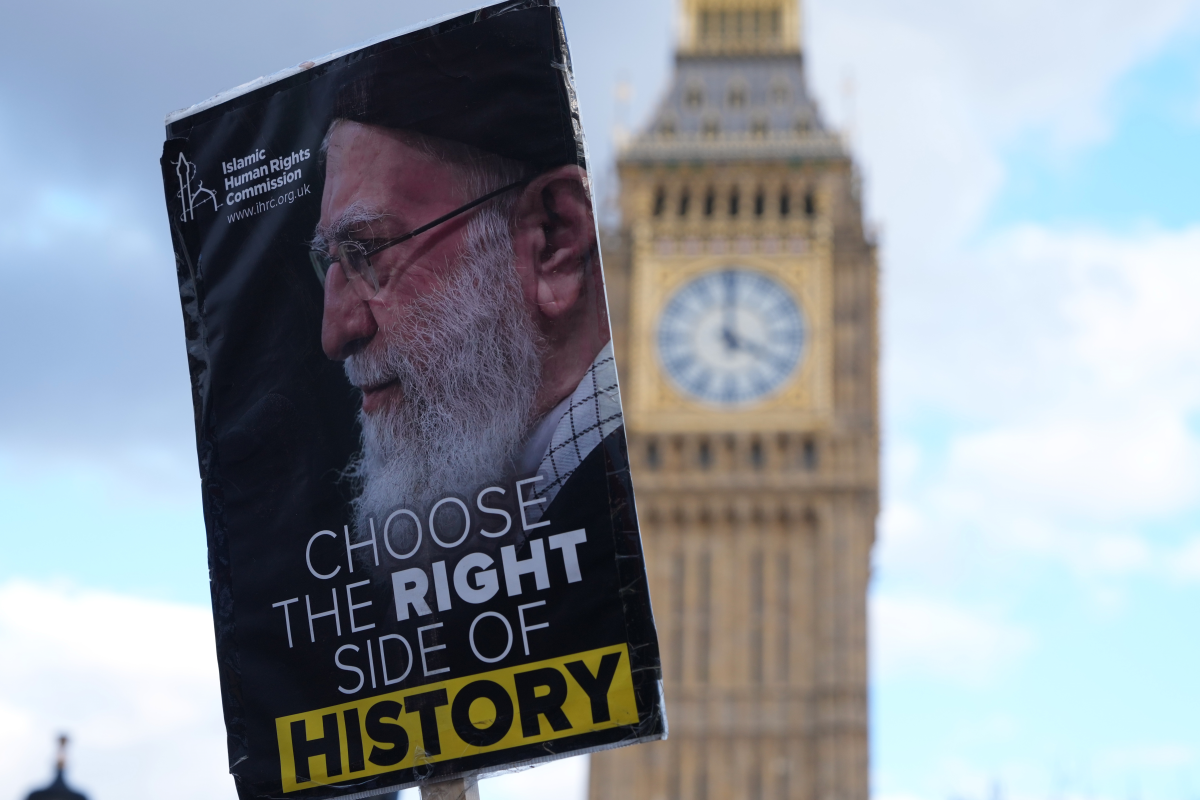
The statement did not explicitly support or denounce the strikes by the U.S. and Israel, it did condemn the subsequent retaliation from Iran.
“We condemn Iranian attacks on countries in the region in the strongest terms. Iran must refrain from indiscriminate military strikes.”
Spain: Spanish Prime Minister Pedro Sánchez said his country rejected “the unilateral military action by the United States and Israel, which represents an escalation and contributes to a more uncertain and hostile international order.”
He added: “We demand immediate de-escalation and full respect for international law. It is time to resume dialogue and achieve a lasting political solution for the region,” he said.
Canada: Prime Minister Mark Carney said that Canada supports the U.S. “acting to prevent Iran from obtaining a nuclear weapon and to prevent its regime from further threatening international peace and security.”
“Canada’s position remains clear: the Islamic Republic of Iran is the principal source of instability and terror throughout the Middle East, has one of the world’s worst human rights records, and must never be allowed to obtain or develop nuclear weapons,” he said.
Russia: The Foreign Ministry issued a statement calling the US-Israeli strikes on Iran “a pre-planned and unprovoked act” of aggression and demanded an immediate return to diplomatic talks.
The ministry also accused Washington and Tel Aviv of falsely hyping threats surrounding Iran’s nuclear program to pursue regime change, and warned the Middle East was in danger of plunging into a cycle of “uncontrolled escalation.”
China: A Chinese Foreign Ministry spokesperson said in a statement that China, a close partner of Iran, “is highly concerned over the military strikes against Iran launched by the U.S. and Israel.”
“Iran’s sovereignty, security and territorial integrity should be respected,” the statement added.
“China calls for an immediate stop of the military actions, no further escalation of the tense situation, resumption of dialogue and negotiation, and efforts to uphold peace and stability in the Middle East.”
Ukraine: In a video address, Ukraine’s President Volodymyr Zelenskyy appeared to endorse the Trump Administration’s strikes, stating “it is important that the United States is acting decisively.”
In his remarks, Zelenskyy talked about the Iranian leadership’s close ties with Russian President Vladimir Putin, and how Russia has struck Ukrainian cities more than 57,000 times with Iranian-designed Shahed drones.
“The Iranian regime chose to be an accomplice to Putin and supplies him with Shaheds,” Zelenskyy said.
Middle East: Oman’s Foreign Minister Badr Albusaidi, who has been mediating between the U.S. and Iran, says there had been active and serious nuclear talks taking place. In a post on X, he wrote that he was “dismayed” by coordinated Israeli-U.S. attacks on Iran.
Albdusaidi said the interests of the United States are not served by this and urged the U.S. not to quote “get sucked in further,” adding “this is not your war.”
The Omani mediator was in Washington Friday meeting with Vice President Vance, and told CBS News that Iran had agreed to zero stockpiling of nuclear enrichment.
Lebanon’s Prime Minister Nawaf Salam said on X that the region was witnessing “dangerous developments.”
Salam added that Lebanon “will not accept anyone dragging the country into adventures that threaten its security and unity.”
Australia: Australian Prime Minister Anthony Albanese said in a statement his country “stands with the brave people of Iran in their struggle against oppression.”
“With international partners, including the United States and the G7, we have called for the Iranian regime to uphold the human rights and fundamental freedoms of Iran’s citizens,” he said. “These calls have gone unheeded.”
“We support the United States acting to prevent Iran from obtaining a nuclear weapon and to prevent Iran continuing to threaten international peace and security,” he added.
NPR will continue to add more global reaction as it comes.
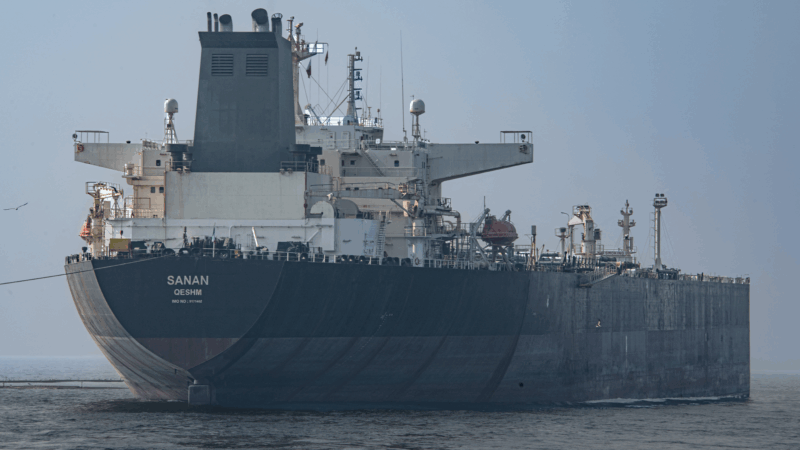
How could the U.S. strikes in Iran affect the world’s oil supply?
Despite sanctions, Iran is one of the world's major oil producers, with much of its crude exported to China.
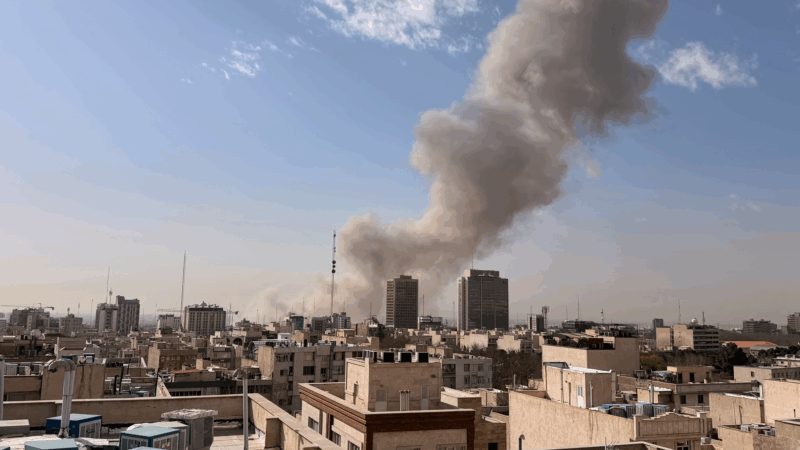
Why is the U.S. attacking Iran? Six things to know
The U.S. and Israel launched military strikes in Iran, targeting Khamenei and the Iranian president. "Operation Epic Fury" will be "massive and ongoing," President Trump said Saturday morning.
Sen. Tim Kaine calls on the Senate to vote on the war powers resolution
NPR's Scott Simon talks to Sen. Tim Kaine, D-Va., about the U.S. strikes on Iran.
Iran strikes were launched without approval from Congress, deeply dividing lawmakers
Top lawmakers were notified about the operation shortly before it was launched, but the White House did not seek authorization from Congress to carry out the strikes.
Political science expert weighs in on Iran’s nuclear program in light of U.S. strikes
NPR's Scott Simon speaks to Ariane Tabatabai, the Public Service Fellow at Lawfare, about U.S. attacks on Iran and how President Trump's calls for regime change might be received there.
Week in Politics: Does Trump have political support for his actions in Iran?
We look at what President Trump's decision to attack Iran means, what kind of support he has in Iran and what this moment means for his administration.
