
Hepatitis B: What parents should know about the virus and the vaccine
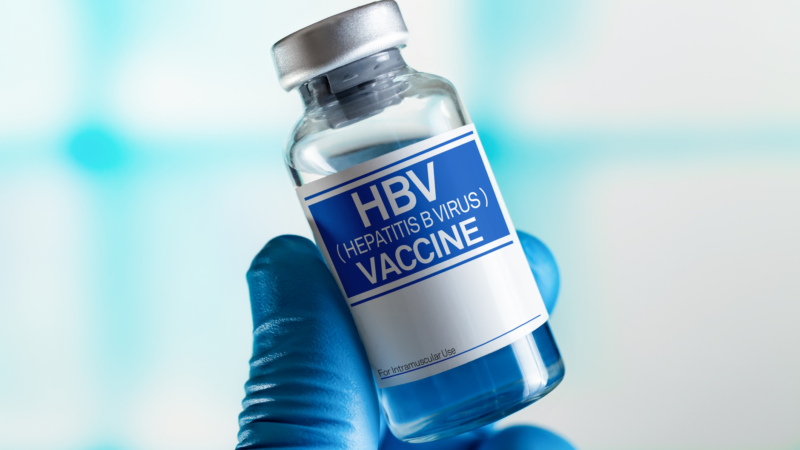
For more than three decades, it has been routine to give all newborns in the U.S. the hepatitis B vaccine. That could soon change.
An advisory committee to the Centers for Disease Control and Prevention is expected to vote Thursday on whether to rescind that universal recommendation.
If that happens, pediatricians say, the health consequences could be dire.
“It would be extremely dangerous,” Dr. Andrew Pavia told NPR this year. He’s a professor of pediatrics and medicine with the University of Utah and a pediatric and adult infectious disease specialist.
The hepatitis B virus attacks the liver. The disease has no cure, and chronic infection can lead to serious outcomes such as liver cancer, cirrhosis and death. And the risks of these outcomes are much higher for people who get infected as infants.
“About 25% of children who develop chronic hepatitis B will die of their infection,” says Pavia, who is also a spokesperson for the Infectious Diseases Society of America.
Delaying the birth dose by just two months could result in at least 1,400 additional preventable cases of hepatitis B for each year the revised recommendation is in place, according to a new analysis. Delaying the vaccine until age 12, as President Trump suggested this year, could result in at least 2,700 preventable infections each year, the analysis found. The study was released prior to peer review, ahead of this week’s meeting of the Advisory Committee on Immunization Practices.
Before the U.S. began universally vaccinating newborns in 1991, some 18,000 children a year would become infected before age 10. About half were infected through mother-to-child transmission, Pavia says. Giving newborns the shot right after birth prevents the virus from taking hold.
The other half of kids got infected from somewhere else. Trump said hepatitis B is sexually transmitted — which is one means of transmission — so there’s no reason to give the vaccine to a baby. But Pavia says the risks for kids are everywhere.
“There have been cases of infections in day care. There have been cases of infection on sports teams. There have been documented infections from shared toothbrushes and from shared razors,” he says.
The virus is found in blood, saliva, semen and other bodily fluids, even tears, and it can live on surfaces for up to seven days. A child with a wound who comes into contact with that surface — even days later — could become infected, says Anita Patel, a pediatrician and pediatric critical care physician in Washington, D.C.
According to the Centers for Disease Control and Prevention, about half of people infected with hepatitis B don’t know they have the virus, but Patel says they can still pass on the virus unwittingly.
“If you have a cut, that blood could potentially get on the infant,” Patel says. “And if that infant has any sort of break in their skin — as infants, frankly, frequently do — they can then get hepatitis B,” says Patel.
Dr. Su Wang says she suspects she got infected with hepatitis B as an infant through her grandparents. She says they likely got exposed through their jobs as medical workers in Taiwan. Taiwan used to have very high rates of hepatitis B infection among adults before it began a successful national vaccination program in the 1980s.
“When I was born, they came over to help, like a lot of grandparents do, and they lived with us,” Wang says. “They became primary caregivers for the first month of life. And so very likely that’s how I got hep B.”
Wang is now an internist and researcher specializing in hepatitis at Cooperman Barnabas Medical Center in New Jersey.
She says it’s very important to give the shot at birth. Since vaccination of newborns became routine in the U.S., case rates have plummeted 99% among people age 19 and younger.
“When we started doing this as universal for all kids, you saw this blanket protection that protected an entire generation of kids,” Wang says.

US military used laser to take down Border Protection drone, lawmakers say
The U.S. military used a laser to shoot down a Customs and Border Protection drone, members of Congress said Thursday, and the Federal Aviation Administration responded by closing more airspace near El Paso, Texas.

Deadline looms as Anthropic rejects Pentagon demands it remove AI safeguards
The Defense Department has been feuding with Anthropic over military uses of its artificial intelligence tools. At stake are hundreds of millions of dollars in contracts and access to some of the most advanced AI on the planet.

Pakistan’s defense minister says that there is now ‘open war’ with Afghanistan after latest strikes
Pakistan's defense minister said that his country ran out of "patience" and considers that there is now an "open war" with Afghanistan, after both countries launched strikes following an Afghan cross-border attack.

Hillary Clinton calls House Oversight questioning ‘repetitive’ in 6 hour deposition
In more than seven hours behind closed doors, former Secretary of State Hillary Clinton answered questions from the House Oversight Committee as it investigates Jeffrey Epstein.
Chicagoans pay respects to Jesse Jackson as cross-country memorial services begin
Memorial services for the Rev. Jesse Jackson Sr. to honor his long civil rights legacy begin in Chicago. Events will also take place in Washington, D.C., and South Carolina, where he was born and began his activism.

In reversal, Warner Bros. jilts Netflix for Paramount
Warner Bros. says Paramount's sweetened bid to buy the whole company is "superior" to an $83 billion deal it struck with Netflix for just its streaming services, studios, and intellectual property.
