
Hegseth says the U.S. will reposition military amid threat from China

SINGAPORE — Defense Secretary Pete Hegseth gave a stark warning Saturday about China’s threat to the status quo in Asia. He said the U.S. is refocusing its strength and policies on deterring China, and coaxed China’s neighbors and U.S. allies to help.
“It has to be clear to all that Beijing is credibly preparing to potentially use military force to alter the balance of power in the Indo-Pacific,” Hegseth told civilian and military officials at the annual Shangri-La Dialogue, Asia’s top defense summit.
The U.S. does not seek conflict, nor intend to “dominate or strangle China, to encircle or provoke,” Hegseth insisted. “We do not seek regime change.”
Previous U.S. administrations have offered similar reassurances to Beijing. But retired Chinese Senior Col. Zhou Bo, now a senior fellow at the Center for International Security and Strategy at Tsinghua University in Beijing, says he thought Hegseth’s speech was “far more hostile than any of his predecessors made at the Shangri-La Dialogue,” and were infused with “ideological rivalry.”
Zhou adds that Hegseth’s Singapore speech was more supportive of U.S. allies than Vice President Vance’s starkly critical remarks at the Munich Security Conference in February. So, Zhou asks, “which one should we really believe?”
Refocusing U.S. military posture on China
Hegseth said the U.S. is “reorienting toward deterring aggression by Communist China.”
One implication of this is that the U.S. could withdraw some of the 28,500 U.S. troops in South Korea to deal with China, including in a case of a potential conflict between mainland China and Taiwan, which the Pentagon calls its “sole pacing scenario.” The Pentagon says it has no plans to pull its forces out of South Korea, but insists it must have the “strategic flexibility” to put troops where it needs them.
U.S. interests could diverge from those of South Korea, as the South sees its primary threat coming from North Korea.
“I do think we’re likely to see a change in force posture on the peninsula. I think the administration has been starting to signal that pretty openly,” says Zack Cooper, a senior fellow at the American Enterprise Institute in Washington, D.C., who was attending the Shangri-La dialogue.
“I think the message from the Trump administration,” he added, “is that all that matters is what South Korea does on China. And the reality is that U.S.-South Korea interests go far beyond what South Korea does on China.”
“America first” defense policies
Hegseth’s emphasis on U.S. priorities echoed much of President Trump’s “America First” rhetoric. The defense secretary slammed the Biden administration’s policies as “feckless,” while praising President Trump’s acumen as a dealmaker and efforts to seal its borders to an “invasion” of illegal immigrants.
“We are not here to pressure other countries to embrace and adopt our politics or ideology,” Hegseth told the assembled leaders and military officials.
Hegseth conceded that geography makes it necessary for Asian nations to rely on China economically, while seeking defense cooperation with the U.S.
“But beware the leverage that the CCP [Chinese Communist Party] seeks with that entanglement,” he warned. “Economic dependence on China only deepens their malign influence and complicates our defense decision space during times of tension.”
Malaysian Prime Minister Anwar Ibrahim said his country would remain non-aligned, and against major powers carving out spheres of influence. He said Malaysia would continue to welcome the U.S. presence in the region, but also continue to value it ties with China.
“What Southeast Asia needs is a dynamic equilibrium,” he said, “that enables cooperation without coercion, and balance without bloc politics.”
European leader warns of double standards
In a speech at the forum the evening before Hegseth spoke, French President Emmanuel Macron offered a critique of U.S. policies, and encouraged nations to maintain strategic autonomy amid the U.S.-China rivalry.
“We want to cooperate. But we don’t want to be instructed on a daily basis what is allowed, what is not allowed and how our life will change because of the decision of a single person,” he said, apparently alluding to Trump.
Macron also rejected the double standard of rushing to defend Taiwan — a self-governing island that China claims as part of its territory — while abandoning Ukraine, a move which he said would undermine the U.S.’ own credibility.
China’s embassy in Singapore shot back on its Facebook page that “comparing the Taiwan question with the Ukraine issue is unacceptable,” as the Taiwan issue is China’s internal affair.
“If we use a double standard to look at a double standard,” it argued, “we still end up with a double standard.”
in response to Hegseth’s remarks, the embassy said in a separate Facebook post that the U.S. “claims to safeguard peace and not to seek conflicts. We’ve heard it. Let’s see what moves will it take.”
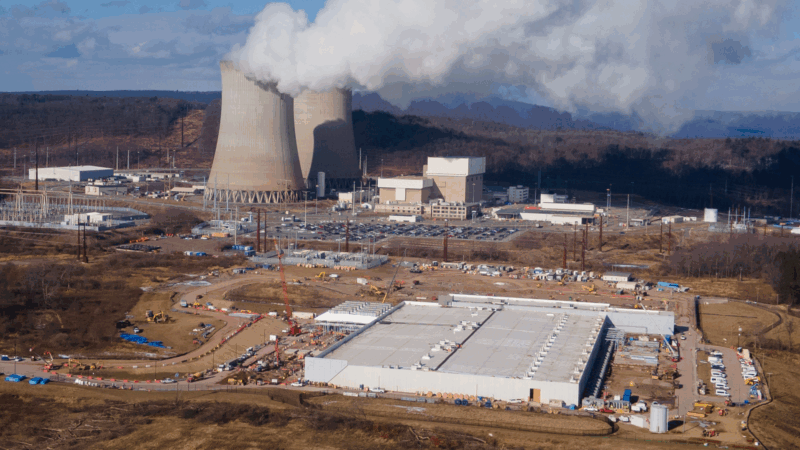
These major issues have brought together Democrats and Republicans in states
Across the country, Republicans and Democrats have found bipartisan agreement on regulating artificial intelligence and data centers. But it's not just big tech aligning the two parties.
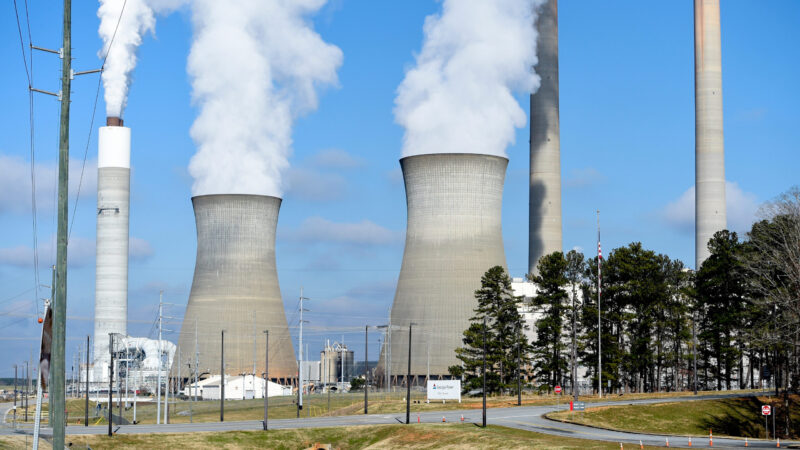
Feds announce $4.1 billion loan for electric power expansion in Alabama
Federal energy officials said the loan will save customers money as the companies undertake a huge expansion driven by demand from computer data centers.

Mortgage rates fall below 6% for the first time in years
The average home loan rate has dropped below 6% for the first time since 2022. Will that help thaw the frozen housing market?

Baby Keem’s boulevard of broken dreams
Ca$ino, the rapper's second album for his cousin Kendrick Lamar's label, is whiplash embodied, a mirror for the extreme highs and lows of his Sin City hometown.

Pentagon shifts toward maintaining ties to Scouting
Months after NPR reported on the Pentagon's efforts to sever ties with Scouting America, efforts to maintain the partnership have new momentum
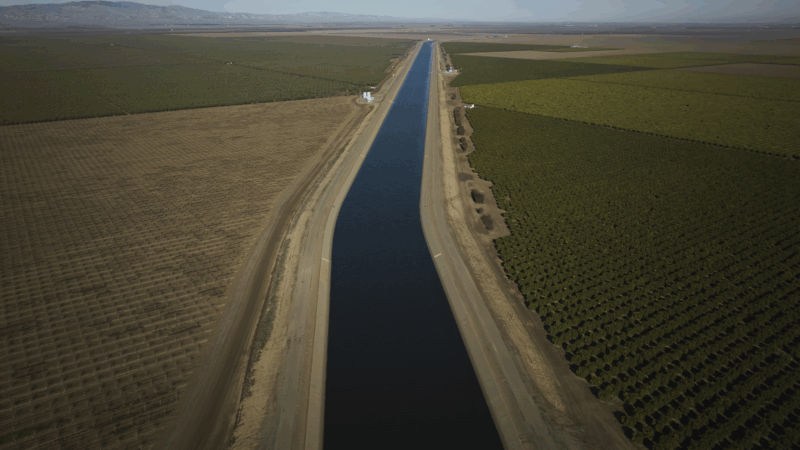
Why farmers in California are backing a giant solar farm
Many farmers have had to fallow land as a state law comes into effect limiting their access to water. There's now a push to develop some of that land… into solar farms.
