
Harrison Ford isn’t retiring: ‘I really wouldn’t know what to do with myself’

After playing some of the most recognizable and beloved characters in cinematic history, Harrison Ford is not interested in retiring. “Without my work, I really wouldn’t know what to do with myself,” the 83-year-old actor says. “I really do love the work. … It constantly changes, and the people change, and the mission and the opportunity change, and it just makes for an interesting way to live your life.”
Ford initially struggled to find his footing in Hollywood. He worked on-and-off as a carpenter for years before landing the breakthrough role of Han Solo in the original Star Wars film. He went on to star in the Star Wars sequels, as well as the Indiana Jones movies and Blade Runner — all the while frequently performing his own action scenes.
“I don’t want to have to hide the face of the character because it’s a stunt guy,” he says. “I want [the audience] to feel the blow. I want them to see the anxiety. I want them to be there when the decision is made or when the decision is missed. I just want them to be there.”
In the current Apple TV series, Shrinking, Ford plays a therapist named Paul who’s been diagnosed with Parkinson’s disease. Thus far, he says, the show’s writers haven’t shared with him the progression of Paul’s disease. Instead, he says, “Like a true Parkinson’s patient, I don’t really know what’s coming. … I’m sort of living with the symptoms I have been last described as having.”
Recently, Ford teared up while accepting a recognition for lifetime achievement at the Actor Awards. “That speech that I wrote was not crafted to be emotional; it just happened to me,” he says. “I feel slightly embarrassed by it, because I have enough experience with these things to want to be able to manage not to be overcome.”
Interview highlights
On being asked to help in Star Wars auditions while on a carpentry job at Francis Ford Coppola‘s office
I was there sweeping up. I was just finishing the job when George Lucas walked in [who Ford knew from appearing in Lucas’ last film, American Graffiti] … and I’m standing there in my carpenter’s work belt, sweeping up the floor. It turned out to be a fortuitous occasion, because weeks later I would end up being asked if I would do them a favor and read with the other actors who were being considered for the parts. … I never was told that I was ever to be considered, and then at the end of the process, I guess they ended up with two groups of three people that were in final consideration. I’ve always been amused that in the second group, the character of Han Solo would have been played by Chris Walken. I would have loved to see that.
On his most famous ad-lib in a film
[It’s] the line in Star Wars where Princess Leia tells me that she loves me and I say, “I know,” instead of saying “I love you too,” which is the scripted line. Simply the impulse was to be more in character. And George Lucas, who had written the line, was not so happy that I didn’t give him the original version. But I really felt strongly about it. So he made me sit next to him when he previewed the film in a public movie theater in San Francisco and it got … a good laugh. And so he accepted it and left it in.
On seeing Star Wars for the first time on screen
I was blown away. I mean, I was really shocked by the power of the film. We shot in England and our English crew were not used to something like Star Wars, and so they were pretty sure that it was going to be a disaster. And we weren’t far from that opinion, ourselves, the actors.
On performing an emergency landing while flying solo in a vintage World War II airplane
Let’s just start by saying that it was a mechanical failure. … It was a 74-year-old airplane, and I was 74 years old at the time. .. Four hundred feet in the air above the airport, the engine quit. And it’s my home airport, and I was familiar with the surrounding terrain, which is cluttered with houses, wires and cars, and people. So I turned to a golf course that was there. …
In my ear was the very clear voice of one of my aviation mentors who always, when talking about mechanical failures or other kinds of failures, the advice was to “fly the airplane as far into the crash as possible.” You think about this thing when you’re a pilot, you think about the potential, the possibility of it happening, and of course you train. So when it happened, it was not really a surprise, and I thought I knew what I had to do to handle it, so I just started doing the things that needed to be done. … I don’t remember actually being scared. [My injuries] were more than described in the newspaper, but I’m over them all, thank you. I got my license back and continue to fly. … I am not a thrill seeker. I am a very conservative pilot. It’s not that I do crazy stuff for the fun of it.
On objecting to the Vietnam War draft
I was facing being drafted and I hired a lawyer to represent me to the draft board. I had to explain why I might qualify as a conscientious objector. I explained that I did not have a history of religious affiliation. My mother was Jewish, my father Catholic. … I was raised Democrat. I’m quite happy to accept other people’s versions of God, but I found in a Protestant theologian named Paul Tillich, a sentence that said: If you have trouble with the word God, take whatever is central and most meaningful to your life and call that God.
And to me that was life itself, the complexity, the biodiversity, the incredible integration and complexity of nature, to me seemed to be the same thing as God. And so I prepared an explanation that was probably so unusual that it found the edge of a desk and had a lot of things piled on top of it because it didn’t fit a niche. They never got back to me, basically. The draft board never got back to me.
Lauren Krenzel and Nico Gonzalez Wisler produced and edited this interview for broadcast. Bridget Bentz, Molly Seavy-Nesper and Beth Novey adapted it for the web.

Rebecca Gayheart Dane on caring for her late husband, Eric Dane, and synthetic voices
The wife of 'Grey's Anatomy' actor Eric Dane says caring for him gave her an "extra dose" of compassion for others.

Chile turns right: Kast inaugurated as nation’s most conservative leader since Pinochet
Chile has sworn in its most right-wing president in decades — and his rise, and ideology, are rooted in a small town beneath the Andes.
Iran’s soccer team cannot participate in the FIFA World Cup, Iranian minister says
Iran is set to play three games in the U.S. this June. But amid the U.S.-Israel military campaign that has killed Iran's supreme leader, Iran's sports minister said the team would pull out.

Pentagon probe points to U.S. missile hitting Iranian school
A military assessment suggests a U.S. Tomahawk cruise missile was responsible for at least 165 deaths at an Iranian girls' school, according to a U.S. official who was not authorized to speak publicly.
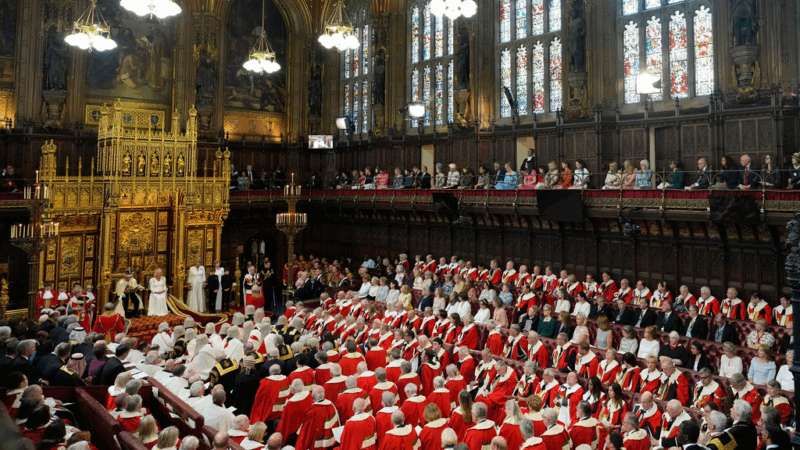
No Nobles Day: Britain’s Parliament boots its last hereditary Lords after 700 years
Government minister Nick Thomas-Symonds said the change put an end to "an archaic and undemocratic principle." The removed aristocrats are 92 of the House of Lords' 800 members.

On her new album, Kacey Musgraves returns home, to the ‘Middle of Nowhere’
Before making her upcoming sixth album, the country star returned to her small-town Texas home and discovered the power of in-between spaces. "I found a lot of clarity there," she says.
