
Greetings from Vienna, where an imperial palace hosts a holiday market for all
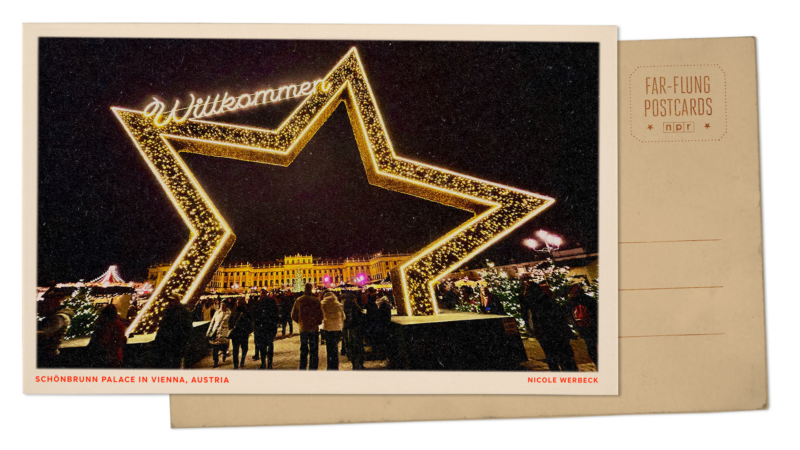
Far-Flung Postcards is a weekly series in which NPR’s international team shares moments from their lives and work around the world.
This was the year I finally made good on a five-year-old promise to my husband that we’d visit Christmas markets in Europe. It was important to us to experience these markets because we really enjoy Christmas festivities, and the mix of culture and history is hard to find anywhere else.
We walked about 10 miles a day in a packed schedule through a couple dozen Christmas markets in Hungary, Germany and Austria. No two were quite alike.
The market at Vienna’s 18th century Schönbrunn Palace, a UNESCO World Heritage Site, was among the most special. When I first saw this huge lit-up star archway with its message of welcome, I gasped. The market, in the palace’s grand courtyard, was full of attractions including an ice rink, ice stock games (like curling), a Ferris wheel, carousel and tons of food and craft booths.
We made a point to try local specialties like Käsespätzle (a German macaroni and cheese) and Glühwein, or mulled wine. Most Christmas markets across Europe serve Glühwein in collectible mugs with the market’s logo or shaped like Santa’s boot. You can pay a deposit and return the mug or keep it as a memento.
What I loved most was the sense of community at these markets. They can get crowded, but everyone’s there to enjoy the food, wine and fun. You often end up chatting with strangers or hearing about another stall to check out.
At the Altwiener Christkindl Market, also in Vienna, we talked with an artisan about a New Year’s tradition, Schwein gehabt, which means “had a pig” and symbolizes prosperity. In Germany and Austria, owning a pig meant wealth. Around New Year’s, people gift pig-shaped charms as tokens of good fortune. I picked up several!
See more photos from around the world:
- Greetings from Jaffa, Israel, where a salon is a welcoming space for Palestinians and Jews
- Greetings from Chiloé Island, Chile, where the fast-moving tides are part of local lore
- Greetings from Andhra Pradesh, India, where a fragrant food stand feeds working women
- Greetings from Ukraine, where churchgoers seek respite ahead of another winter at war
- Greetings from Amman, Jordan, where history lent a colossal hand

Supreme Court appears split in tax foreclosure case
At issue is whether a county can seize homeowners' residence for unpaid property taxes and sell the house at auction for less than the homeowners would get if they put their home on the market themselves.

Top House Dem wants Justice Department to explain missing Trump-related Epstein files
After NPR reporting revealed dozens of pages of Epstein files related to President Trump appear to be missing from the public record, a top House Democrat wants to know why.
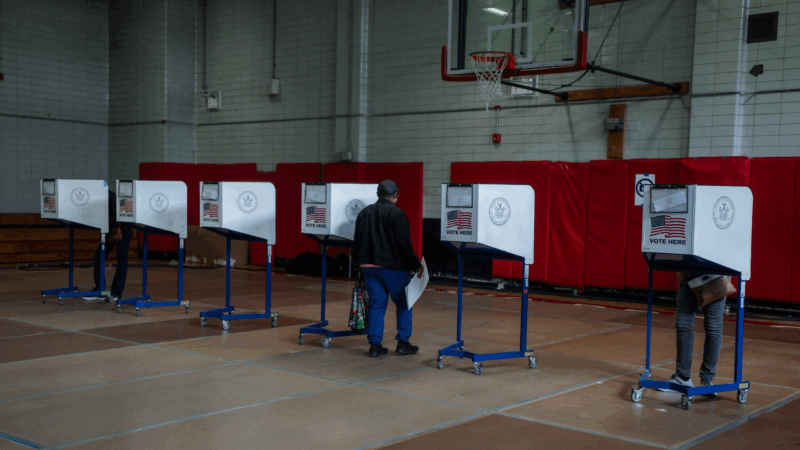
ICE won’t be at polling places this year, a Trump DHS official promises
In a call with top state voting officials, a Department of Homeland Security official stated unequivocally that immigration agents would not be patrolling polling places during this year's midterms.
Cubans from US killed after speedboat opens fire on island’s troops, Havana says
Cuba says the 10 passengers on a boat that opened fire on its soldiers were armed Cubans living in the U.S. who were trying to infiltrate the island and unleash terrorism. Secretary of State Marco Rubio says the U.S. is gathering its own information.

Surgeon general nominee Means questioned about vaccines, birth control and financial conflicts
During a confirmation hearing, senators asked Dr. Casey Means about her current positions and her past statements on a range of public health issues.

Rock & Roll Hall of Fame 2026 shortlist includes Lauryn Hill, Shakira and Wu-Tang Clan
The shortlist also includes a 1990s pop diva, heavy metal pioneers and a legendary R&B singer and producer.
