
Giant robots battle it out in Detroit’s Robowar
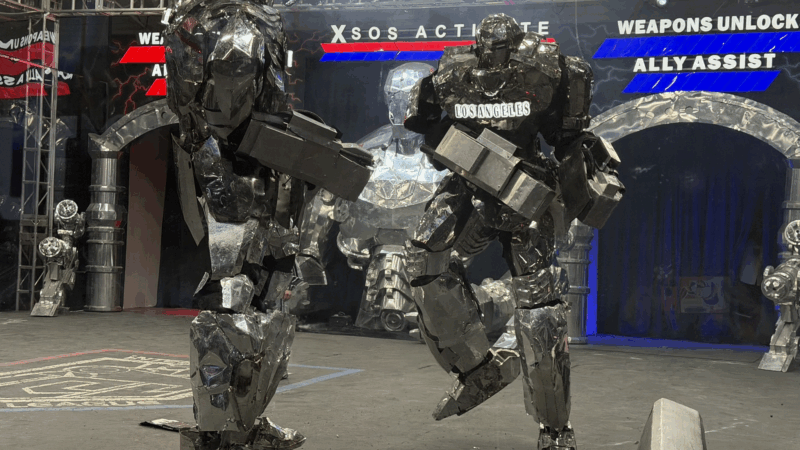
In the back of a church in an anonymous stretch of 7 Mile in Detroit dotted with industrial lots and fast food stores, performers dressed as giant robots battle it out in front of a live audience behind bullet-proof glass.
“We have these nine foot tall metal gladiators that shoot exploding projectiles at 20 rounds a second,” says Art Cartwright, the impresario who founded both the church, Global Empowerment Ministries, and the organization behind the robot show, The Interactive Combat League.
The show, running every few months, is called Robowar. Cartwright’s two enterprises have little to do with each other, he says, save for sharing space and introducing members of his community to potential employment in robotics.
“Metropolitian Detroit right now leads the nation in robotics,” Cartwright says. “We have more robots than any other place in America.”
But the gleaming, glowing-eyed stars of the Interactive Combat League are nothing like industrial robots that help assemble automobiles. They are played by humans wearing what might be considered mech suits. Robots fighting each other as entertainment is a cultural fantasy that goes back at least to 1956, when Richard Matheson’s short story “Steel” was published in The Magazine of Fantasy & Science Fiction. It was adapted into a 1963 episode on the TV show The Twilight Zone, and helped inspire the 2011 movie, Real Steel.
“I’m a Marvel fan,” Cartwright says. “So I’m like, okay, let’s make some robots that look like superheroes.”
Robowar has been selling out shows in its 572 seat auditorium since it launched last summer, and has attracted admiring national coverage. Tickets start at around $50. Cartwright says he eventually plans to stage online interactive robot fights where remote viewers control the action by buying virtual tokens. He says he’s created AI personas for robots representing 30 different cities, from Boston to Los Angeles.
“They talk cash money trash,” he chuckles.

Robowar also features real robots — robot dogs and child-sized humanoids that dance and pose for pictures. Cartwright bought the smaller robots from a Chinese company, Unitree, known for making accessible robots, with some models available at places like Walmart and costing fewer than $20,000. At one point during the show, there’s a robot competing in a dance-off against a human audience member, executing impressive spins and flips. But the audience, including a 10 year old Kaden Denard, mostly seems to root against the machine.
“They are clankers!” Denard exclaims, using an emerging slur against robots and AI. “I want to be mean to the robots! They are clankers!”
“You better be nice to them before they finish you,” his mother, Nawal Denard, jokes. Though the two depart into a cold Michigan night, along with hundreds of other spectators, the room they left was full of human warmth.
Edited for radio and web by Meghan Sullivan

Bill would move Alabama to closed primaries
Right now, any Alabama voter can participate in a primary election. Lawmakers in Montgomery took up a bill this week that would change that system.

Why ‘Sinners’ should win best picture (but probably won’t) — and more Oscar predictions
NPR critics share their hopes and predictions for the 2026 Academy Awards, which air on Sunday.

Countries are negotiating rules to mine the deep sea. The U.S. is pushing ahead alone
With growing interest in mining critical metals from the seafloor, countries are now negotiating international rules. The Trump administration is forging ahead on its own, speeding up environmental review for mining the fragile ecosystem.
4 confirmed dead after U.S. military aircraft goes down in Iraq
The U.S. Central Command confirmed that at least four of six crew members on the KC-135 aircraft were dead, after the refueling plane went down in western Iraq on Thursday.

It’s Chalamet vs. ballet in this week’s news quiz. Are your answers en pointe?
Meanwhile, if you've been paying attention to medicine, basketball and the British Parliament, you'll get at least three questions right this week.
Trump wants more apprenticeships. An Arkansas manufacturer is giving it a try
President Trump has touted apprenticeships as part of his promise of a golden era for American workers. But are his administration's investments enough?
