
Frank Gehry, whose designs defied gravity and convention, dies at 96
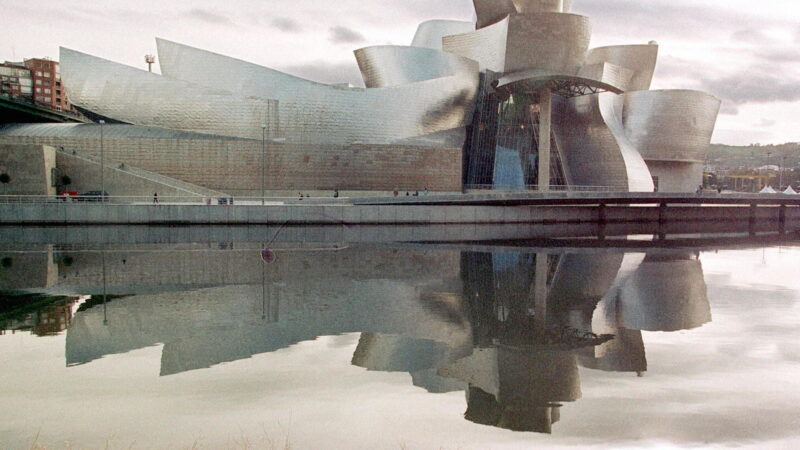
Swooping, swirling, gleaming, sculpted — Frank Gehry made buildings we’d never seen before. The architect behind the Guggenheim Museum in Spain and the Walt Disney Concert Hall in Los Angeles transformed contemporary architecture. He died Friday at his home in Santa Monica, Calif., after a brief respiratory illness, according to his chief of staff. He was 96.
Gehry won all the top awards — including the Pritzker Prize and the Presidential Medal of Freedom. In 1999, when the American Institute of Architects gave him their Gold Medal, Gehry looked out at an audience that included contemporary gods of building — Philip Johnson, Richard Venturi, Michael Graves — and said, “it’s like finding out my big brothers love me after all.”
“He was probably the only truly great artist I’ve ever encountered who desperately cared what people thought of him and that people loved his work,” says Gehry’s biographer Paul Goldberger. The architect got his share of criticism — “accusations that he made crazy shapes and paid no attention to budget.”
But the praise was louder, because his striking buildings made people happy.


“I’ve always been for optimism and architecture not being sad,” Gehry told NPR in 2004. “You know, a building for music and performance should be joyful. It should be a great experience and it should be fun to go to.”
There was exuberance in his work. The swoops and swirls — made possible with aerospace technology — lifted the spirits of viewers used to post-war modernism — strict, boxy glass and steel buildings that looked imposing and unwelcoming.
Gehry says he found that style, cold, inhuman and lifeless. “I thought it was possible to find a way to express feeling and humanistic qualities in a building,” Gehry said. “But I wasn’t clear about it until I started experimenting, quite accidentally, with fish forms.”
He loved the shape of fish, and the way they moved. He drew them all his life, an inspiration that began in his grandmother’s bathtub in Toronto.
“Every Thursday when I stayed at her house, I’d go with her to the market,” he recalled. “And there would be a big bag of some kind filled with water that we would carry home with a big carp in it. We’d put it in the bathtub. I’d sit and watch it and the next day it was gone.”
Those carp were turned into gefilte fish — a classic Jewish dish — but stayed in Gehry’s memory long past suppertime. He translated their curves and motions into architecture. In Prague, Czechs call his elegant design for an office building “Fred and Ginger” — two cylindrical towers, one solid, the other glass, pinched in at the waist, like dancers. His Disney Hall and his Guggenheim museum swell like symphonies.

“He really wanted you to feel a sense of movement,” Goldberger says. “A building is a static thing, but if it feels like it’s moving, for him that was more exciting.”
The Guggenheim — a billowing swirl of titanium in gold and sunset colors — excited viewers. After it opened in 1997, Gehry said everyone who came to him wanted a Guggeinheim. But Gehry wasn’t interested.
“Like all great artists, he wanted to keep pushing himself and move forward,” Goldberger says. “He did not want to copy himself. He did not want to do that building again.”
The Guggeinheim Museum in Bilbao, Spain and The Disney Hall in Los Angeles (it opened in 2003, a swoosh of silver stainless steel, 1/16th of an inch thick) are Gehry’s signature buildings. But they’re a far cry from his early work. His own 1978 residence in Santa Monica sports common materials. If clients couldn’t afford fancy — marble, say — he’d use cheap.


“He started using plywood and chain link fence and corrugated metal,” Goldberger says.
Those buildings got attention. But the later ones made him a star — and a term was coined: Starchitect. Goldberger says Gehry hated it.
“I’ve always been for optimism and architecture not being sad. … A building for music and performance should be joyful.”
Architect Frank Gehry
“He didn’t really hate fame,” Goldberger explains. “But he was too smart to sacrifice everything for it.”
Gehry kept faithful to his vision. He turned down jobs that didn’t feel right and imagined others that got built, were widely admired, but sometimes didn’t live up to his imagination.
“You know, what’s in my mind’s eye is always 10 times better than what I ever achieve because the dream image can leak …” Gehry said with a laugh. “But in terms of its public acceptance it’s beyond anything I ever expected. I’ve never been accepted before like this.”
Gehry received a National Medal of Arts from Bill Clinton and a Presidential Medal of Freedom from Barack Obama. The New Yorker called Bilbao “a masterpiece of the 20th century.” Architect Philip Johnson said it was “the building of the century.” And the public (with some exceptions, of course) adored the work.
“He made great architecture accessible to people,” Goldberger says, and that re-shaped their sense of what buildings could be.
He describes Gehry’s work as “one of those extraordinary moments where the most advanced art intersects with popular taste. That only happens very rarely in the culture, in any field.”
It’s been said that architecture is the message a civilization sends to the future. With walls that are shaped and sculpted, and buildings that look joyous and free, Frank Gehry’s is a message of humanism and hope.
The author of this obituary, Susan Stamberg, died in October 2025. The story was updated and reviewed before publication.
Shannon Rhoades edited the audio of this story. Beth Novey adapted it for the Web.

Carney says he backs strikes on Iran ‘with some regret’ as world order frays
Canadian Prime Minister Mark Carney says he supports the strikes on Iran "with some regret" as they represent an extreme example of a rupturing world order.
Iranian civilians are now fleeing the relentless bombing for neighboring Turkey
As the U.S. military broadens its strikes in Iran, traumatized Iranians are reaching the border with Turkey.

A split Senate votes against measure to constrain Trump’s authorities in Iran
Democrats in the Senate were facing an uphill climb Wednesday in their push to restrain President Trump's ability to wage war against Iran.
WATCH: How traffic dried up in the Strait of Hormuz since the Iran war began
The effective closure of the Strait of Hormuz is "about as wrong as things could go" for global oil markets. Iran achieved it not with a naval blockade, but with cheap drones.

As Mississippi waits to spend opioid settlement funds, children and families suffer
Mississippi will receive more than $400M to fight the opioid epidemic. So far, officials haven't directed it toward programs that support addiction recovery.

Alabama’s new state climatologist takes the reins
The controversial John Christy is retiring as Alabama’s state climatologist. Lee Ellenburg now assumes the role and is already making a few changes, including declaring that climate change is real and caused by humans.
