
For the first time this century, child deaths under age 5 will likely rise. Why?
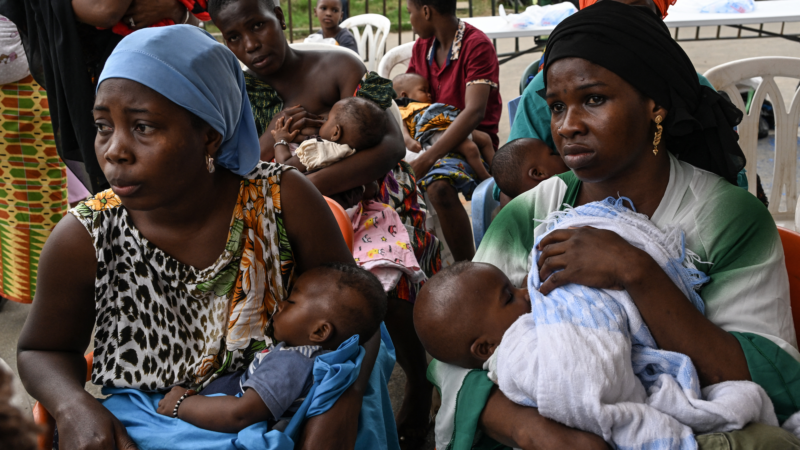
One of the crowning achievements in global health is at risk of coming undone.
Between 2000 and 2020, the number of children who die before they hit their 5th birthday dropped by half — from nearly 10 million deaths a year to under 5 million deaths a year.
What brought about this remarkable progress? It’s the result of many improvements in global health, including the widespread rollout of childhood vaccinations. The decline in child deaths slowed during the height of the COVID pandemic as health systems were disrupted but it did not reverse — until now.
Estimates suggest 2025 will be the first year this century that child deaths have gone up instead of down.
In 2024, 4.6 million children died before hitting age 5. That number is projected to rise by just over 200,000 — to an estimated 4.8 million children — in 2025, according to modeling work done by the Institute for Health Metrics and Evaluation (IHME) at the University of Washington in Seattle.
“It’s horrific,” says Brooke Nichols, an associate professor of global health at Boston University, who was not involved in this research but has done her own work on estimating the impact of the drop in foreign aid.
She says the methodology used by IHME looks sound and in line with many of the other estimates — including one published in July in the medical journal The Lancet. The IHME estimate “looks relatively conservative in terms of estimates,” she says.
The U.S. State Department did not respond to NPR’s request for comment regarding the the IHME findings.
What’s behind the numbers?
The researchers did not yet have reliable data from health agencies around the world on how many children have died, so they needed to model changes in child mortality based on what has happened in the past.
While many of the leading causes of death in young children — including infectious diseases like malaria and diarrhea as well as pre-term birth complications — have not changed, the report did not focus on specific diseases or conditions.
“We don’t yet have direct observations on child mortality. Unfortunately, that will take a few years,” says Dr. Steve Lim, one of the researchers at IHME behind the estimates and a professor of health metrics sciences at IHME. Lim notes that many countries don’t have good systems for tracking deaths.
Instead, Lim and his team built a mathematical model that forecast future child mortality based on how a number of factors — like health spending in a country — were linked to child health outcomes. Their model used past data and analysis on the relationship between these factors to make the predictions. Their approach zeroed in on one factor: The impact of cuts to foreign aid. They looked at this by considering historical data on what the relationship has been between health spending, driven in large part by foreign aid, and child mortality.
This year has brought a historic drop in foreign aid. In 2024, Lim says, around $49 billion was given in foreign aid for health. In 2025, that number dropped to $36 billion — a drop of more than 26%.
It wasn’t just the U.S. that dramatically scaled back international aid. Other high-income countries like the United Kingdom, France and Germany have also been making significant cuts as priorities have shifted. And while some countries have stepped up — for example, Indonesia began contributing more than it receives from Gavi, the international vaccine alliance this year and South Africa increased its contribution to the Global Fund to Fight AIDS, Tuberculosis and Malaria — it does not make up for the cuts.
Lim says the countries where their model suggests the biggest spike in childhood deaths are those most dependent on foreign aid for their health budgets. “We expect low-income countries and countries in Sub-Saharan Africa to be the most affected,” he says. Lim estimates that some countries spent 20% less on health as a result of the cuts: “So, as you can imagine, such large cuts will have substantial consequences on health services.”
What does the future look like?
Lim’s estimates — which were published this week as part of the Gates Foundation’s annual Goalkeepers Report that tracks how well the world is doing on development goals — modeled out a few scenarios going forward. (The Gates Foundation provides financial support for this blog and NPR.)
If global health funding cuts of 20% below 2024 levels persist, Lim’s team found that 12 million children could die by 2045 above and beyond what the number was already expected. If there is a 30% cut in aid, they found it would bring that toll to 16 million additional child deaths.
They also looked at a positive scenario: If the world was to recommit to funding health for the poorest countries at the same level as 2024, the researchers found that health innovations in the pipeline — like new vaccines, malaria control interventions, new maternal and neonatal care strategies — would save 12 million additional children by 2045.
Lim says it’s “basically an impossible task” to predict how particular countries might reallocate money toward health programs and that these estimates will have to be updated as countries adjust to the new reality.
Nichols says it’s important not to lose track of what is behind the numbers. “Sometimes we talk about numbers. Oh, this is an increase in mortality, a percent increase. What is a percent? It’s a human. It’s a child,” she says. “It could be your child. It could be my child.”

HUD proposes time limits and work requirements for rental aid
The rule would allow housing agencies and landlords to impose such requirements "to encourage self-sufficiency." Critics say most who can work already do, but their wages are low.
Paramount and Warner Bros’ deal is about merging studios, and a whole lot more
The nearly $111 billion marriage would unite Paramount and Warner film studios, streamers and television properties — including CNN — under the control of the wealthy Ellison family.

A new film follows Paul McCartney’s 2nd act after The Beatles’ breakup
While previous documentaries captured the frenzy of Beatlemania, Man on the Run focuses on McCartney in the years between the band's breakup and John Lennon's death.

An aspiring dancer. A wealthy benefactor. And ‘Dreams’ turned to nightmare
A new psychological drama from Mexican filmmaker Michel Franco centers on the torrid affair between a wealthy San Francisco philanthropist and an undocumented immigrant who aspires to be a dancer.

Bill making the Public Service Commission an appointed board is dead for the session
Usually when discussing legislative action, the focus is on what's moving forward. But plenty of bills in a legislature stall or even die. Leaders in the Alabama legislature say a bill involving the Public Service Commission is dead for the session. We get details on that from Todd Stacy, host of Capitol Journal on Alabama Public Television.

My doctor keeps focusing on my weight. What other health metrics matter more?
Our Real Talk with a Doc columnist explains how to push back if your doctor's obsessed with weight loss. And what other health metrics matter more instead.
