
Feeling burned out? There’s a word for that in Mandarin Chinese
If you are feeling dispirited at work or burned out by the general pressure of life, there is a perfect word for you: “involution.”
The Mandarin Chinese word for “involution” — neijuan — is now a ubiquitous slang term. It has struck a chord with students exhausted by relentless academic competition, parents overwhelmed by social expectations and workers constantly filling overtime shifts. So for this installment of Word of the Week, we explore the evolution of involution.
“Involution” first appeared in English with its modern connotation of futility in a 1963 academic tract by American anthropologist Clifford Geertz on Dutch colonial society in Indonesia. He had observed people working harder than ever on the land — but yielding less and less food.
The term then bounced around niche academic circles. Scholar Philip Huang used it in a seminal study trying to explain why capitalism did not organically develop in the 20th century. Then the term appeared in a study of tax collectors in early 20th-century China.
Prasenjit Duara, now a professor at Duke University, had noticed that these tax collectors were actually not that good at forcing peasants to pay up. “This suggested to me that there was this involution, administrative involution,” he says.
Duara’s resulting book, Culture, Power, and the State, was later translated into Chinese. But how to translate “involution”? Book translators came up with the phrase neijuan, combining the Mandarin words for “inner” (nei) and “to curl” or “to roll” (juan), invoking this idea of cycling endlessly back into oneself.
Neijuan as a Mandarin term might have stayed in academic parlance, if not for the coronavirus pandemic in early 2020.
“I still vividly remember I gave a long interview to a Chinese journalist,” says Biao Xiang, a director at the Max Planck Institute for Social Anthropology, in Germany. In that 2020 interview, with Chinese outlet Sixth Tone, he set down the first definition for how neijuan is now used — to pinpoint a general feeling of ennui when trapped in what he called an “endless cycle of self-flagellation.”
“You have to intensify your effort, competing with other people for no purpose, yet you cannot quit,” he explained to NPR. His interview with Sixth Tone went viral, and from there, neijuan took off among the Chinese public. “I somehow just put the words to what people already know and already feel.”
People in China now use neijuan to describe something useless or doing something just for appearances.
Then neijuan got meme-ified — for example, a video of an elite Chinese university student studying on his laptop even while biking at night, providing a visual emblem for the absurdity of neijuan behavior.
Now, the word’s winding path has taken another twist — neijuan has entered the official bureaucratic lexicon.
In 2024, China’s top economic official, Li Qiang, criticized “spiraling involution” in the economy, describing a chronic problem where too many Chinese companies are competing with each other and producing the same thing.
Then this year, Chinese policymakers led by the country’s top leader, Xi Jinping, kicked off their “anti-involution” campaign to crack down on this overcapacity in production.
So, the term has come full circle to its roots describing unproductive economic activity. Might one say the word neijuan … has made a full involution?

When a horse whinnies, there’s more than meets the ear
A new study finds that horse whinnies are made of both a high and a low frequency, generated by different parts of the vocal tract. The two-tone sound may help horses convey more complex information.

Trump’s many tariff tools mean consumer prices won’t go down, analysts say
The Supreme Court struck down President Trump's signature tariffs. But the president has other tariff tools, and consumers shouldn't expect cheaper prices anytime soon, economists say.
Hundreds of American nurses choose Canada over the U.S. under Trump
More than 1,000 American nurses have successfully applied for licensure in British Columbia since April, a massive increase over prior years.

Tax credits for solar panels are available, but the catch is you can’t own them
Rooftop solar installers are steering customers toward leases instead of purchases. Federal tax credits for purchased systems have ended but are still available for leased ones.

5 takeaways from Trump’s State of the Union address
President Trump hit familiar notes on immigration and culture in his speech Tuesday night, but he largely underplayed the economic problems that voters say they are most concerned about.
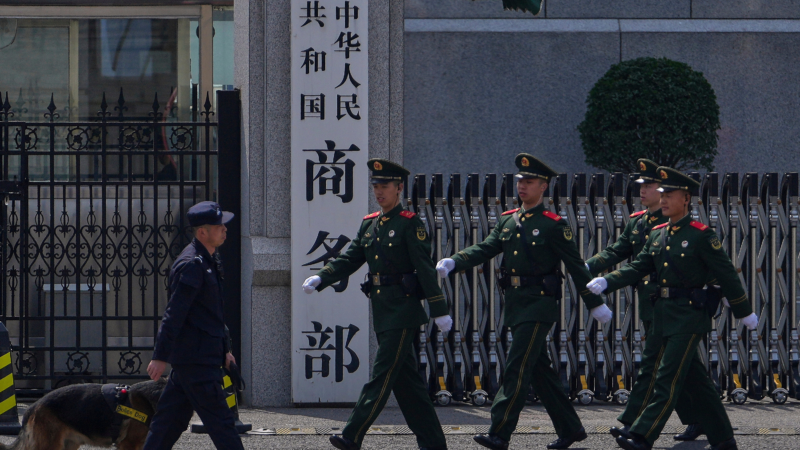
China restricts exports to 40 Japanese entities with ties to military
China on Tuesday restricted exports to 40 Japanese entities it says are contributing to Japan's "remilitarization," in the latest escalation of tensions with Tokyo.
