
Federal judge appears likely to temporarily halt Trump’s sweeping government overhaul
A federal judge in San Francisco appeared ready to temporarily block the Trump administration’s sweeping overhaul of the federal government.
U.S. District Judge Susan Illston, a Clinton appointee, held a hearing Friday in a lawsuit filed by a coalition of labor unions, nonprofits and local governments, who argue in their complaint that President Trump’s efforts to “radically restructure and dismantle the federal government” without any authorization from Congress violate the Constitution.
Illston appeared to agree with the plaintiffs, asserting in the hearing that Supreme Court precedent makes clear that while the president does have the authority to seek changes at agencies, he must do so in lawful ways. She went on to say that critical transformations of the type Trump is attempting to carry out “must have the cooperation of Congress.”
Plaintiffs were seeking a temporary restraining order to pause further implementation of the administration’s planned mass layoffs. Temporary restraining orders cannot be appealed, but the government would be expected to appeal any injunction the judge could issue later on.
Illston said a temporary restraining order was likely necessary “to protect the power of the legislative branch.” She noted that in his first term, Trump did in fact seek Congress’ approval for similar restructuring plans.
“He could have done that here, but he didn’t,” Illston said.
The case is just the latest in a string of court battles testing the limits of Trump’s executive authority.
In court filings, his administration has argued that he has “inherent authority” to exercise control over those executing the nation’s laws.
The government argued a temporary restraining order was inappropriate
In court on Friday, the Trump administration’s lawyer, Deputy Assistant Attorney General Eric Hamilton, argued the plaintiffs’ request for a temporary restraining order was inappropriate given how much time has lapsed since Trump first signed an executive order to reshape the government.
“Plaintiffs are not entitled to any TRO because they waited far too long to bring this motion and any ’emergency’ is thus entirely of their own making,” he and other attorneys wrote in an earlier court filing.
The plaintiffs’ attorneys have argued that only now have they been able to ascertain what agencies are doing to carry out Trump’s directives, given the secrecy with which his administration has been operating.
“They’re trying to insulate from judicial review an unlawful set of instructions by not making public how they’re being implemented,” plaintiffs’ lawyer Danielle Leonard told the court on Friday.
Hamilton also argued — as the government has in numerous other cases involving federal employees — that the court lacks jurisdiction to hear the case. Instead, matters involving personnel issues within the federal government must be brought to the bodies Congress created to hear such complaints, he said.
Judge Illston appeared unpersuaded by that argument, questioning Hamilton over whether the matter at hand — a radical overhaul of the entire government — was one Congress intended to go through those administrative channels.
Seeking a halt to mass layoffs and shuttering of programs
The plaintiffs — which include the American Federation of Government Employees and several of its local branches, the American Public Health Association and the cities of Chicago, Baltimore and San Francisco — had asked the court to find Trump’s Feb. 11 executive order directing agencies to prepare for mass layoffs and shutter programs unlawful, and to temporarily stop agencies from implementing their restructuring plans — including issuing reduction-in-force (RIF) notices and closing offices.
Already, the plaintiffs’ lawyers argued, agencies including the Departments of Health and Human Services and Veterans Affairs are executing plans “not based on their own independent analysis or reasoned decision-making” but instead in accordance with the president’s executive order and accompanying instructions from Elon Musk’s DOGE team, the Office of Personnel Management and the Office of Management and Budget.
The Trump administration has defended the executive order, arguing it merely provides direction in very broad terms, while making clear any actions taken must be “consistent with applicable law.”
“This type of directive is a straightforward way for a President to exercise his undoubted authority to require a subordinate agency to determine what the law allows and then take whatever action is legally available to promote the President’s priorities,” the government’s attorneys wrote in court filings.
In court, Leonard said the government’s take was not an accurate description of the executive order.
“This is a mandatory order instructing agencies to begin RIFs now and to do so in the manner the president is directing,” she said.
This historian dug up the hidden history of ‘amateur’ blackface in America
In her new book, Darkology, historian Rhae Lynn Barnes writes about how blackface and minstrel shows became one of the most popular forms of entertainment in 19th- and 20th-century America.
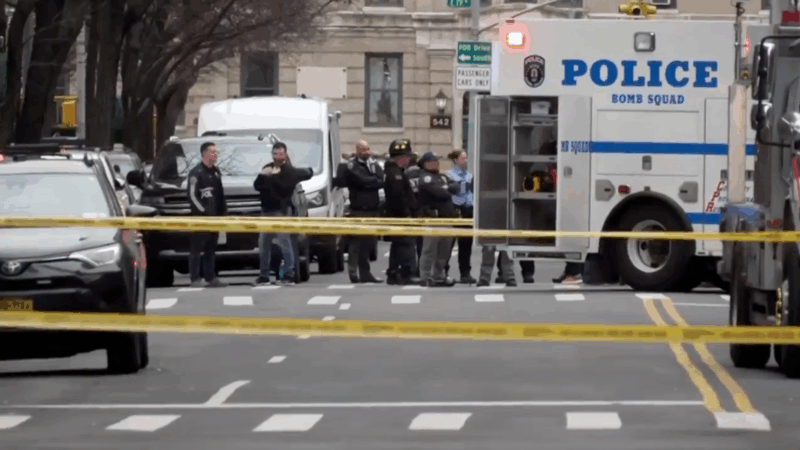
Attempted attack with explosives in New York City investigated as “ISIS-inspired terrorism”
New York City NYPD Commissioner: "Explosive devices that could have caused serious injury or death."

Trump is using immigration policy to suppress speech, lawsuit claims
A new lawsuit accuses the administration of violating the First Amendment by threatening the visas of researchers for work on disinformation and content moderation of social media.

Why young girls are disguised as boys in Afghanistan
The Taliban has released a video of an interrogation of a girl who passed as a boy. It's an age-old practice in this patriarchal society but now appears to be happening with some frequency.

Live Nation and Justice Department reach settlement in antitrust case
The trial, which began a week ago in a New York City courtroom, aimed to break up Live Nation and its subsidiary, Ticketmaster.

Microshelters for Birmingham’s unhoused set to open soon
The pilot program called Home For All involves building 14 small pallet homes to house those who would otherwise be living on the streets.
