
‘Even the Dead’ wraps up John Banville’s smart, moody mystery series
It’s a particularly bleak January — reason enough for literary escape. But, while some readers opt for sunshine (maybe a romance or historical novel) others are drawn to a genre that transports us deeper into darkness, while also affirming the power of reason to arrive at some clarity. I’m talking of course about noir fiction. And turning up just in time to accompany us through the gloom, here comes Quirke, again.
Quirke is the anti-hero of a series of mysteries set in 1950s Dublin written by Irish novelist John Banville. A coroner and pathologist, Quirke — who goes by one name only — dwells, as he’s put it, “Down among the dead men” in the basement morgue of a hospital.
Banville, who won the Booker Prize for his 2005 literary novel, The Sea, published his first Quirke mystery in 2006, under the pseudonym Benjamin Black. Holt paperbacks has been reissuing the novels under Banville’s name; the seventh and last reprint has just come out.
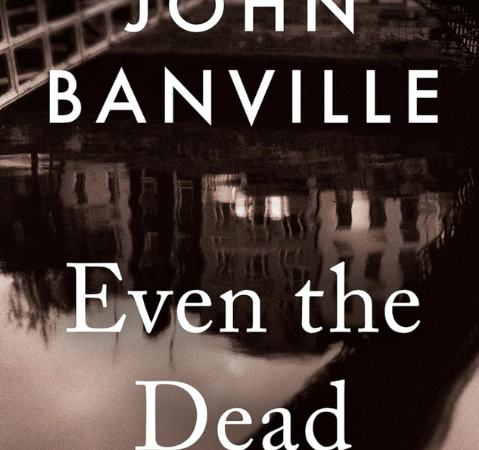
Even the Dead, affirms what we Quirke admirers already know: namely, that there never was much distinction between Banville’s so-called “literary novels” and his mysteries. Both are graced with Banville’s signature pensive atmosphere and a subdued beauty of language.
Even the Dead finds Quirke recovering from traumatic brain injuries he sustained in a previous investigation. He’s suffering from “absence seizures,” which Quirke describes as: “the odd moment of separation from myself.” We’re told early on that:
He had pills to make him sleep, and other pills to keep him calm when he was awake. And so the days trickled past, each one much the same as all the others. He felt like Robinson Crusoe, grown old on his island.
Back at the morgue, Quirke’s assistant, David Sinclair, is unsympathetically hoping his nasty boss never returns. But, when examining the charred corpse of a young man, an apparent suicide who crashed his car into a tree, Sinclair finds a suspicious indentation of the skull. Reluctantly, Sinclair calls on Quirke for a consult.
Meanwhile, Quirke’s semi-estranged daughter, Phoebe, is approached by a terrified young woman she recognizes from the secretarial course they both took. Turns out that this woman, who’s pregnant, witnessed the murder of her boyfriend. You guessed it: The boyfriend and the body in the morgue are one and the same.
This barest of plot summaries makes Even the Dead sound like a contrivance, when, in actuality, the intersecting relationships here are in accord with the claustrophobia of Banville’s 1950s Dublin. This is a city infused with “the heavy, cloying fragrance of malt roasting in Guinness’s brewery,” and “blue cigarette smoke” and “a smell of cabbage and boiled bacon.” Like Quirke, the city itself seems to be suffering from a series of “absence seizures,” — a lingering post-World War II malaise and dampening of appetite that could also be ascribed to the stifling power of the Catholic Church.
The past, as it does in all noirs, returns here in the form of a storyline from previous Quirke novels about the Magdalene laundries run by the Church where “fallen” women were sent to work, often against their will. And, Quirke, long tormented by the mystery of his own origins, finally achieves a limited epiphany.
In most mystery series, it would be a deal-breaker to begin with the final novel. But, if you’ve never read a Quirke book before, it won’t matter where you start. The primary draw of this moody and intelligent series has never been its plots. Instead, listen to the dark lyricism of this passage where Quirke reflects on growing up as an orphan:
Sometimes it seemed to him that all his life he had been standing with his back to a high wall, on the other side of which an endless circus show was going on. Now and then there would come to him on the breeze the sound of a drumroll, … or a surge of raucous laughter from the crowd. Why could he not scale the wall, … and jump down and run to the flap of the big top and peer in? Just to see what the performance looked like, even if he didn’t go inside, even if he were only to have that one, hindered glimpse of the dingy, sequined magic — that would be something.
I’d say the only reason not to read the Quirke series, wherever you begin, is if you’ve never in your life felt like that.
Iranian civilians are now fleeing the relentless bombing for neighboring Turkey
As the U.S. military broadens its strikes in Iran, traumatized Iranians are reaching the border with Turkey.

A split Senate votes against measure to constrain Trump’s authorities in Iran
Democrats in the Senate were facing an uphill climb Wednesday in their push to restrain President Trump's ability to wage war against Iran.
WATCH: How traffic dried up in the Strait of Hormuz since the Iran war began
The effective closure of the Strait of Hormuz is "about as wrong as things could go" for global oil markets. Iran achieved it not with a naval blockade, but with cheap drones.

As Mississippi waits to spend opioid settlement funds, children and families suffer
Mississippi will receive more than $400M to fight the opioid epidemic. So far, officials haven't directed it toward programs that support addiction recovery.
Alabama’s new state climatologist takes the reins
The controversial John Christy is retiring as Alabama’s state climatologist. Lee Ellenburg now assumes the role and is already making a few changes, including declaring that climate change is real and caused by humans.

Colossal Biosciences breeds controversy while trying to revive mammoths
A Texas biotech company is trying to bring mammoths and other extinct creatures back to life. The science is as intriguing as the ethical questions are thorny.
