
Even healthy brains decline with age. Here’s what you can do

After about age 40, our brains begin to lose a step or two.
Each year, our reaction time slows by a few thousandths of a second. We’re also less able to recall items on a shopping list.
Those changes can be signs of a disease, like Alzheimer’s. But usually, they’re not.
“Both of those things, memory and processing speed, change with age in a normal group of people,” says Matt Huentelman, a professor at TGen, the Translational Genomics Research Institute, in Phoenix.
Huentelman should know. He helps run MindCrowd, a free online cognitive test that has been taken by more than 700,000 adults.
About a thousand of those people had test scores indicating that their brain was “exceptional,” meaning they performed like a person 30 years younger on tests of memory and processing speed.
Genetics played a role, of course. But Huentelman and a team of researchers have been focusing on other differences.
“We want to study these exceptional performers because we think they can tell us what the rest of us should be doing,” he says.
Early results suggest that sleep and maintaining cardiovascular health are a good start. Other measures include avoiding smoking, limiting alcohol and getting plenty of exercise.
Huentelman was one of several dozen researchers who met in Miami this summer to discuss healthy brain aging. The event was hosted by the McKnight Brain Research Foundation, which funds studies on age-related cognitive decline and memory loss.
To preserve cognitive function in later life, “we’re going to have to understand [brain] aging at a mechanistic level,” says Alice Luo Clayton, a neuroscientist who is the group’s chief executive officer.
Another speaker was Christian Agudelo, a sleep neurologist at the University of Miami’s Evelyn F. McKnight Brain Institute.
“I think the value of sleep and sleep deprivation became true to me when I had kids,” Agudelo says.
Those kids are 4 and 6 now, so Agudelo is getting more sleep. But his own experience is consistent with his research on the relationship between sleep and cognitive decline.
“The better you sleep, the better your brain health is going to be both structurally and functionally,” Agudelo says.
Keep in mind: Better sleep isn’t just about getting more sleep.
The key is getting high-quality sleep, which allows the brain to cycle through all the sleep stages, Agudelo says.
Researchers can measure how well a person is sleeping by monitoring their brain wave patterns. But people usually know when they’ve had a good night’s rest, Agudelo says.
“You go to sleep, you wake up and you feel like that experience was worthwhile,” he says. “You feel refreshed.”
Ensuring high-quality sleep is tricky. But people can improve the odds with certain behaviors, Agudelo says
“Waking up at the same time every single day and aligning our sleep rhythms with the rhythm of the sun” can lead to better sleep, he says. So can “being active, both socially and physically.”
Those behaviors increase “sleep pressure,” the body’s natural desire to sleep the longer we are awake, Agudelo says. When that pressure is high, he says, “we can fall asleep more easily and deeply.”
Brain aging is also influenced by vascular risk factors, like blood pressure, cholesterol levels and diabetes, says Charles DeCarli, a neurologist who co-directs the Alzheimer’s Disease Research Center at the University of California, Davis.
People know that these risk factors usually contribute to medical conditions like heart attack or stroke, DeCarli says. But research on thousands of people 65 and older has found that these risk factors can also impact the brain directly — even if they don’t cause a heart attack or other cardiovascular problems.
“The size of the brain, the shape of the brain, the tissue integrity of the brain looks older in people who have these risk factors than in people who do not have them,” he says.
So DeCarli and a team of researchers are studying whether it’s possible to protect the brain by aggressively treating conditions that affect the circulatory system.
“The question is, if you have these diseases and they are well controlled, will you have a younger-looking brain?” he says. “And the answer seems to be yes.”

U.S. and Iran to hold a third round of nuclear talks in Geneva
Iran and the United States prepared to meet Thursday in Geneva for nuclear negotiations, as America has gathered a fleet of aircraft and warships to the Middle East to pressure Tehran into a deal.

FIFA’s Infantino confident Mexico can co-host World Cup despite cartel violence
FIFA President Gianni Infantino says he has "complete confidence" in Mexico as a World Cup co-host despite days of cartel violence in the country that has left at least 70 people dead.
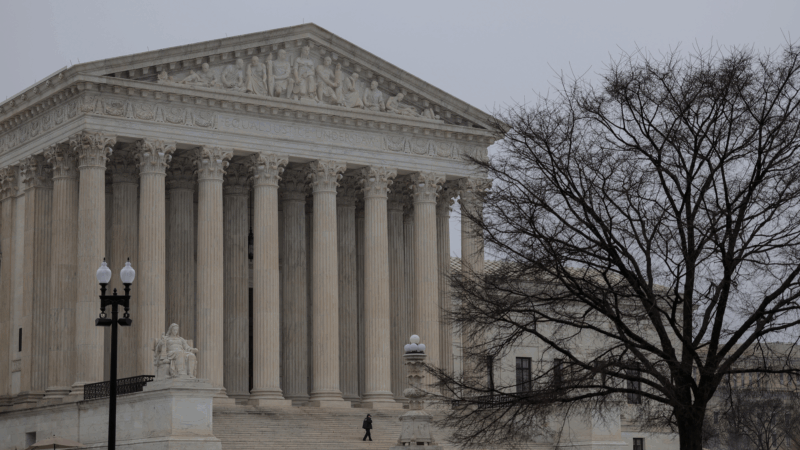
Supreme Court appears split in tax foreclosure case
At issue is whether a county can seize homeowners' residence for unpaid property taxes and sell the house at auction for less than the homeowners would get if they put their home on the market themselves.

Top House Dem wants Justice Department to explain missing Trump-related Epstein files
After NPR reporting revealed dozens of pages of Epstein files related to President Trump appear to be missing from the public record, a top House Democrat wants to know why.

ICE won’t be at polling places this year, a Trump DHS official promises
In a call with top state voting officials, a Department of Homeland Security official stated unequivocally that immigration agents would not be patrolling polling places during this year's midterms.
Cubans from US killed after speedboat opens fire on island’s troops, Havana says
Cuba says the 10 passengers on a boat that opened fire on its soldiers were armed Cubans living in the U.S. who were trying to infiltrate the island and unleash terrorism. Secretary of State Marco Rubio says the U.S. is gathering its own information.
