
Does the sale of Dominion Voting Systems mean a transformation? Depends who’s asking
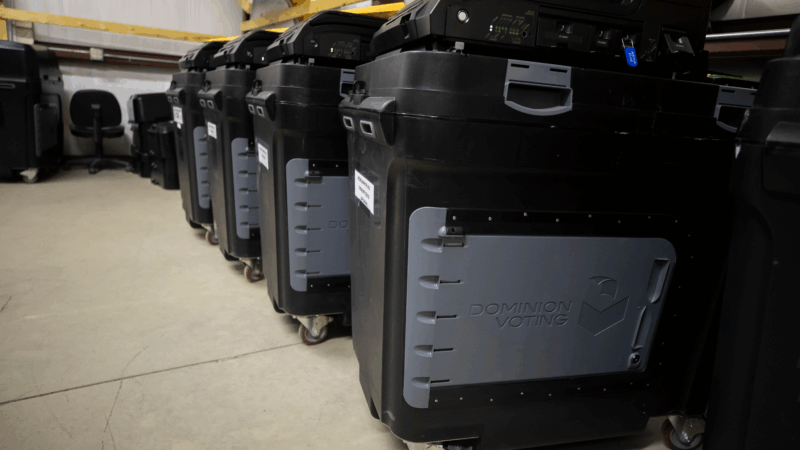
When Scott Leiendecker announced he was buying Dominion Voting Systems — the elections technology company at the heart of countless 2020 election conspiracy theories — he teased a transformation.
“As of today, Dominion is gone,” read the first line of a press release that seemed to many readers to lean into the unfounded rumors that have swirled around the company (and led to hundreds of millions of dollars in defamation settlements) since Donald Trump’s loss in the 2020 presidential election.
“We are turning the page and beginning the vital work of restoring faith in American elections,” Leiendecker wrote in a public letter posted on the website for his new company, Liberty Vote.
But in private, when speaking to the company’s county election official customers, the messaging has been different, raising the question of how much the company plans to change.
“Feel assured that Liberty Vote shares the same values as Dominion,” company representatives in Georgia, which has a statewide contract with the company, wrote in an email that NPR reviewed that was sent to counties after the sale was announced. “Same team, same support, different name.”
In Colorado, where Dominion was headquartered and where 60 of 64 counties have a contract with the company, Molly Fitzpatrick, who’s the Democratic Boulder County clerk, talked with Leiendecker shortly after the sale and helped facilitate another call to include every clerk in the state.
“He reiterated that he is an elections person and he has a long track record of being involved in elections,” Fitzpatrick said.
After serving as a Republican elections director in St. Louis 20 years ago, Leiendecker started a company, KNOWiNK, in 2011 that has become the United States’ largest vendor for voter check-in technology.
And while the message on Liberty Vote’s website notes KNOWiNK’s ubiquity in U.S. elections, the Liberty Vote press release doesn’t mention KNOWiNK and paints Leiendecker as more of an outsider, referring to him as a “nationally recognized election reform advocate.”
Leiendecker did not respond to NPR’s requests for comment.
A press release’s partisan tone
The press release announcing the Dominion sale nodded at conservative election priorities, highlighting Liberty Vote’s 100% American ownership and a mission to “restore public confidence in the electoral process through transparent, secure, and trustworthy voting systems, including the use of hand-marked paper ballots.”
Liberty Vote also promised to comply with Trump’s March executive order on election security, which has largely been paused by federal judges.
David Becker, who runs the nonpartisan nonprofit Center for Election Innovation & Research, said that he couldn’t remember an election vendor ever seeking out publicity in the way Liberty Vote did and that the partisan tone of the announcement may generate even more suspicion around the company than existed before.
“I thought the announcement was weird — I’ll be honest,” Becker said. “That just raised a lot of questions on the part of election officials. They’re already under siege. There is already so much disinformation swirling about voting systems and their security. … They don’t want drama around their voting systems.”
Some in the voting world see the difference in the public and private messaging as more of a rebrand aimed at capitalizing on doubts that people have about elections, rather than transforming the company into a partisan entity.
As one state voting official, who was not authorized to speak about the sale publicly, put it to NPR: “[Leiendecker] sees an opportunity to sell Dominion to all the conservative jurisdictions who wouldn’t touch it with a 10-foot pole the past five years.”
“It’s all business for him,” the official said.
“Is this a GOP takeover?”
Some Colorado clerks were frustrated they were given no notice before the sale was made public.
“There was no notification to us that this was even a conversation,” said Tiffany Lee, the politically unaffiliated clerk of La Plata County, in southwest Colorado. “That’s concerning to me that we didn’t get any kind of information from [Liberty Vote] directly or Dominion.”
The announcement — along with Leiendecker’s history as a Republican elections official — raised questions for some voters as well, Lee said: “It was, ‘Is this a GOP takeover? Are elections going away? What’s happening?’ Probably one of the biggest questions I’ve overall gotten is, ‘Are we gonna continue to have elections?'”
Lee and other election officials are urging calm, considering that nothing about the equipment used to scan and count votes is even changing in the short term. In most cases, voters whose ballots were tallied using Dominion technology in 2024 will have their votes counted in the 2026 midterms using the same machines.
“From a security and technical perspective, everything still stands,” Fitzpatrick, the Boulder County clerk, said. “We still have multiple checks and balances to demonstrate and verify the integrity of the system. Everything that we have been saying for years is still the same.”
The sale may not satisfy conspiracy theorists
Like most of the country, Colorado is a paper-ballot state, and by law, all Colorado counties conduct risk-limiting audits after each election, double-checking the scanning machines’ tallies against the actual votes on the original paper ballots.
While audits and hand counts have shown that the state’s election results are accurate, Colorado has been at the epicenter of false election claims.
That fact has many wondering whether a marketing campaign can actually win the buy-in of those convinced that Dominion was involved in stealing elections.
Indeed, after the sale was announced, conservative activist and podcaster Joe Oltmann, a prominent election denier based in Colorado, blasted Leiendecker in a Facebook post.
“This guy is not a conservative… I truly hate what our country has become… it is literally a cartel that wear[s] different badges while stealing the voice in a sea of treason,” posted Oltmann.
NPR’s Miles Parks reported from Washington, D.C., and Colorado Public Radio’s Bente Birkeland reported from Colorado.

Deadline looms as Anthropic rejects Pentagon demands it remove AI safeguards
The Defense Department has been feuding with Anthropic over military uses of its artificial intelligence tools. At stake are hundreds of millions of dollars in contracts and access to some of the most advanced AI on the planet.

Hillary Clinton calls House Oversight questioning ‘repetitive’ in 6 hour deposition
In more than seven hours behind closed doors, former Secretary of State Hillary Clinton answered questions from the House Oversight Committee as it investigates Jeffrey Epstein.
Chicagoans pay respects to Jesse Jackson as cross-country memorial services begin
Memorial services for the Rev. Jesse Jackson Sr. to honor his long civil rights legacy begin in Chicago. Events will also take place in Washington, D.C., and South Carolina, where he was born and began his activism.

In reversal, Warner Bros. jilts Netflix for Paramount
Warner Bros. says Paramount's sweetened bid to buy the whole company is "superior" to an $83 billion deal it struck with Netflix for just its streaming services, studios, and intellectual property.

Trump’s ballroom project can continue for now, court says
A US District Judge denied a preservation group's effort to put a pause on construction

NASA lost a lunar spacecraft one day after launch. A new report details what went wrong
Why did a $72 million mission to study water on the moon fail so soon after launch? A new NASA report has the answer.
