
China’s Xi Jinping arrives in Cambodia to wrap up 3-nation Southeast Asia tour
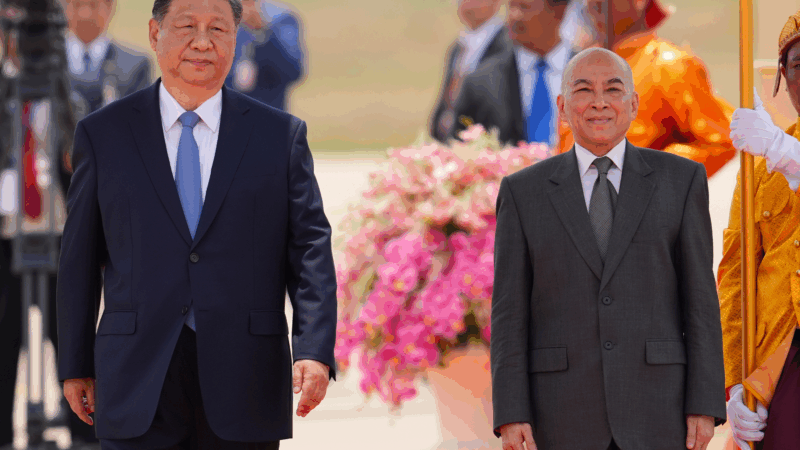
PHNOM PENH, Cambodia — Chinese President Xi Jinping arrived in Cambodia on Thursday for a two-day state visit that serves as an opportunity to further strengthen already robust relations.
The visit, Xi’s first since 2016, will conclude a three-nation Southeast Asian tour that included stops in Vietnam and Malaysia. China has been increasing its influence in the region over the past decade, largely by exercising its substantial economic leverage.
Cambodian Prime Minister Hun Manet recently described Beijing as “an important and indispensable friend of Cambodia that has helped support the country’s economic and social development.”
Xi was formally greeted at the airport in Cambodia’s capital Phnom Penh by head of state King Norodom Sihamoni. During his visit, Xi is also scheduled to meet Prime Minister Hun Manet and Senate President Hun Sen, who is Hun Manet’s father and predecessor as prime minister.
In a statement at Phnom Penh International Airport after his arrival on his presidential aircraft, an American-made Air China Boeing 747, Xi said he was “delighted” to visit again.
“Cambodia is a priority in China’s neighborhood diplomacy. China will unswervingly support Cambodia in upholding strategic autonomy and in pursuing a development path suited to its national conditions,” he said according to a transcript of his remarks distributed by the Chinese embassy.
Trade will likely be a major topic of Xi’s discussions in Cambodia, which faces among the highest tariff rates proposed by Washington. In addition to Trump’s universal 10% tariff, the country faces the threat of a 49% tax on exports to the U.S. once his 90-day pause expires.
In addition to discussions on strengthening bilateral ties and regional and international issues, several agreements are expected to be signed on cooperation in various sectors.
In both countries, Xi emphasized strengthening ties, particularly in trade and investment, amid global economic uncertainties and the backdrop of trade tensions with the United States. He underscored the need to oppose unilateralism and protectionism and uphold the multilateral trading system.
China is presenting itself as a source of stability and certainty as Southeast Asia scrambles to respond to tariffs imposed by U.S. President Donald Trump, which threaten the region export-oriented economies whose largest markets are generally the United States.
The visit comes on the 50th anniversary of the April 17, 1975 takeover of Cambodia by the communist Khmer Rouge, which imposed a reign of terror with Maoist-inspired policies that saw an estimated 1.7 million Cambodians die of starvation, overwork or executions.
Beijing was the main foreign backer of the Khmer Rouge and supported the group in carrying on a guerrilla war after it was ousted from power in 1979 by an invasion from Vietnam, though such history is rarely discussed by either country.
Cambodia’s rapid growth in recent decades has been fueled largely by Beijing.
In Hun Manet’s remarks earlier this month at the inauguration of a Chinese-funded road, he called China “a first-class partner country,” pointing to achievements like the inauguration of the Chinese-named Angkor Siem Reap Airport and a Phnom Penh ring road named after Xi as evidence of continued strong relations and gratitude, and noted China’s continued ranking as the top investor in Cambodia in 2024.
China is Cambodia’s largest trading partner, surpassing $15 billion in 2024 and representing nearly 30% of Cambodia’s total trade volume, though greatly in Beijing’s favor.
Beijing also helped fund an expansion of the Ream Naval Base on Cambodia’s southern coast, raising worries it could become a strategic outpost for the Chinese navy in the Gulf of Thailand. Cambodia has repeatedly denied any agreement granting China special privileges or the establishment of a foreign military base.
Cambodia has stated that warships from all friendly countries are welcome to dock at its new pier, provided they comply with certain conditions. Japan announced on Tuesday that two of its minesweepers will visit the Ream base this weekend in the first foreign navy visit since the expansion project was completed.
Pentagon says it’s cutting ties with ‘woke’ Harvard, ending military training
Amid an ongoing standoff between Harvard and the White House, the Defense Department said it plans to cut ties with the Ivy League — ending military training, fellowships and certificate programs.
‘Washington Post’ CEO resigns after going AWOL during massive job cuts
Washington Post chief executive and publisher Will Lewis has resigned just days after the newspaper announced massive layoffs.

In this Icelandic drama, a couple quietly drifts apart
Icelandic director Hlynur Pálmason weaves scenes of quiet domestic life against the backdrop of an arresting landscape in his newest film.

After the Fall: How Olympic figure skaters soar after stumbling on the ice
Olympic figure skating is often seems to take athletes to the very edge of perfection, but even the greatest stumble and fall. How do they pull themselves together again on the biggest world stage? Toughness, poise and practice.
They’re cured of leprosy. Why do they still live in leprosy colonies?
Leprosy is one of the least contagious diseases around — and perhaps one of the most misunderstood. The colonies are relics of a not-too-distant past when those diagnosed with leprosy were exiled.

This season, ‘The Pitt’ is about what doesn’t happen in one day
The first season of The Pitt was about acute problems. The second is about chronic ones.
