
Canceled grants get the spotlight at a Capitol Hill ‘science fair’

Sumit Chanda, a professor of immunology and microbiology at Scripps Research who focuses on pandemics, has made a career out of preparing for disaster.
But Chanda faced a disaster of a different kind this year, when the future of his research was thrown into doubt by the Trump administration’s cuts to science funding.
On Tuesday, Chanda stood alongside roughly two dozen other scientists in the lobby of the Rayburn House Office Building on Capitol Hill for what resembled a science fair — but with a twist. Instead of students presenting class projects, the event featured leading researchers from across the country standing in front of posters outlining their work — and the federal cuts that now threaten it.
Attendees said the event, which was organized by Democrats on the House Committee on Science, Space and Technology, was meant to showcase the kind of future advancements in science and medicine that may be lost because of the cuts.
“These discoveries may not just save our own lives, but the lives of people we love,” Adam Riess, who won the Nobel prize in physics in 2011, said at the event.
“Nearly every innovation that defines our era, every breakthrough from my field and from those of my colleagues, traces back to basic science research,” he added.
NPR sought comment from the White House and the Republican chair of the House committee, Rep. Brian Babin, but did not receive immediate replies.
Chanda leads one of nine pandemic response centers once funded by the National Institutes of Health that have been summarily defunded. They were part of a plan to develop broad-spectrum antiviral drugs targeting the types of pathogens most likely to trigger future pandemics and forward-deploy them around the world to be ready the moment a dangerous outbreak is detected.
“When the next pandemic happens, we rush drugs to, say, Wuhan. We contain that epidemic. So it doesn’t become a pandemic,” he explains.
He’s not even sure exactly why his NIH grant was cut. He got an email saying essentially “now that the pandemic is over, these funds are no longer needed,” without further explanation, he says.
Chanda isn’t alone. Several of the scientists NPR talked to, such as Kimiko Krieger, an assistant professor of biochemistry and molecular biology at the Bloomberg School for Public Health at Johns Hopkins University, didn’t get a clear explanation as to why their funding had been pulled.
Krieger is studying how the lack of certain vitamins can contribute to the accumulation of DNA damage in prostate tumors in African American men, who are more than twice as likely to be diagnosed with prostate cancer than other demographics. She found out that her NIH grant had been terminated when she got an email saying her research is “amorphous.”

“I don’t know what is amorphous about cancer research or about prostate cancer patients,” she says. “I’m guessing they probably didn’t really read into my work.”
Austin Becker, a professor in the Department of Marine Affairs at the University of Rhode Island, has spent more than a decade developing tools to assess and forecast the impacts of extreme weather events, such as hurricanes, on the Southern New England coast. As a result, he’s been able to develop a “hyper-local” tool to help emergency managers and resilience planners make quick decisions in such cases.
“I was sitting in the Rhode Island State House, preparing to testify in support of our tool, when I got the email,” Becker says about receiving the notice that the Department of Homeland Security grant would be eliminated. He says there was no hint prior to the email that the project had been targeted for cuts.
Asked whether the administration’s antipathy to climate change, which President Trump has called a “hoax,” might be a factor, he says: “These are early warning systems. They help emergency managers act before infrastructure fails.
“Yes, they’re motivated by climate change, but they solve today’s problems,” he says, pointing to the recent devastating floods in Texas where the death toll has surpassed 100.
But David Corey, a professor of neurobiology at Harvard Medical School who is developing therapies for childhood deafness, has no doubt about the cause of his funding cut. In Corey’s case, it is all about the more than $2.2 billion in multi-year grants and contracts to Harvard that the administration has frozen after the university rejected demands from the White House that it change hiring, admissions and other policies.
Corey and colleagues have spent years carefully studying some 200 genes that cause inherited deafness. He points out that this kind of basic research has already paid dividends.
“Our work mapping how those proteins function has directly led to potential therapies,” says Corey.
One part of his research involves using a virus to deliver a healthy copy of a gene into cells, allowing them to reproduce and replace the version that causes deafness. One such gene is too large to fit in a virus, so Corey’s team “had to figure out a way of snipping out a bit, of shortening the protein in a way that it was still functional.” But without “years and years and years of work on understanding the structure of the protein,” it would not have been possible to do that, he says.
Riess, whose Nobel-winning work showed that the universe was expanding at a faster and faster rate, expressed concern about the “brain drain” that would result from an interruption in funding for important scientific research even if a future administration restored it.
In terms of his own work, he says, he’s spent the last two decades working on refining the value of the Hubble Constant — a key parameter that describes how fast the universe is expanding.
“When you go 19 years working on it and then you go, ‘oh, we’re going to cut the budget this year,’ it’s a waste of that effort,” he says.
“The really smart people who have opportunities, you know, will go to where the science is being done, whether it’s Europe or China or other places,” he says, adding, “I’m definitely hearing from a lot of colleagues who are saying, … ‘I need to look at, what’s plan B.'”
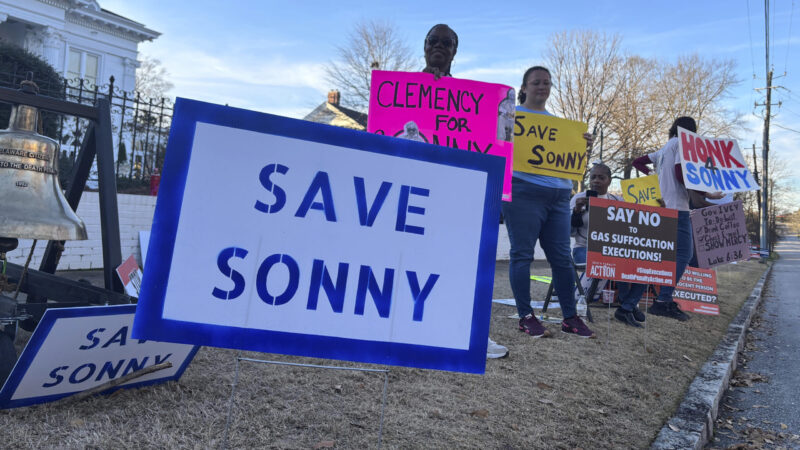
Alabama man facing execution for deadly robbery asks for clemency as he didn’t kill victim
Charles “Sonny” Burton is scheduled to be executed March 12 for his role in a 1991 robbery in which a man was fatally shot. His supporters and attorney are asking the governor for clemency, arguing that his life should be spared because Burton didn’t fire the gun or witness the killing.
One week into the Iran war, the fallout is global
The war is no longer just about the U.S., Israel and Iran. More countries are getting caught in the political crossfire or being drawn into the fighting themselves.
Iran’s president defies U.S. demands while apologizing for strikes on neighbors
President Masoud Pezeshkian said Saturday that a demand by the U.S. for an unconditional surrender is a "dream that they should take to their grave." He also apologized for Iran's attacks on regional countries.
What the Trump administration says about why it went to war with Iran
The Trump administration says it is "laser focused" and mission driven, but the messaging has been varied. The range of cited motivations for striking Iran now are sometimes at odds with each other.
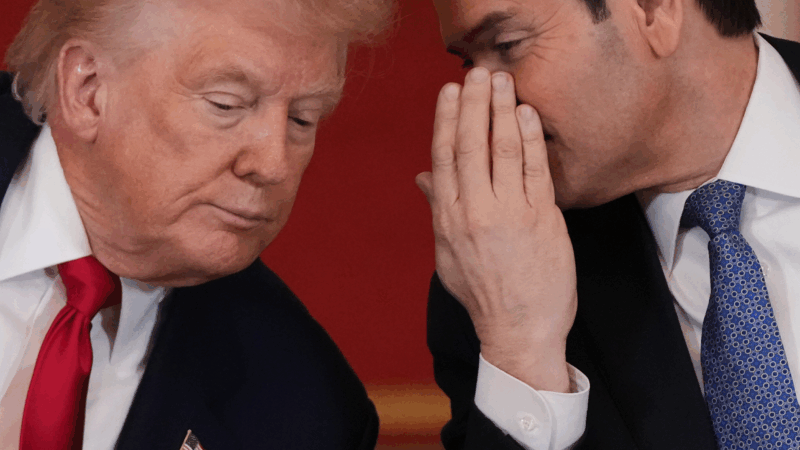
Trump looks to turn attention to Western Hemisphere at Americas summit
President Trump is set to gather with Latin American leaders on Saturday at his Miami-area golf club as his administration looks to turn attention to the Western Hemisphere, at least for a moment.
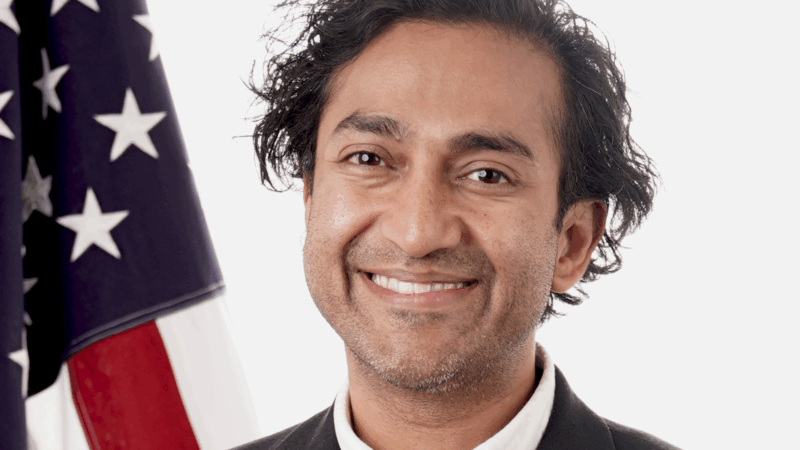
Trump administration’s embattled FDA vaccine chief is leaving for the second time
The FDA's controversial vaccine chief, Dr. Vinay Prasad, is leaving the agency. It's the second time he has abruptly departed following decisions involving the review of vaccinations and specialty drugs.
