
Back seats aren’t as safe as they should be. A crash test is trying to help
For three decades, the Insurance Institute for Highway Safety (IIHS) has been smashing vehicles with an adult-sized dummy sitting in the front seat, simulating a type of head-on collision where two vehicles are slightly offset.
It’s always been a challenging test, above and beyond the minimum standards that car companies are legally required to meet. The IIHS conducts tests and independently awards safety ratings that are meant to reward companies for superior safety, well exceeding minimum standards.
But a few years ago, IIHS realized they needed to make this test even harder.
The original test focused on that front seat. It’s a frontal collision, after all; when the test was first designed, the rear was obviously the safer place to be.
Then automakers made enormous progress in making head-on collisions more survivable for front seat occupants. Crumple zones got better at absorbing force. Seat belts got more sophisticated.
After a few decades of these improvements, real-world injury data showed that fatalities had, counterintuitively, become more common in the back seat. And not just a little more common; the risk was 46% higher.
“What we saw when we went back and looked at the field data is that while we’ve made lots of improvements for the front seat, the rear seat hadn’t kept pace,” says Jessica Jermakian, the senior vice president of vehicle research for IIHS.
IIHS continues to recommend that younger children ride in the back seat, thanks in large part to the unique risks posed to those children by frontal airbags. But for teenagers wearing seatbelts, the back seat is now riskier than the front. Same for adult back-seat passengers — whose numbers have increased as ridesharing has caught on.
So IIHS added a small dummy in the back seat in 2022, and refined the test in 2024 to make it even more stringent.
The test can be surprisingly hard to watch, even if you’ve driven to this facility in rural Virginia specifically to watch a car get crashed.
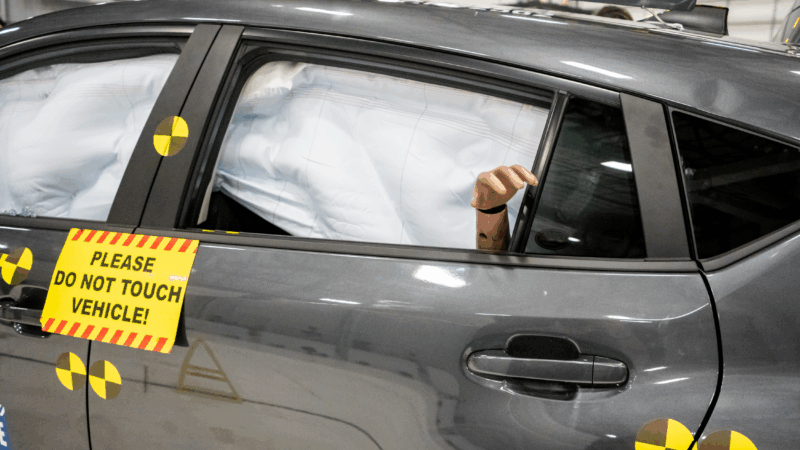
I stood on a metal platform overlooking a concrete-and-steel crash barrier as a Subaru Crosstrek was prepared to be yanked forward at 40 miles per hour. An adult-size dummy was buckled into the front seat, and behind it sat a second dummy the size of a 12-year-old.
After a countdown, the car slammed into the crash barrier with a violent bang, so hard that the child-sized dummy’s hand was flung out the rear window.
“Oh my God,” I heard myself gasping out loud. “The tiny hand.”
Obvious shortcomings, rapid improvements
Almost immediately after the test was updated, it began to reveal vehicles’ shortcomings. Under the latest version of the test, 20% fewer vehicles qualified for IIHS’ safety awards than in the less-stringent version.
Consider what happened to minivans, the quintessential family vehicle. Under older versions of the test, two minivans earned the “Top Safety Pick” award; in 2025, not a single one did. “That’s really due to lackluster performance in the updated moderate overlap crash test,” Joe Young, the IIHS media relations director, told NPR via email.
The good news is that changes are already underway. By way of example, Young pointed to the Hyundai Sonata, which earned the lowest possible rating on this test in 2023. As the results made clear, that was entirely due to backseat performance. The driver was well-protected, but the dummy in the backseat showed likely injuries to the head or neck, chest and abdomen.
Since then, Hyundai has added crucial technology to the Sonata’s rear seat belts: pretensioners, which tighten seat belts in the first instant of a crash, and force limiters, which add a little slack moments later. When IIHS tested the 2025 model, it scored the highest-possible rating on the test. Asked for comment, Hyundai directed NPR to a statement it put out last year acknowledging IIHS’ more stringent rear-seat tests and spotlighting the automakers’ “enhancements to rear occupant protection.”
And that’s just one example — Young says numerous vehicles from other automakers have shown similar rapid improvements since the rear-seat dummy was added to the test.
Jermakian says upgrading seat belts is a change automakers could make very quickly. But now companies are starting to introduce more challenging redesigns, like alterations to the shape of the rear seat itself.
To her, the fact that many vehicles are now flunking this test is, in some ways, a positive sign. Whenever all vehicles are getting great ratings on one of the group’s tests, it indicates the test is not challenging enough to motivate further safety improvements. That’s “an opportunity for us to raise the bar,” Jermakian says — precisely what the group is trying to do now.
Feds announce $4.1 billion loan for electric power expansion in Alabama
Federal energy officials said the loan will save customers money as the companies undertake a huge expansion driven by demand from computer data centers.
Mortgage rates fall below 6% for the first time in years
The average home loan rate has dropped below 6% for the first time since 2022. Will that help thaw the frozen housing market?
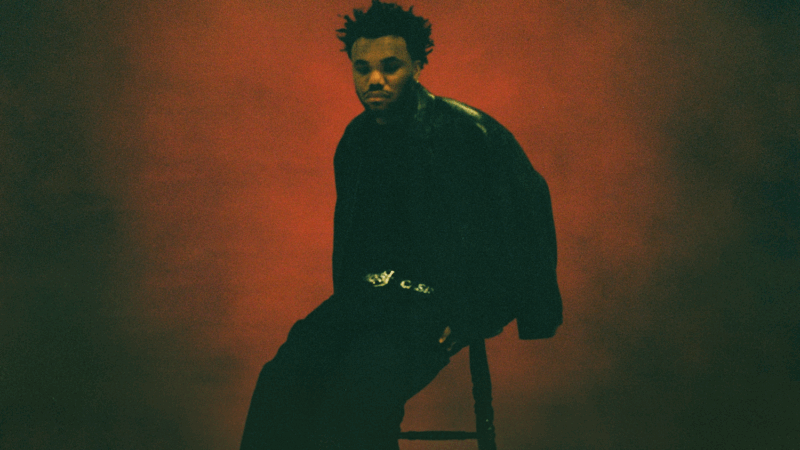
Baby Keem’s boulevard of broken dreams
Ca$ino, the rapper's second album for his cousin Kendrick Lamar's label, is whiplash embodied, a mirror for the extreme highs and lows of his Sin City hometown.

Pentagon shifts toward maintaining ties to Scouting
Months after NPR reported on the Pentagon's efforts to sever ties with Scouting America, efforts to maintain the partnership have new momentum
Why farmers in California are backing a giant solar farm
Many farmers have had to fallow land as a state law comes into effect limiting their access to water. There's now a push to develop some of that land… into solar farms.
Tariffs cost American shoppers. They’re unlikely to get that money back
After the Supreme Court declared the emergency tariffs illegal, the refund process will be messy and will go to businesses first.
