
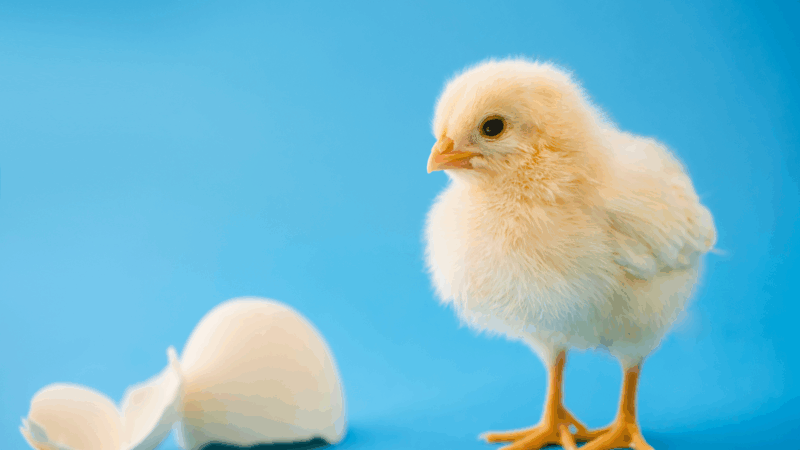
Baby chicks link certain sounds with shapes, just like humans do
When people are shown a spiky shape next to a rounded one and asked which shape is called “kiki” and which one is “bouba,” people from all kinds of cultures overwhelmingly associate “bouba” with the blob-like shape and “kiki” with the more jagged, pointy one.
And it turns out that baby chickens do the exact same thing.
A set of experiments with chicks, described in the journal Science, suggests that these birds, like humans, associate the nonsense word “bouba” with roundness and “kiki” with spikiness.
“I was surprised by it,” says Marcus Perlman, a linguistics and communication researcher at the University of Birmingham in the United Kingdom, who wasn’t part of the team that did the work. “If I had to guess whether baby chickens would exhibit the bouba-kiki effect, I would have guessed no.”
The bouba-kiki effect has been studied for decades, with researchers showing that even four-month-old human infants think that “bouba” applies to something rounded and “kiki” is somehow spiky.
That’s led to speculation that such innate associations could have helped lead to the emergence of speech, because these associations would serve as a shared foundation to build on when creating new kinds of meaningful spoken symbols.
Efforts to find a bouba-kiki effect in great apes like chimpanzees and gorillas — animals closely related to humans — have come up empty. So a group of researchers at the University of Padova in Italy recently decided to take a completely different approach to look for it in animals: they tested very young chickens.
“With chicks, we had the chance to test animals at the very, very first stage of life,” says researcher Maria Loconsole, who did the experiments with colleagues Silvia Benavides-Varela and Lucia Regolin.
Being able to test the chicks so young would mean that any observed associations between sounds and shapes would be innate, rather than based on experience, she explains.
First, three-day-old chickens were taught that if they went behind a panel decorated with a combination shape that was both blobby and spiky, they would get some food. The chicks quickly learned to do this. Then, the scientists presented the chicks with two panels, one decorated with a blob-like shape and one decorated with a spiky one.

That created a moment of uncertainty for the chicks, says Loconsole. During this moment of uncertainty, the researchers played either the sound “bouba” or the sound “kiki,” over and over. What they found is that the chicks significantly preferred to go to the panel with the rounded shape when they heard “bouba.” When they heard “kiki,” they generally preferred to go to the panel with the spiky shape.
A similar experiment with even younger chicks, just one day old, involved showing the chicks two video screens that displayed moving objects. Chicks of that age will tend to draw close to a moving, engaging object. And what the researchers found is that when they played the “kiki” sound, the chicks would move towards the spiky shape. When they heard “bouba,” they went to the rounded, blob-like shape.
“I’m not saying that chicks have human language,” says Loconsole. But to her, it’s clear that, similar to humans, chicks have some basic linkages between different kinds of perception that “in our species was then co-opted and exploited for language.”
That means this is something deeply rooted in evolution, says Perlman, going all the way back to an ancestor of birds and mammals. “So that’s interesting,” he says. “It shows that the vertebrate’s sensory systems are primed to expect certain regularities in the world.”
There are other examples like this that have been seen in animals: high-pitched sounds are associated with smaller, lighter objects, while lower-pitched sounds are associated with larger, darker figures.
And the bouba-kiki effect is just part of a broader suite of similar sound-shape associations that people seem to share, says Perlman. One recent study, for example, found that people tended to match a trilled “r” sound with the feeling of a rough surface rather than a smooth one.
But humans can link ideas not just with sounds, but with gestures, too, and they can even draw pictures. That’s why, in Perlman’s view, what really differentiates humans is a wide-ranging capacity to generate novel symbols that communicate meaning—to basically play charades—in all kinds of ways.
“We’re really good at it, and effectively, no other animal does anything like charades,” says Perlman. “That’s a creative capacity, that maybe in some cases leverages certain hard-wired associations.”

Internal memo details cosmetic changes and facility repairs to Kennedy Center
Trump announced his plans to close the Kennedy Center entirely for two years "for Construction, Revitalization, and Complete Rebuilding." The announcement came after many prominent artists canceled existing scheduled appearances.
R&B stars consider two ways to serve an audience
Two albums released the same day — Jill Scott's return from a long absence, and Brent Faiyaz's play for a mid-career pivot — offer opposing visions of artistic advancement in the genre.
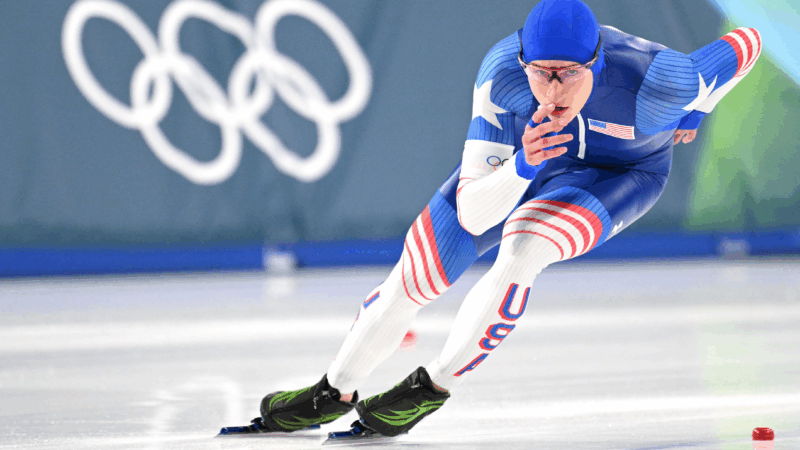
American Jordan Stolz speedskates to a third Olympic medal — silver this time
U.S. speedskater Jordan Stolz had a lot of hype accompanying him in these Winter Olympic Games. He's now got two gold medals, one silver, with one event to go.

Bad Bunny and J. Cole rule the pop charts
These days, the Super Bowl halftime show is a massive driver of the streaming, airplay and sales that fuel the Billboard charts. This week, Bad Bunny benefits from that influence.

Reporter’s notebook: My Olympic Lunar New Year
An NPR reporter covering the Olympics in Milan takes us on cultural side quests, to a hospitality house and a candy store.

Michael Pollan says AI may ‘think’ — but it will never be conscious
"Consciousness is under siege," says author Michael Pollan. His new book, A World Appears, explores consciousness on both a personal and technological level.
