
At Davos, U.S. allies question a fraying world order
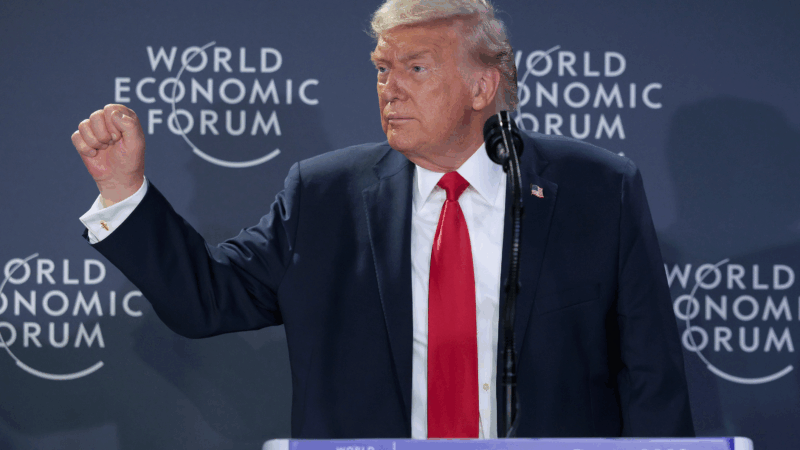
DAVOS, Switzerland — It was among the most volatile weeks for trans-Atlantic relations in recent history, marked by a series of disruptive statements from President Trump that unsettled global markets and strained relations with some of America’s closest allies — on topics that ranged from Greenland to Gaza.
The diplomatic whiplash was on full display in the Swiss ski resort of Davos, where the annual World Economic Forum unfolded against the backdrop of growing uncertainty about America’s role as a global leader among Western democracies. By the time President Trump’s delayed helicopter landed in the Alpine snow, much of the damage — at least diplomatically — had already been done.
In the weeks leading up to the gathering, occasionally off-the-cuff remarks from Trump and White House staff about a possible U.S. military takeover of Greenland had culminated in renewed tariff threats against eight European nations.
The unprecedented presidential rhetoric had left allies scrambling to interpret American intentions, while global financial markets responded nervously and diplomats questioned how durable long-standing U.S. commitments had become.
A candid speech from Canada
That unease was then voiced openly by several leaders in Davos. Canada’s prime minister, Mark Carney, argued that the post-World War II economic and security architecture was breaking down in ways that left middle-sized countries, like Canada, newly exposed.
“Let me be direct — we are in the midst of a rupture, not a transition,” Carney told delegates in the forum’s large congress hall. “Great powers have begun using economic integration as weapons — tariffs as leverage, financial infrastructure as coercion, supply chains as vulnerabilities to be exploited.”
Carney warned that the rules-based international order that had helped manage great-power rivalry for decades “is fading,” and that countries like his could no longer assume the United States would reliably act as the system’s stabilizing force.
French President Emmanuel Macron struck a similar note, framing the moment as one of historic political and security uncertainty. “We are reaching a time of instability, of unbalances, both from the security and defense point of view and the economic point of view,” he told the Davos audience of global policymakers and business executives.
Macron linked those imbalances to a wider democratic retreat and a resurgence of geopolitical confrontation, what he called “a shift towards a world without rules, where international law is trampled under foot, and where the only law that seems to matter is that of the strongest.” It was a characterization that, two years ago, Macron would have intended for leaders like Presidents Xi Jinping and Vladimir Putin — but for many in the audience it seemed, this week, to target President Trump too.
When the U.S. commander-in-chief appeared on that same stage a day later, he offered a sharply different interpretation, arguing that raw military and economic power — rather than verbal reassurance — was the key to maintaining security partnerships.
“We want strong allies, not seriously weakened ones. We want Europe to be strong,” Trump said, while invoking his own Scottish and German ancestry. “Ultimately, these are matters of national security, and perhaps no current issue makes the situation more clear than what’s currently going on with Greenland.”
In the same speech, Trump did appear to definitively rule out a U.S. invasion of Greenland, which is a semiautonomous territory of Denmark, a NATO ally. But he still continued to question Denmark’s stewardship of the strategically important Arctic territory. NATO Secretary-General Mark Rutte moved quickly to defuse tensions in a meeting that followed, leaving Trump to declare on social media that a deal on Arctic security — with almost no public details — had been struck. Trump also said he had backed off the new tariffs he planned to impose on goods from European countries.
Denmark’s political leadership later said Rutte did not speak on their behalf, only heightening the kind of diplomatic ambiguity that has dogged the U.S. administration’s perception, particularly in Europe.
Trump later announced on social media he was revoking an invitation for Canada to join his Board of Peace to work on stabilizing postwar Gaza and possibly other conflicts, an initiative Trump touted at Davos.
Zelenskyy calls on Europe to do more
Nonetheless, the entire episode had already deepened concerns within the NATO alliance about U.S. predictability and trust. For Ukrainian President Volodymyr Zelenskyy, such concerns underscored a frustration he has voiced repeatedly since Russia’s full-scale invasion nearly four years ago.
“Europe loves to discuss the future, but avoids taking action today, action that defines what kind of future we will have,” Zelenskyy said during his own keynote speech after he arrived in Switzerland Thursday. “That is the problem.”
For the Ukrainian leader, it’s an issue not merely of strategy but credibility too, at a moment when U.S. political attention appears increasingly distracted and European governments remain occasionally leery about exercising hard power.
The week in Davos began with sharp market reactions and diplomatic shocks, and ended without clear resolution. What lingered instead was a question increasingly voiced by U.S. allies, both publicly and privately: whether the disruptions of recent days are temporary turbulence — or evidence of a more permanent shift in global leadership that they must now prepare to navigate largely on their own.
Transcript:
JUANA SUMMERS, HOST:
From NPR News, this is ALL THINGS CONSIDERED. I’m Juana Summers.
MARY LOUISE KELLY, HOST:
And I’m Mary Louise Kelly, with a question that has dominated the week both here and across the globe – do we know what’s happening with Greenland? For weeks, President Trump has made plain he wants the United States to own the Arctic island. He threatened military action. He also threatened tariffs on U.S. allies, all to get his way. President Trump appears to have backed off those threats for now. By the end of the day yesterday, speaking from the World Economic Forum in Davos, Switzerland, President Trump said he had reached a framework for a deal on Greenland. What is it, and how exactly was this deal reached? Questions I put to Pentagon correspondent Tom Bowman and reporter Willem Marx on NPR’s weekly national security podcast, Sources & Methods.
(SOUNDBITE OF EMANUEL KALLINS AND STEPHEN TELLER’S “PLUNGED INTO CRISIS”)
KELLY: So, Willem, what do we know about this deal, this framework of a deal?
WILLEM MARX, BYLINE: I’m going to disappoint you, Mary Louise. We don’t know a lot for sure in terms of confirmed information from public sources.
KELLY: The U.S. does not own Greenland that we know of at this hour?
MARX: Not yet. Not yet. There may be conversations about that down the road. It’s not clear. It seems like there have been these very, very key discussions between President Trump and a man called Mark Rutte, who is the secretary general of the North Atlantic Treaty organization – NATO. He’s the former Dutch prime minister. I have a Dutch passport. I’ve known the guy for years. He’s very charming, very glib and very astute politically. He stayed on top of a coalition in the Netherlands for a long time, and those skills have been brought to bear, not for the first time, with President Trump this week.
The discussion seem to have unlocked some of the U.S. president’s concerns about the role that Greenland would play in Arctic security. And Rutte, on behalf of NATO at least, seems to have made some sort of assurances about security efforts, potentially security expenditure and security access for the U.S. in that North Atlantic massive island, as Greenland is.
KELLY: So Rutte has somehow managed to back us up from the precipice for now. We have not seen the end of NATO – the alliance he leads – this week. But, I mean, I’ll point out the obvious, which is that NATO is not Greenland, NATO is not Denmark, and Greenland is part of Denmark. Were Danish officials involved in these conversations? Are they on board with whatever has been agreed?
MARX: That is a very delicate question. There was no one from Denmark or their delegation in the room with Rutte and Trump. The Danish have made very clear that Rutte does not speak on behalf of them, even though he speaks on behalf of an alliance of which they’re members. In fact, you know, we’ve heard from the Danish prime minister, Mette Frederiksen, since this announcement that they can’t negotiate on their sovereignty.
And in fact, the Danish prime minister, Mette Frederiksen, has been meeting with the British prime minister in the U.K., presumably for conversations about this pretty exclusively. Very grateful that the U.K. and others stood with Denmark over the last couple of weeks after we heard those initial threats from President Trump, but it’s pretty clear from what we’ve heard both from Danish officials and Greenlandic officials over the last few hours that essentially they haven’t been that closely involved in any of these conversations, but they look forward to having further conversations with the U.S. side in the days and weeks to come.
KELLY: Tom Bowman, what are you hearing from sources here in the States?
TOM BOWMAN, BYLINE: Well, as far as this so-called framework, I talked to a European official, and he said one of the things they’re looking at is providing the U.S. with another U.S. military base or bases in Greenland. Of course, they have one there now that does early warning and also operates satellites. And Trump, importantly, mentioned the Golden Dome, his missile defense system. So it’s possible that this additional base or another – extra bases could be used for Golden Dome. You could have interceptor missiles there, or some high-tech equipment and so forth and so on.
Now, there are reports that – well, right now, at the current base there, it flies the Danish flag. It’s -Denmark has sovereignty over it.
KELLY: OK.
BOWMAN: The reports of what the U.S. wants is, if we can’t have all of Greenland, just give us a little piece so we can put this base or other bases there.
KELLY: So there is a U.S. flag…
BOWMAN: Correct.
KELLY: …Flying somewhere over Greenland.
BOWMAN: And as Willem pointed out, the Danish prime minister, Frederiksen, said sovereignty is non-negotiable. It’s not going to happen. And again, the people we all talk with say, what’s the future of NATO? Is the U.S. going to walk away from NATO or are we in this on our own? I think those are the serious questions, I think.
KELLY: And you don’t feel like we got an answer to that this week?
BOWMAN: I don’t think we got an answer to that.
KELLY: Not a definitive one.
BOWMAN: No.
KELLY: That’s NPR’s Tom Bowman and reporter Willem Marx in Davos, speaking with me on Sources & Methods, NPR’s weekly national security podcast. You can hear more of our conversation wherever you get your podcasts.

The Trump administration’s crackdown on immigrant truckers shifts into higher gear
The White House wants tougher rules for commercial licenses after several high-profile crashes involving foreign-born drivers. But critics say that would do little to make the nation's roads safer.

5 ways to resist the urge to keep looking at your phone
So you want to spend less time on your phone. How do you do that when it's designed to suck you in? Life Kit spoke to experts in behavioral science, psychology and technology for real-world advice.
Trump’s war with Iran is angering some swing voters who want money spent at home
Swing voters who helped reelect President Trump in 2024 don't support his decision to go to war in Iran and instead want to see U.S. tax dollars spent tackling economic pressures facing Americans.

Bam Adebayo’s 83-point night was one to remember. But not everyone was pleased
Detractors point to Adebayo's one-of-a-kind stat line — 43 field goal attempts, 22 3-point attempts and, most of all, NBA records of 36 free throws and 43 attempts — as proof of stat-padding.
Trump says Democrats must cheat to win. What do his supporters think?
NPR spent several days traveling across a pair of swing districts in Pennsylvania to find out. The answers show how much has changed since the 2020 election.
The government is investigating new claims that DOGE misused Social Security data
The fallout from DOGE staffers' efforts to access sensitive Social Security data continues as an agency watchdog disclosed a new investigation into "potential misuse" reported by a whistleblower.
