
Americans are split on wanting the National Guard to monitor voting, a new poll finds
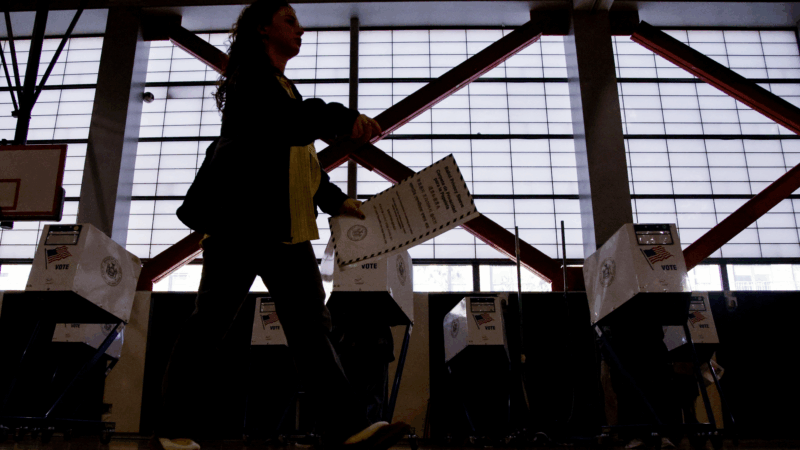
Close to half of Americans support the idea of the National Guard at polling places to monitor this November’s midterm elections — something that would be illegal if ordered by the federal government — potentially signaling an openness, especially by Republicans, to the sort of nationalizing of elections that President Trump says he wants.
That datapoint comes from a new NPR/PBS News/Marist poll out Wednesday, which found 46% of Americans support the idea, compared to 54% who say they oppose it.
The finding is complicated by the fact that the National Guard can legally be used to support elections in many capacities when ordered by state governors.
Loading…
And many Americans may be more open to military protection for elections now that the U.S. is at war with Iran, said Florida State University professor Michael Morley, an expert in election law.
“I think the conflict with Iran and recent terrorist bombing attempt in New York may influence public opinion on this issue, especially over the next few weeks,” Morley said in an email to NPR. “Most of the time having the National Guard at polling places would be seen as unnecessary. But I think most average Americans may be far more worried about the possibility of a terrorist attack than they are about the National Guard.”
Trump has not said he wants to deploy the Guard for this year’s midterms, but in an interview with the New York Times in January he said he wished he had deployed Guard members in 2020 to try to seize election equipment he falsely claims was manipulated.
And state and local voting officials have told NPR they began to worry about the possibility after the National Guard deployments to numerous American cities last year.
Those fears have only grown recently, as Trump has said that he wanted Republicans to “take over” voting in some places.
In the poll, which was conducted last week, a wide majority of Republicans, roughly 3 in 4, say they would support the National Guard monitoring polling locations this fall. The almost exact inverse is true for Democrats, with 3 in 4 Democrats saying they opposed the idea.
Although states can deploy their National Guard troops to support elections (many use National Guard members to help with state cybersecurity, for instance), federal law clearly bans the federal government from sending soldiers to polling places.
“These laws were designed to ensure that there is no federal interference with voting,” said Rebecca Green, who co-directs the election law program at William & Mary. “There’s all kinds of very established precedent that prevents law enforcement activity that could intimidate voters.”
Americans trust elections, but less universally so
Broadly speaking, the majority of Americans — two-thirds — are confident that their state or local government will run fair and accurate elections this year. That number however, is a drop-off from the near-universal positive feelings people had about election administration following the 2024 election.
Paul Gronke, an election administration expert at Reed College, also noted that trust in the elections process seems to be declining across the political spectrum, whereas a few years ago it was isolated mostly to Republicans after Trump’s loss in 2020. Other surveys have found the same thing.
“It’s as if partisans are seeing the same image but through different mirrors or prisms,” Gronke said. “They’re worried about the election. But the source of those worries, the undercurrent, seems to be different.”
Democrats, for instance, said in the NPR survey they are most concerned with voter suppression efforts and misleading information, while Republicans overwhelmingly say voter fraud is their biggest concern. Independents are roughly split between the three things.
All of those concerns are exacerbated by political candidates who have normalized casting doubt on election results, Gronke said. He noted Trump as the obvious and most extreme example, but noted that some Democratic candidates and politicians have used similar rhetoric in recent years too.
“Politicians seem to have learned that when they lose an election, one of their post-election responses is to claim some sort of cheating,” Gronke said. “It feels like right now that rhetoric has entered our political system, and it may take a while, if ever, for us to get rid of it.”
Other findings
- The poll also revealed a near-universal concern about how artificial intelligence will impact the midterm elections. More than 8 in 10 Americans are expecting the technology will spread misinformation about voting this year.
- In terms of politics, if this year’s congressional midterm elections were held now, 53% of registered voters said they would support the Democratic candidate on the ballot in their district, compared to 44% who said they would support the Republican.
- Thirty-eight percent of Americans said they approve of Trump’s job as president, a number that is virtually unchanged from the rating he received in the same poll in February.
Methodology: The survey of 1,591 adults was conducted from March 2-4 and has a margin of error of +/-2.8 percentage points, meaning results could be about 3 points higher or lower than the reported number. Pollsters reached out to respondents in multiple ways, including with live callers, by text and online and in both English and Spanish.

Greetings from a Shanghai temple where you can ward off bad luck in the Year of the Horse
According to Chinese mythology, those born in the Year of the Horse will clash with Tai Sui, a heavenly general. Luckily, there are ways to appease Tai Sui, including amulets at Shanghai's Jade Buddha Temple.

Countries agree to historic release of stockpiled oil to ease the global disruption
Members of the International Energy Agency have announced a coordinated release of 400 million barrels of stockpiled oil in an attempt to counter the disruption in oil trade triggered by the Iran war.

U.S. attacks Iranian mine-laying vessels near Hormuz on Day 12 of war
Attacks and counterattacks continued throughout the Middle East Wednesday. Two cargo ships were struck in the Gulf, as some lawmakers in Washington pressed for answers on the war's rationale.

Over puppy yoga? Try it with snakes.
You've heard of yoga with kittens, and goats, and maybe even reindeer… but what about a bunch of pythons and one baby Columbian Common Boa named Mango?
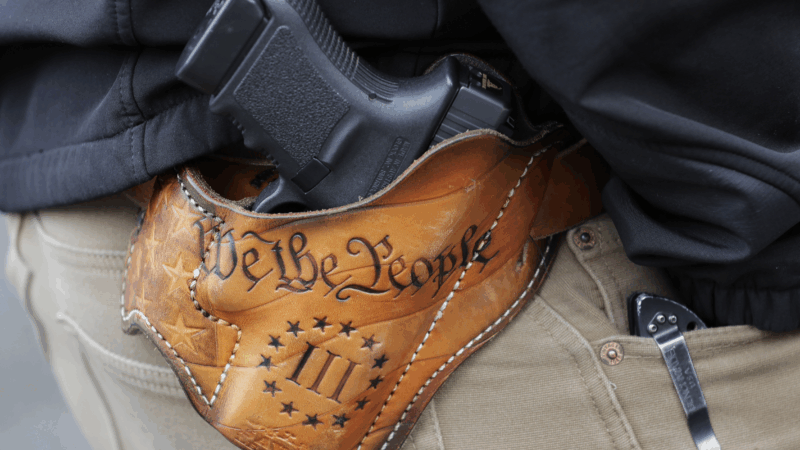
The Trump DOJ is giving guns back to felons, including one alleged fake elector
The Department of Justice is quietly restarting a decades-dormant program to restore gun rights to felons. One of them was an alleged fake elector in 2020.

Federal oversight protects student borrowers. Some of it has stopped, watchdog says
Without this Education Department oversight, borrowers could "be placed in the wrong loan repayment status, billed for incorrect amounts" and more, the U.S. Government Accountability Office says.
