
Air Canada suspends restart plans after union defies return to work order
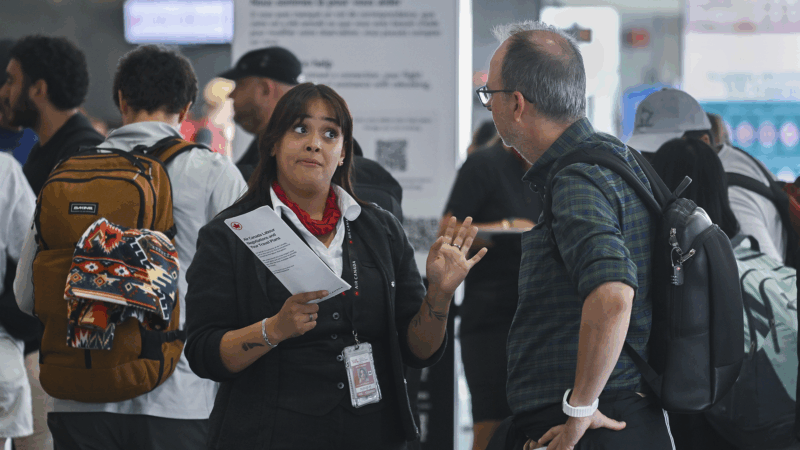
TORONTO — Air Canada said it suspended plans to restart operations on Sunday after the union representing 10,000 flight attendants said it will defy a return to work order. The strike was already affecting about 130,000 travelers around the world per day during the peak summer travel season.
The Canada Industrial Relations Board ordered airline staff back to work by 2 p.m. Sunday after the government intervened and Air Canada said it planned to resume flights Sunday evening.
Canada’s largest airline now says it will resume flights Monday evening. Air Canada said in a statement that the union “illegally directed its flight attendant members to defy a direction from the Canadian Industrial Relations Board.”
“Our members are not going back to work,” Canadian Union of Public Employees national president Mark Hancock said outside Toronto’s Pearson International Airport. “We are saying no.”
The federal government didn’t immediately provide comment on the union refusing to return to work.
Hancock said the “whole process has been unfair” and said the union will challenge what it called an unconstitutional order.
“Air Canada has really refused to bargain with us and they refused to bargain with us because they knew this government would come in on their white horse and try and save the day,” he said.
The country’s largest airline had said early Sunday in a release that the first flights would resume later in the day but that it will take several days before its operations return to normal. It said some flights will be canceled over the next seven to 10 days until the schedule is stabilized.
Less than 12 hours after workers walked off the job, Federal Jobs Minister Patty Hajdu ordered the 10,000 flight attendants back to work, saying now is not the time to take risks with the economy and noting the unprecedented tariffs the U.S. has imposed on Canada. Hajdu referred the work stoppage to the Canada Industrial Relations Board.
The airline said the CIRB has extended the term of the existing collective agreement until a new one is determined by the arbitrator.
The shutdown of Canada’s largest airline early Saturday was impacting about 130,000 people a day. Air Canada operates around 700 flights per day.
Flight attendants walked off the job around 1 a.m. EDT on Saturday. Around the same time, Air Canada said it would begin locking flight attendants out of airports.
The bitter contract fight escalated Friday as the union turned down Air Canada’s prior request to enter into government-directed arbitration, which allows a third-party mediator to decide the terms of a new contract.
Last year, the government forced the country’s two major railroads into arbitration with their labor union during a work stoppage. The union for the rail workers is suing, arguing the government is removing a union’s leverage in negotiations.
The Business Council of Canada had urged the government to impose binding arbitration in this case, too. And the Canadian Chamber of Commerce welcomed the intervention.
Hajdu maintained that her Liberal government is not anti-union, saying it is clear the two sides are at an impasse.
Passengers whose flights are impacted will be eligible to request a full refund on the airline’s website or mobile app, according to Air Canada.
The airline said it would also offer alternative travel options through other Canadian and foreign airlines when possible. Still, it warned that it could not guarantee immediate rebooking because flights on other airlines are already full “due to the summer travel peak.”
Air Canada and CUPE have been in contract talks for about eight months, but they have yet to reach a tentative deal. Both sides have said they remain far apart on the issue of pay and the unpaid work flight attendants do when planes aren’t in the air.
The airline’s latest offer included a 38% increase in total compensation, including benefits and pensions, over four years, that it said “would have made our flight attendants the best compensated in Canada.”
But the union pushed back, saying the proposed 8% raise in the first year didn’t go far enough because of inflation.
Feds announce $4.1 billion loan for electric power expansion in Alabama
Federal energy officials said the loan will save customers money as the companies undertake a huge expansion driven by demand from computer data centers.

Mortgage rates fall below 6% for the first time in years
The average home loan rate has dropped below 6% for the first time since 2022. Will that help thaw the frozen housing market?

Baby Keem’s boulevard of broken dreams
Ca$ino, the rapper's second album for his cousin Kendrick Lamar's label, is whiplash embodied, a mirror for the extreme highs and lows of his Sin City hometown.

Pentagon shifts toward maintaining ties to Scouting
Months after NPR reported on the Pentagon's efforts to sever ties with Scouting America, efforts to maintain the partnership have new momentum
Why farmers in California are backing a giant solar farm
Many farmers have had to fallow land as a state law comes into effect limiting their access to water. There's now a push to develop some of that land… into solar farms.

Tariffs cost American shoppers. They’re unlikely to get that money back
After the Supreme Court declared the emergency tariffs illegal, the refund process will be messy and will go to businesses first.
