
A wildfire destroyed the historic Grand Canyon Lodge. It burned down once before
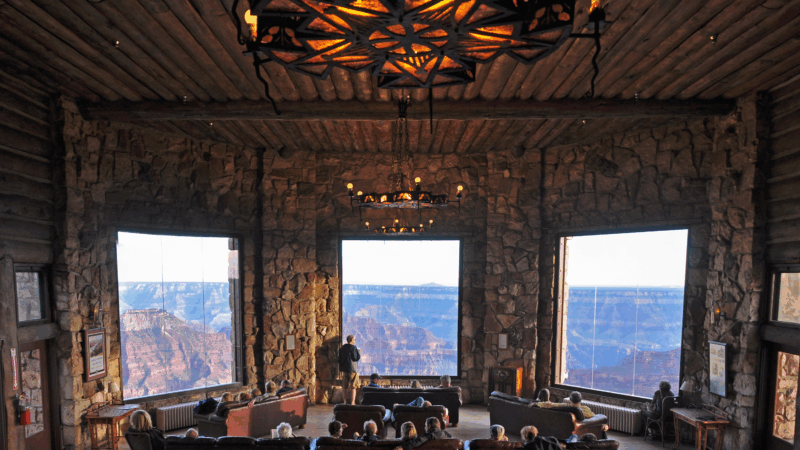
A raging wildfire has destroyed dozens of structures in Grand Canyon National Park, including a beloved historic lodge that was already rebuilt once after burning down nearly a century ago.
For decades, the Grand Canyon Lodge was the only hotel inside the North Rim, a more secluded portion of the park with higher elevation and fewer visitors.
The lodge complex consisted of a main building and 114 standalone cabins perched at some 8,000 feet overlooking the canyon. The lodge was one of the most notable sights that visitors would see when arriving at the end of the North Rim’s main road, welcoming generations of travelers and staffers.
But officials confirmed on Sunday that it was destroyed in the Dragon Bravo Wildfire, one of two wildfires that has been raging at or near the North Rim since early July.
The National Park Service says the “extreme and volatile” blaze grew by 500 acres on Saturday night, destroying an estimated 50 to 80 structures including the lodge, cabins and visitor facilities. No injuries were reported.
“We are grateful that all our employees and guests have been safely evacuated, and we join the National Park Service in mourning the loss of these iconic and beloved structures,” said Aramark, the company that operates the hotel.

Arizona Gov. Katie Hobbs said she was “incredibly saddened” by the destruction of the lodge, and is calling for an investigation into the federal government’s handling of the wildfire, which was started by a lightning strike on July 4.
Park personnel say the North Rim will remain closed for the rest of the 2025 season, which runs through mid-October.
Meanwhile, locals and visitors alike are mourning the loss of the lodge, which was designated a National Historic Landmark and listed on the National Register of Historic Places.
Could it be rebuilt again? Here’s what happened the first time around.
A tale of building and rebuilding

The first Grand Canyon Lodge was built in the late 1920s for the Union Pacific Railroad and its subsidiary, the Utah Parks Company, which invested millions of dollars in creating tourist facilities on the lesser-developed North Rim, according to the Grand Canyon Conservancy.
Architect Gilbert Stanley Underwood envisioned a Spanish-style centerpiece lodge built with native limestone and pine wood to look like it rose out of the canyon’s rocky cliffs. It embraced those views with features such as a glass-enclosed lounge, canyon-facing upper veranda and observation tower. And it was surrounded by rustic cabins, scattered organically throughout the hilly landscape.
The hotel opened to the public in 1928.
“But unfortunately that lodge only existed for four years, because in 1932, one very early morning, a fire broke out in the kitchen and the lodge was all burned down,” says Davy Crockett, vice president of the Grand Canyon Historical Society.
The fire destroyed the lodge and two cabins. No one was hurt, and a group of nearly 100 rangers and volunteer firefighters helped bring the blaze under control, according to local newspaper coverage.
The Utah Parks Company set about rebuilding. But the Great Depression — and a series of other incidents — made progress slow.
Crockett says a temporary lodge that housed construction workers also burned down in September 1936, though the exact cause of that fire is unknown. Then, that winter, a historic snowstorm — and a broken snowplow — left some two dozen workers stranded at the site for two months, an event that made national headlines.
As rescue efforts failed and food supplies dwindled, half of the group roped themselves together and hiked through the snowy canyon to safety. The rest were rescued after an airplane dropped a needed part to a tractor that had stalled on its way to get them.
“A lot of people put their lives in jeopardy to bring that lodge together,” Crockett says. “It was completed in 1937 and opened, and it has been a wonderful place ever since.”
A destination for decades
The lodge that opened in 1937 reused the original stonework but had some key differences from the original: It had steeper roofs to handle heavy snow, used more stone than wood and lacked a second story and observation tower.
Other distinctive features of the main lodge include a dining room with canyon views, saloon, sunroom, auditorium and post office. It contained plenty of valuable artifacts and decor, Crockett says, from historic dinnerware and furniture to a beloved bronze statue called Brighty the Burro.
While some changes have been made over the years, including updated bathrooms and concrete finished terraces, the building has changed very little since 1937, according to a history by Arizona State University. A 1986 nomination form for the National Register of Historic Places called the lodge “the most intact rustic hotel development remaining in the national parks from the era when railroads fostered construction of ‘destination resorts.'”
“The log and stone building materials, the very human scale of the cabins, the topographic scattering of the development, crowned by the main lodge building and its grand vistas, make the Lodge the rustic visitor experience that the Union Pacific Railroad intended it to be,” it reads.
And it wasn’t just the physical property that made the lodge so beloved.
Crockett says the North Rim’s high altitude and dense pine trees make it an ideal escape from the heat in summer. As the North Rim’s only hotel, the lodge has welcomed generations of honeymooners, families and staff members.

The hotel was long staffed by college students who served not just as waiters but entertainers, Crockett says (his aunt was one of them in the 1960s). For decades, workers put on traditions like nightly talent shows and “sing-aways,” in which they would line up outside to serenade departing visitors.
“And so it was just an amazing experience for both the tourists who came there and also for those who worked there,” Crockett says.
A future unknown
The full extent of the damage isn’t yet known as the fire continues.
Park Superintendent Ed Keable said on Sunday that the visitor center, gas station, a wastewater treatment plant, an administrative building and some employee housing were among the dozens of structures lost.
The hotel’s website says it will be in contact with guests who have existing reservations. Crockett worries about lodge employees, who are physically safe but now need to find jobs and housing for the rest of the season.
National parks and their surrounding communities are already feeling the financial and environmental impacts of federal funding and job cuts.
Crockett acknowledges that funding could be an issue, but hopes the lodge will eventually be rebuilt.
“I hope that it will still be an inviting place to go,” he said. “I mean, there certainly are other lots of beautiful places on the North Rim that have views of the canyon, but most of those are still remote on dirt roads — so this is the paved place where people come to view the canyon.”
These major issues have brought together Democrats and Republicans in states
Across the country, Republicans and Democrats have found bipartisan agreement on regulating artificial intelligence and data centers. But it's not just big tech aligning the two parties.
Feds announce $4.1 billion loan for electric power expansion in Alabama
Federal energy officials said the loan will save customers money as the companies undertake a huge expansion driven by demand from computer data centers.

Mortgage rates fall below 6% for the first time in years
The average home loan rate has dropped below 6% for the first time since 2022. Will that help thaw the frozen housing market?

Baby Keem’s boulevard of broken dreams
Ca$ino, the rapper's second album for his cousin Kendrick Lamar's label, is whiplash embodied, a mirror for the extreme highs and lows of his Sin City hometown.

Pentagon shifts toward maintaining ties to Scouting
Months after NPR reported on the Pentagon's efforts to sever ties with Scouting America, efforts to maintain the partnership have new momentum
Why farmers in California are backing a giant solar farm
Many farmers have had to fallow land as a state law comes into effect limiting their access to water. There's now a push to develop some of that land… into solar farms.
