
A Swiss village is buried after a glacier collapses in the Alps
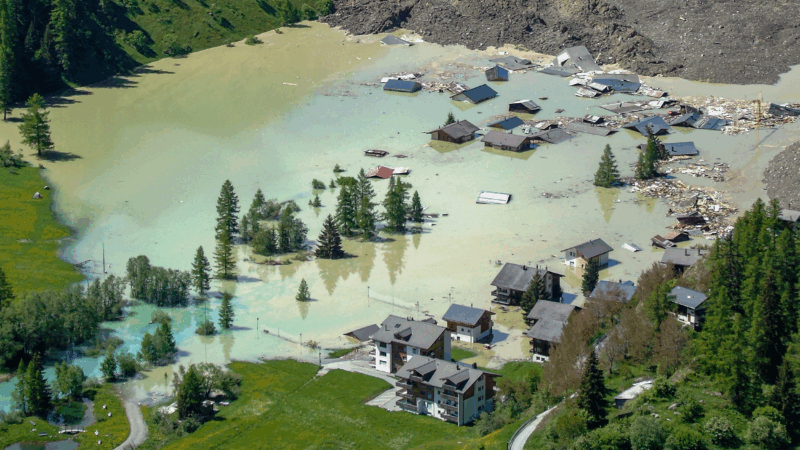
A Swiss Alpine village was largely wiped out on Wednesday after a massive glacier carrying rock and debris detached and roared down the mountainside, destroying everything in its path.
Scientists had predicted a likely disaster and authorities evacuated the entire village of 300 people in the Valais region, south of Switzerland’s capital Bern, on May 19. Sheep and even grazing cows were airlifted by helicopter.
Video footage of the collapsing glacier went viral Wednesday afternoon as the natural disaster unfolded. Afterward, a massive cloud of rock, ice and dirt rose up and enveloped the mountains and valley, reminding some of the cloud of an atomic bomb.
“What happened is the unthinkable, the catastrophic worst-case scenario,” Christophe Lambiel, a specialist in high-mountain geology and glaciers at the University of Lausanne, told RTS Swiss Television.
Lambiel said scientists knew something was coming, thanks to increasingly frequent rockfalls from the mountain face onto the glacier. But he said the glacier’s total collapse was not predicted.
In a press release on Thursday, the Valais local government said the Birch Glacier had collapsed in near-entirety above Blatten village. Ice and rock several dozens of yards thick and about a mile long now lie in the valley. “The damage is considerable,” the press release says.
A local river has been blocked, the press release says, “and a lake is forming. The challenge lies in the behavior of this accumulation of water and the Lonza River, which could cause a torrential lava flow if the river overflows onto the deposit.”
One person, a 64-year-old man, has been reported missing, according to police, and a search has been suspended temporarily due to dangerous conditions.
Lambiel said the Birch Glacier was different from others. “It is the only glacier that has been advancing for the past decade,” he said. “All the others are receding.”
Its advance, he said, was due to the rock face breaking off above it, which dropped boulders on it, adding weight and pressure. Lambiel said the rockfalls were due to climate change.
“The increase in the falling rocks is due to the melting permafrost, which increases instability,” he explained, noting the permafrost has warmed by at least 1 degree Celsius in the past 10 to 15 years.
Some 3 million cubic meters, or nearly 4 million cubic yards, of debris had accumulated on the glacier, France’s Le Monde quoted Raphaël Mayoraz, head of the local government’s Natural Hazards Service, as saying.
“Nature is stronger than human beings and mountain people know this well,” Swiss Environment Minister Albert Rösti told reporters after the disaster. “But what happened today is absolutely extraordinary. It was the worst we could’ve imagined.”
Matthias Bellwald, the mayor of Blatten, offered words of encouragement at the press conference.
“We lost our village but not our lives,” he said. “The village is under the gravel but we’re going to get up. We are going to be in solidarity and rebuild. Everything is possible.”
University students hold new protests in Iran around memorials for those killed
Iran's state news agency said students protested at five universities in the capital, Tehran, and one in the city of Mashhad on Sunday.
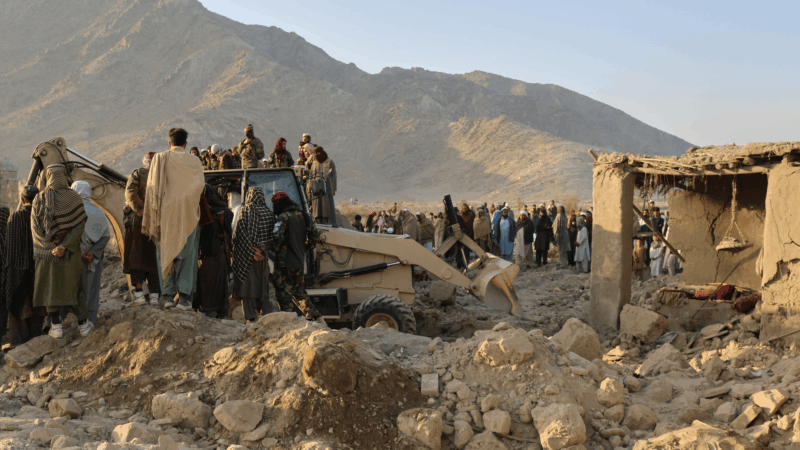
Pakistan claims to have killed at least 70 militants in strikes along Afghan border
Pakistan's military killed at least 70 militants in strikes along the border with Afghanistan early Sunday, the deputy interior minister said.
Team USA faces tough Canadian squad in Olympic gold medal hockey game
In the first Olympics with stars of the NHL competing in over a decade, a talent-packed Team USA faces a tough test against Canada.

PHOTOS: Your car has a lot to say about who you are
Photographer Martin Roemer visited 22 countries — from the U.S. to Senegal to India — to show how our identities are connected to our mode of transportation.

Sunday Puzzle: TransformeR
NPR's Ayesha Rascoe plays the puzzle with listener Joan Suits and Weekend Edition Puzzlemaster Will Shortz.

Looking for life purpose? Start with building social ties
Research shows that having a sense of purpose can lower stress levels and boost our mental health. Finding meaning may not have to be an ambitious project.
