
A haboob covered central Arizona in dust. But what exactly is it?
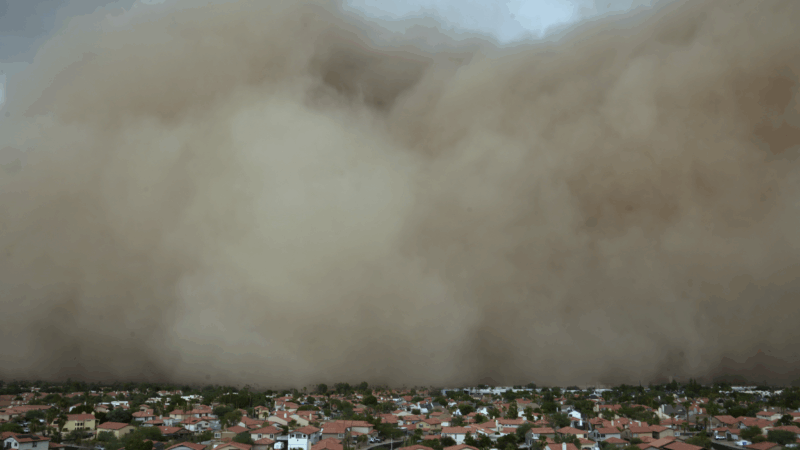
Parts of central Arizona were engulfed by a towering wall of dust on Monday evening — producing dramatic scenes that sent shockwaves far beyond the Grand Canyon state.
“ It was larger and it went through a metropolitan area so it gained a lot of attention,” said Mark O’Malley, a meteorologist with the National Weather Service in Phoenix.
According to O’Malley, the dust storm — known as a haboob — originated in southern Arizona around 3:30 p.m. local time and reached the city of Phoenix about two hours later.
The storm gradually weakened as it moved through north-central Arizona and in total, lasted about an hour, O’Malley added.
The haboob was accompanied by intense thunderstorms. On Monday evening, more than 39,000 households in Arizona were without power and the bulk of outages were in Maricopa County, which includes Phoenix, according to NPR member station KJZZ.
The dust storm also reduced visibility to a quarter-mile across the city. The state’s Department of Transportation urged drivers to stay off the road and flights at the Phoenix Sky Harbor International Airport were temporarily grounded, KJZZ reported.
Although images from the haboob may look apocalyptic, dozens of dust storms occur each year in southwestern U.S., according to the National Oceanic and Atmospheric Administration (NOAA).
Here’s what to know.
How do haboobs form?
These dust storms are the result of powerful winds from a thunderstorm. As the storm cell moves, it forces air down and forward, picking up dust and debris along the way, according to NOAA.
The recent haboob that swept through Phoenix also came after a series of severe thunderstorms in the area.
“ That’s how these outflows form is behind thunderstorms and it pushes across the desert and in this case, picked up a lot of dirt and transported it into the Phoenix metro area,” O’Malley said.
The word “haboob” comes from the Arabic word “haab” meaning “wind” or “blow,’ according to NOAA. Haboobs are common in hot and dry regions like the Sahara desert and the Arabian Peninsula.
How dangerous are haboobs?
Wind speeds reaching 60 miles per hour can cause a wall of dust as high as 10,000 feet, NOAA said. But these storms are typically brief, lasting between 10 to 30 minutes.
Still, dust storms have been the cause of dozens of traffic fatalities in the U.S. over the years. In 2023, researchers from NOAA’s Air Resources Laboratory estimated that between 2007 and 2017, there were at least 232 deaths from dust storm-related traffic events.
“We found that dust events caused life losses comparable to events like hurricanes and wildfires in some years,” Daniel Tong, one of the authors of the research paper, said in 2023. “Greater awareness could reduce crashes and possibly save lives.”

Court records: Chicago immigration raid was about squatters, not Venezuelan gangs
In the documents the Department of Homeland Security said the raid "was based on intelligence that there were illegal aliens unlawfully occupying apartments in the building." There is no mention of criminal gangs or Tren de Aragua.

What does the CIA not want you to know? The quiz has the secret
Plus: ambiguous mascots, rodents with hard-to-spell names, and three boring photos of buildings.

Dog sled, ski ballet and other sports you could once see at the Winter Olympics
For many decades, Olympic Games included "demonstration sports." Some, like curling, became part of the permanent roster. But others, like skijoring, didn't stick around.

Minneapolis now has daily deportation flights. One man has been documenting them
A professional airplane enthusiast has been tracking the federally chartered deportation flights out of the Minneapolis airport as DHS sends immigration detainees to other states and, eventually, other countries.

Ronald Hicks to be installed as 11th archbishop of New York
Ronald Hicks, a former Illinois bishop chosen by Pope Leo XIV to replace the retiring Cardinal Timothy Dolan, is set to be installed as New York's 11th archbishop
Iran and US set for talks in Oman over nuclear program after Tehran shaken by nationwide protests
Iran and the United States could hold negotiations in Oman after a chaotic week that initially saw plans for regional countries to participate in talks held in Turkey
