
A frog, a lobster and a unicorn walked into a No Kings protest
WASHINGTON, D.C. — Even before the No Kings rallies kicked off last weekend, some Republicans cast the protests in a sinister light. House Speaker Mike Johnson called them “Hate America” rallies. Treasury Secretary Scott Bessent warned that they would attract “the most unhinged in the Democratic party.”
Instead, the rallies were most notable for a funhouse Noah’s Ark of frogs, pandas, koalas, woodchucks, sharks and lobsters. Taking a page from the protest playbook in Portland, people showed up in inflatable animal costumes.
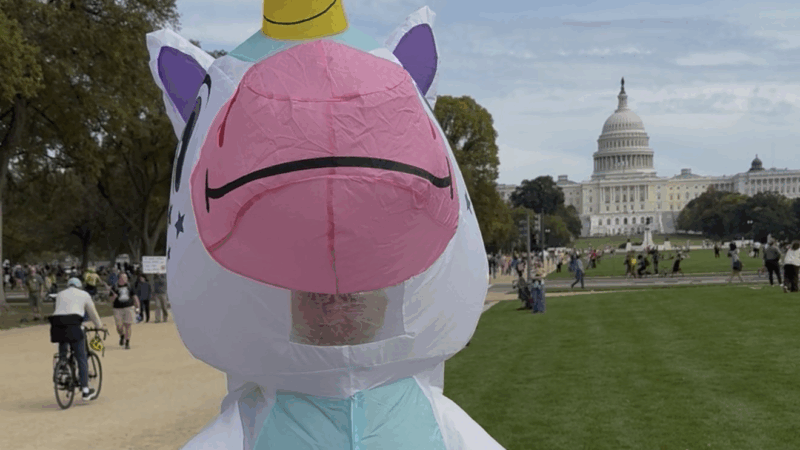
In Washington, a poodle and a chicken danced to drum music with three dinosaurs next to the National Gallery, a short walk from the U.S. Capitol. Scott Rohrbach, a senior optical engineer at NASA, came dressed as a unicorn. It was not his first choice.
“I would have come as a frog, but I couldn’t find a frog,” said Rohrbach, disappointed that all the frog costumes were sold out.
Rohrbach said he came to protest because he fears that under President Trump, future elections may not be fair. He wore the costume to counter the Republican narrative that protesters like him are hate-filled, anti-American radicals.
Inspiration from a frog suit
“One of the things fascists can’t handle is humor,” said Rohrbach, who added that fellow protesters posed with him for selfies and kids gave him high-fives.
President Trump has said repeatedly that he is neither a fascist nor a king and dismissed the rallies.
“I think it’s a joke,” he told reporters. “I looked at the people. They’re not representative of this country.”
The president answered the demonstrations with his own brand of humor, posting an AI-generated video of him wearing a crown while flying a jet and dumping what looked like excrement on protesters.
So what inspired Rohrbach and so many others to dress up like animals and mythical creatures last weekend?
It all started earlier this month in Portland. A man in a frog suit was trying to help a fellow protester at an anti-ICE rally. A law enforcement officer responded by spraying the suit’s air valve with a chemical agent as captured on video.
The image of the officer in a black helmet and shield going after the protester in the frog costume caught the eye of many, including Jordy Lybeck, a political streamer. Lybeck began brainstorming in real time with his viewers.
“How much are those outfits?” Lybeck wondered aloud. “Are you thinking what I’m thinking? What if somebody bought a lot of them and distributed them at the facility?”
That’s exactly what Lybeck and Brooks Brown, who streams about philosophy, did. They raised money online, bought more costumes and drove them to the ICE facility in Portland.

They call it “Operation Inflation.” The goal: Undermine Trump’s argument that he had to deploy troops because Portland was, as he put it, a “war zone.”
Absurdist humor as an effective tactic
“People who were watching at home saw that we were mocking the lies about how Portland is a wasteland of burning nightmares,” Brown told NPR.
He also said the costumes make protesters seem less threatening — it’s hard to see out of or move quickly in an inflatable suit. Brown said he spoke to a police officer on the scene who thought the same.
“He said he knows anyone in these costumes isn’t going to be doing something that they’ve got to run from,” said Brown, “which is fair, because if you haven’t been in one of these costumes, you cannot run in them.”

Kim Lane Scheppele is a Princeton professor who studies democracy and authoritarianism. She says absurdist humor can be an effective tactic against autocrats, which is how she views Trump. Scheppele recalled a case in the Siberian city of Barnaul in 2012.
Critics of Vladimir Putin, who was running for a third term as Russian president, put dozens of children’s toys in the main square. The toys, which included teddy bears and Transformers, held signs criticizing corruption and calling for fair elections.
Toys in Siberia
City officials in Barnaul determined the demonstration was unsanctioned. When demonstrators petitioned to hold a second protest, officials rejected it on the grounds that the toys were “inanimate objects” and not “citizens of Russia,” according to Britain’s Guardian newspaper and the U.S. government’s Radio Free Europe.
Scheppele says stunts like this publicize a political message while laying a trap for officials.
“They do it in such a way that any response from the government makes them look worse,” she told NPR.
Brown, the streamer, says dressing up as animals serves a similar purpose here. He says the funny-looking outfits change the optics of protests so that government force looks more like farce. After all, it’s not easy to portray an inflatable frog — or unicorn — as “the enemy from within.”
Pentagon puts Scouts ‘on notice’ over DEI and girl-centered policies
After threatening to sever ties with the organization formerly known as the Boy Scouts, Defense Secretary Hegseth announced a 6-month reprieve

President Trump bans Anthropic from use in government systems
Trump called the AI lab a "RADICAL LEFT, WOKE COMPANY" in a social media post. The Pentagon also ordered all military contractors to stop doing business with Anthropic.

HUD proposes time limits and work requirements for rental aid
The rule would allow housing agencies and landlords to impose such requirements "to encourage self-sufficiency." Critics say most who can work already do, but their wages are low.
Paramount and Warner Bros’ deal is about merging studios, and a whole lot more
The nearly $111 billion marriage would unite Paramount and Warner film studios, streamers and television properties — including CNN — under the control of the wealthy Ellison family.
A new film follows Paul McCartney’s 2nd act after The Beatles’ breakup
While previous documentaries captured the frenzy of Beatlemania, Man on the Run focuses on McCartney in the years between the band's breakup and John Lennon's death.

An aspiring dancer. A wealthy benefactor. And ‘Dreams’ turned to nightmare
A new psychological drama from Mexican filmmaker Michel Franco centers on the torrid affair between a wealthy San Francisco philanthropist and an undocumented immigrant who aspires to be a dancer.
