
As COVID-19 Spreads, Meals On Wheels Adapts To Serve Seniors
Meals on Wheels delivers food to nearly 3,000 senior citizens in Jefferson County, almost a third of whom are home-bound. Karla Lawrence, who oversees the program, says they rely heavily on volunteers to deliver daily meals, but a lot of them are also elderly and at high risk for COVID-19.
“You know, a lot of our senior volunteers aren’t going to be able to continue volunteering like they do daily,” Lawrence says, “and so we need other individuals to fill those gaps.”
She says recruiting new volunteers is a top priority and many people have already stepped up to help. Lawrence says the program is also working to serve additional senior citizens who are currently on a waiting list. She says the coronavirus could further increase demand, since all senior citizens are encouraged to stay home.
In response, Meals on Wheels announced Friday that it is changing its delivery system. Rather than one hot meal every day, volunteers will now deliver seven meals once a week.
“Because they are so vulnerable and we want to limit our exposure to those seniors,” Lawrence says, “while continuing to provide the meals to them so that they do not go hungry.”
They are also giving seniors a 21-day supply of “shelf stable meals” in case delivery has to stop at any point.
Lawrence says another challenge they face is that many senior centers are closing. Typically, more than half of Meals on Wheels’ recipients pick up their food from these kinds of places. She says they are working to establish replacement pick-up sites, and if needed, they will deliver these meals door to door.
Many nonprofits are feeling similar pressures due to the spread of the coronavirus.
“We’re stressed,” says Drew Langloh, president of United Way of Central Alabama (UWCA). “Our budgets are stressed. Our operating budgets are stressed. And at the same time, we’re being asked to do more, with less.”
At a press conference Friday, Isabel Rubio, director of the Hispanic Interest Coalition of Alabama, said the coronavirus is “hitting the Latino community like a bombshell.”
A representative with the American Red Cross said they face a “severe shortage” of blood donations due to thousands of blood drives cancelled across the country.
In response to the growing need, UWCA announced Friday the creation of a Community Crisis Fund to help people and nonprofits who are struggling financially due to the pandemic.
Officials say any individual looking for help can call 2-1-1 to get connected to area resources.
A new Nepali party, led by an ex-rapper, is set for a landslide win in parliamentary election
A Nepali political party led by an ex-rapper is set for a landslide victory in the country's first parliamentary election since Gen Z protests ousted the old leadership that has ruled the Himalayan nation for decades.

U.S. Judge says Kari Lake broke law in overseeing Voice of America
He declared all of Lake's actions over the past year to be null and void, including the layoffs of more than 1,000 journalists and staffers.

Trump vows to ‘take care of Cuba,’ praises Venezuela cooperation at summit
Trump made the promise in front of an assembled meeting of Latin American leaders.
British Columbia to make daylight saving time permanent
The Canadian province is permanently ending the biannual time shifts for more light at the day's end. But research shows daylight saving increases health risks.

Jan. 6 plaque honoring police officers is now displayed at the Capitol after a 3-year delay
Visitors to the Capitol in Washington now have a visible reminder of the siege there on Jan. 6, 2021, and the officers who fought and were injured that day.
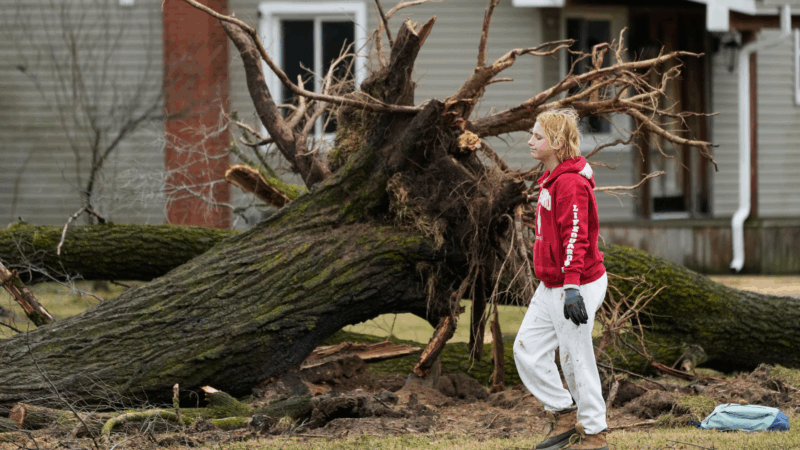
Authorities searching debris after suspected tornadoes kill 6 in Michigan, Oklahoma
A 12-year-old boy is reported to be among the dead following powerful storms that stretched across the middle of the country.
