
Former Jefferson County Commissioner Chris McNair Dies
Former Jefferson County Commissioner Chris McNair died Wednesday at the age of 93. For most of my life, I’ve had a close up view of his triumph and heartbreaks.
He was good friends with my father, and when I graduated from college 1982 Mr. McNair, as I always called him, gave me my first freelance writing assignment. At the time he was publishing Down Home, a lifestyle magazine about blacks in Alabama.
McNair’s own story took many twists and turns. In 1963, his eleven-year-old daughter Denise and three of her friends were killed in the bombing of 16th Street Baptist Church. McNair did not often speak publicly about the tragedy. But in 2003, the 40th anniversary, he and U.S. Sen. Doug Jones, who prosecuted two of the klansmen responsible for the bombing, were interviewed on WBHM.
“I would have been as vocal before had I not seen the possibility of somebody else being convicted,” McNair said. “I didn’t think I needed to be a braggadocious person or a kicking the door down person.”
Three men were eventually convicted in the bombing. Robert Chambliss and Bobby Cherry died in prison. Thomas Blanton is still alive and serving a life sentence.
McNair was from Fordyce, Arkansas. He came to Alabama to attend Tuskegee Institute and decided to stay. At the time of the bombing, he was a door-to-door milkman. He said people often asked why he stayed here.
“My quick answer would be why would I go? If I was going to stay in America, where in America could I go? I couldn’t change the color of my skin. I was going to be black wherever I went,” he said in the 2003 interview.
Eventually, McNair opened a successful photography business and was elected to the state Legislature. In 1986, I covered his election as one of the first blacks on the Jefferson County Commission. By this time, I was a local government reporter at The Birmingham News.
McNair served on the commission for 15 years. In 2006, a jury convicted him of 11 counts of bribery and conspiracy for taking gifts and services from contractors in exchange for work on the county’s $3 billion sewer rehabilitation project. In an interview after the conviction he told me, “There was no corrupt intent. But I realize now how it could be perceived. In my mind, I never thought I did anything wrong.”
Jones hopes his friend’s life won’t be defined by just that one chapter.
“What I hope they will remember him for is not his transgressions. What I hope they will remember Chris for is someone who stayed in Birmingham in spite of an unimaginable loss,” Jones said. “He and Maxine [McNair’s wife] stayed behind to build a better community.”
Sunday, I visited Mr. McNair at his home. We discussed national politics. He talked about his hopes for an America that is not so divided by race. McNair is survived by his wife, Maxine, and daughters Lisa and Kimberly McNair. Funeral arrangements have not been announced.

Trump to raise global tariffs to 15%
President Trump previously said he would implement 10% global tariffs after the U.S. Supreme Court struck down his tariff policies.

Pin trading has taken over the Olympics. Here’s what it’s like in Milan
Pin trading has become a hallmark of the Olympics in recent decades — and not just for athletes. An official trading center in Milan was a hotspot for longtime collectors and curious newcomers alike.
US military airlifts small reactor as Trump pushes to quickly deploy nuclear power
The Pentagon and the Energy Department have airlifted a small nuclear reactor from California to Utah, demonstrating what they say is potential for the U.S. to quickly deploy nuclear power for military and civilian use.

How Nazgul the wolfdog made his run for Winter Olympic glory in Italy
Nazgul isn't talking, but his owners come clean about how he got loose, got famous, and how they feel now
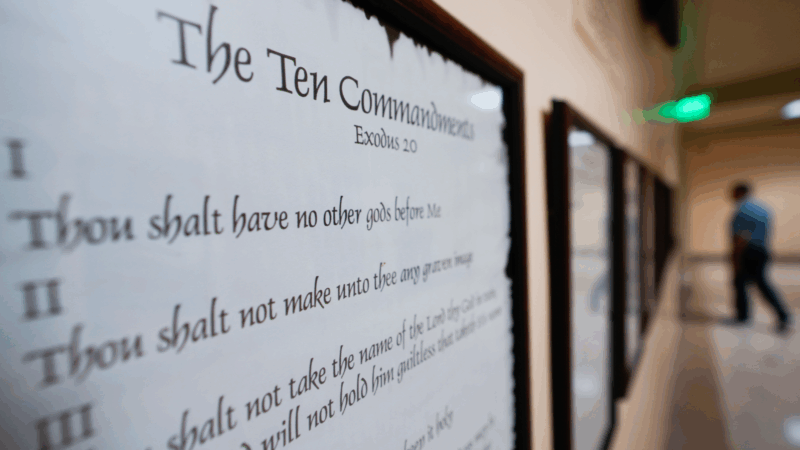
Court clears way for Louisiana law requiring Ten Commandments in classrooms to take effect
The 5th U.S. Circuit Court of Appeals has cleared the way for a Louisiana law requiring displays of the Ten Commandments in public classrooms to take effect.
From cubicles to kitchens: How empty offices are becoming homes
Many U.S. cities have too many office buildings and not enough homes. Developers are now converting some old offices into apartments and condos, but it's going slowly.
