
RushTok backlash: Why sororities aren’t letting prospects post
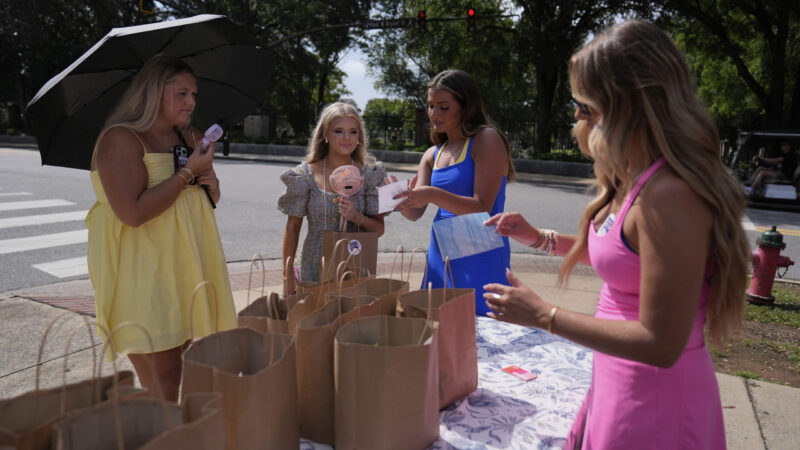
Sorority recruits talk with former sorority members near sorority row at the University of Alabama, Thursday, Aug. 14, 2025, in Tuscaloosa, Ala.
By Safiyah Riddle
TUSCALOOSA, Ala. (AP) — Kylan Darnell became an overnight celebrity in the TikTok niche that documents the glitzy, ritualistic recruitment process for sororities. As a 21-year-old rising senior four years later, she’s taking more of her sorority life offline.
Darnell has until now been the embodiment of RushTok, a week-long marathon that has teens at schools around the country meticulously documenting their efforts to land a cherished spot in a sorority during the colorful, girly and enigmatic recruitment process known as rush week.
Reactions to the content that once catapulted her to fame — depicting her life as a Zeta Tau Alpha member at the University of Alabama — had become so negative that it was affecting her mental health, she said.
“This year it was just like a whole different level of hate,” Darnell said.
Citing a need to protect prospects from harassment, many sororities have made similar moves, issuing a de facto ban against talking to the press or posting on social media during rush week at Alabama, where almost 13,000 students participate in the nation’s largest on-campus Greek life.
A centuries-old tradition
Across the country, rush is typically a 10-day event where “prospective new members” try out sororities through rounds of activities prescribing a strict slate of outfits and etiquette. In the lead-up, girls often submit “social resumes” and letters of recommendation from sorority alums.
Participation often requires an eye-opening price tag.
After spending sometimes tens of thousands of dollars on outfits, makeup and plane tickets, each of this week’s 2,600 recruits paid $550 to participate. It’s non-refundable if they don’t get picked. If accepted, they’ll pay an average $8,400 a semester to live in the sorority house, or $4,100 if they live elsewhere, according to the Alabama Panhellenic Association.
The pressure can be so intense that an industry of consultants now helps girls navigate the often mysterious criteria for landing a desired sorority. Some charge up to $10,000 for months of services that can begin in high school.
Throughout rush, many events are invite-only. At any point, girls can get a dreaded call informing them they’ve been dropped — that a sorority is no longer interested in letting them join. Matches are finally made on bid day as prospects rank top choices and sororities make offers.
Morgan Cadenhead, now 20, gained such an audience on RushTok despite being dropped that she covered most of her tuition with income from social media. Then came the social cost as she was slammed online for criticizing Greek life. Now the marketing major — featured on Lifetime’s “Sorority Mom’s Guide to Rush!” — said she’s looking for offline work.
A zealous TikTok following
A fixation with rush was renewed when sororities resumed in-person recruiting after the pandemic.
Social media became flooded with “outfit of the day” and “get ready with me” videos showing sorority members and recruits in well-lit rooms, sometimes flaunting exorbitantly priced designer wear or pieces purchased on Amazon, always precisely curated.
Alabama’s Greek life got attention before, when its traditionally white sororities racially integrated, accepting their first Black members in 2013. Targeted by protests following allegations of racial discrimination, the university agreed with the Justice Department in 2016 to encourage diversity. Today, Black students outside of traditionally Black sororities and fraternities represent 2% of the total Greek membership, the university website says.
Meanwhile, online attention to rush has led to books, a polarizing documentary and the reality television series, widening the appeal of sororities in the South in particular, according to Lorie Stefaneli, a New York City-based consultant who flies to Tuscaloosa each year for rush.
Stefaneli coaches girls from around the country, and about a third of her clients enroll at Alabama. She says many are drawn by the vibrant depictions of sisterhood, showing female friendships that can ensure girls feel seen and supported.
“That’s the reason why a lot of them want to go to Alabama, is because they see it on TikTok,” Stefaneli said.
Recruits told to stop posting — or else
If they gain enough followers to become social influencers, RushTok participants can earn ad revenue and brand deals. Darnell’s posts brought her financial independence, more than covering the $58,000 it costs her annually to attend Alabama from out-of-state.
Rush can be fun and help girls build confidence, but it’s also an “emotional rollercoaster,” especially for girls who feel they need to reveal themselves to a massive audience, Stefaneli said. She answers phone calls at all hours of the night during rush week.
“I’m literally a therapist, I’m talking these girls down from a ledge,” she said.
Numerous incoming freshmen told The Associated Press this week that they were expressly prohibited from speaking with the media or even posting about rush at Alabama. Darnell said the most selective “Old Row” houses will automatically drop prospects who do.
“Now a lot of girls just come to the university to be influencers,” she said. “It kind of gets in the way of sisterhood.”
Some incoming freshmen — including Darnell’s 19-year-old sister Izzy, with a vast social media following of her own — have chosen to post anyway, satisfying a demand that can reach millions of views within days.
Izzy Darnell — who wouldn’t share her choices for sorority ahead of Saturday’s bid day — said her older sister’s acumen has equipped her to navigate criticism and potentially predatory business deals. But she worries about how other girls might handle the fame and money.
“I just fear what some girls will do because they think they have to,” Izzy Darnell said.
Top Arizona lawmaker says he’s complied with a subpoena for 2020 election records
Arizona's state Senate president says he has complied with a subpoena he received last week seeking records from a flawed, Republican-led review of the 2020 election in Maricopa County.

Colors fly as Hoover celebrates Holi
Colored powder filled the air at Veterans Park in Hoover on Saturday. Crowds gathered to celebrate Holi, the Hindu festival of Spring, usually identified by the throwing of colors.
Americana’s newcomer Jobi Riccio faces the pressure on her new record
The country and bluegrass songwriter talks about her sophomore album, Face the Feeling, out May 15.

What to know about Mojtaba Khamenei, Iran’s new supreme leader
The second son of the late supreme leader keeps a low profile. But he's long been viewed as wielding his power behind the scenes, from crushing dissent to influencing presidential elections.
Anthropic sues the Trump administration over ‘supply chain risk’ label
The Pentagon told suppliers they can't use Anthropic's artificial intelligence tools after the company said it would not let its tech be used for autonomous weapons and mass domestic surveillance.
This historian dug up the hidden history of ‘amateur’ blackface in America
In her new book, Darkology, historian Rhae Lynn Barnes writes about how blackface and minstrel shows became one of the most popular forms of entertainment in 19th- and 20th-century America.
